Math problem-solving skills Addition & Subtraction Worksheets for Ages 8-9
4 filtered results
-
From - To
Enhance your child's math skills with our specially designed addition and subtraction worksheets for ages 8-9. Our collection focuses on solving word problems, allowing young learners to develop critical thinking and practical math application. Perfect for third graders, these worksheets provide a solid foundation in essential arithmetic while challenging students with engaging, real-world scenarios. Each worksheet encourages your child to think critically and boosts their confidence in math. Ideal for classroom and home practice, our printable resources make learning both fun and effective. Visit today to help your child master problem-solving skills in addition and subtraction!
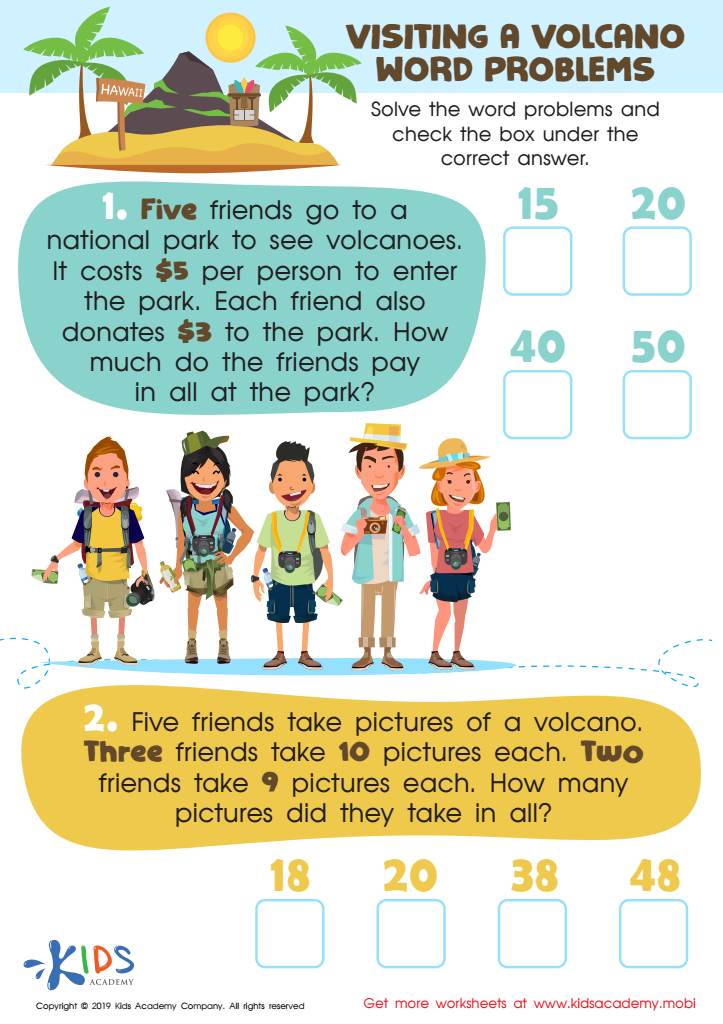
Visiting a Volcano Word Problems Worksheet
 Assign to My Students








At ages 8-9, children are in a crucial stage of cognitive and academic development, where mastering addition and subtraction is foundational. These skills are more than just arithmetic; they are essential building blocks for future mathematical concepts and everyday life applications. When children grasp addition and subtraction, they gain confidence and enthusiasm for learning more complex subjects like multiplication, division, and eventually, algebra.
For parents and teachers, fostering strong problem-solving skills in these areas offers multiple benefits. It enhances critical thinking, as children learn to approach problems systematically, identify patterns, and develop logical reasoning. These skills are transferable and help improve performance in other subjects, such as science and technology. Moreover, proficiency in math problem-solving nurtures perseverance and resilience, as students learn to tackle challenges and find solutions.
In today's world, where STEM (Science, Technology, Engineering, and Math) fields are increasingly important, early math competency opens doors to future academic and career opportunities. Furthermore, addition and subtraction are essential for daily activities, such as budgeting, cooking, and shopping. By prioritizing these fundamental skills, parents and teachers are empowering children with the tools they need to succeed both in and out of the classroom, fostering a lifelong appreciation and curiosity for learning.








