
Understanding seasons Addition & Subtraction Worksheets for Ages 8-9
4 filtered results
Difficulty Level
Grade
Age
-
From - To
Subject
Activity
Standards
Discover our engaging "Understanding Seasons Addition & Subtraction Worksheets" tailored for children aged 8-9. These worksheets combine math skills with seasonal themes, helping young learners grasp essential addition and subtraction concepts while exploring the beauty of nature throughout the year. Each activity encourages students to solve problems related to seasonal events and weather patterns, making math both fun and relevant. Designed to enhance comprehension, these worksheets support curriculum standards and foster a love for learning. Perfect for classrooms or at-home practice, our resources make it easy to integrate math with an understanding of the changing seasons. Download now and watch your child's math skills flourish!
Favorites
With answer key
Interactive
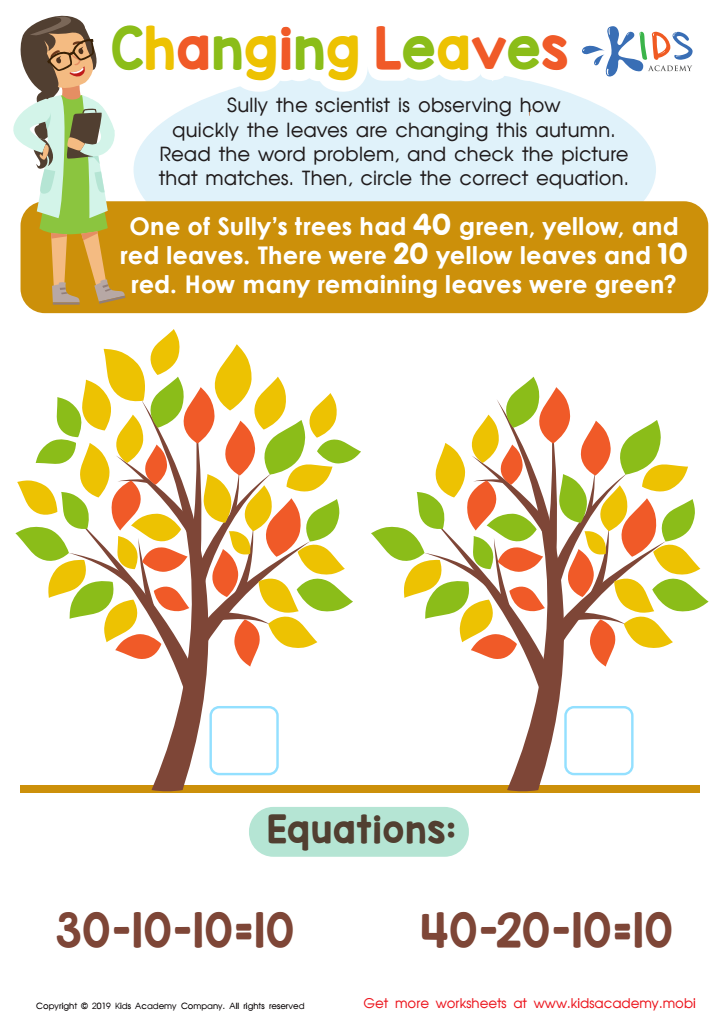
Changing Leaves Worksheet
Fall is the perfect time for kids to help Sully the scientist observe the changing leaves! Download the free worksheet with a subtraction word problem and bolded info to find the matching equation and picture. It's a fun way for your tots to learn while they admire the reddening, yellowing, and orange leaves.
 Assign to My Students
Changing Leaves Worksheet
Worksheet
Join Kids Academy for Free
Who is primarily going to use this learning content?








Understanding seasons and concepts of addition and subtraction is vital for children aged 8 to 9. This age marks a crucial period in a child's cognitive development, where they are not only enhancing their mathematical skills but also making connections between the world around them.
Seasons provide a rich context for teaching math. As children relate numbers to their environment, they grasp real-world applications of addition and subtraction, such as calculating the temperature changes throughout the seasons or counting the days until summer vacation. This contextual learning fosters engagement and enhances retention.
Additionally, mastering addition and subtraction during this developmental stage builds a strong mathematical foundation. These skills are critical for solving more complex problems in the future. Educators and parents should prioritize developing fluency in these operations to ensure that children can confidently tackle advanced mathematics as they progress.
Lastly, by integrating the concept of seasons, parents and teachers can stimulate discussions about nature and changes in the environment. This interdisciplinary approach not only nurtures a child's mathematical understanding but also nurtures curiosity about the world, promoting a well-rounded education. Fostering these connections highlights the importance of math in everyday life, encouraging lifelong learning and exploration.








