Understanding number sequence Addition Worksheets for Ages 8-9
3 filtered results
-
From - To
Enhance your child's math skills with our "Understanding Number Sequence Addition Worksheets" designed specifically for ages 8-9. These engaging worksheets help young learners master number sequences and improve their addition skills through fun and interactive exercises. Students will explore patterns and relationships between numbers, reinforcing their comprehension of mathematical concepts while developing problem-solving abilities. Each worksheet features a variety of challenges that cater to different learning styles, ensuring that your child stays engaged and motivated. Foster a strong foundation in mathematics with these valuable resources, perfect for classroom or home use to boost confidence and proficiency in addition.
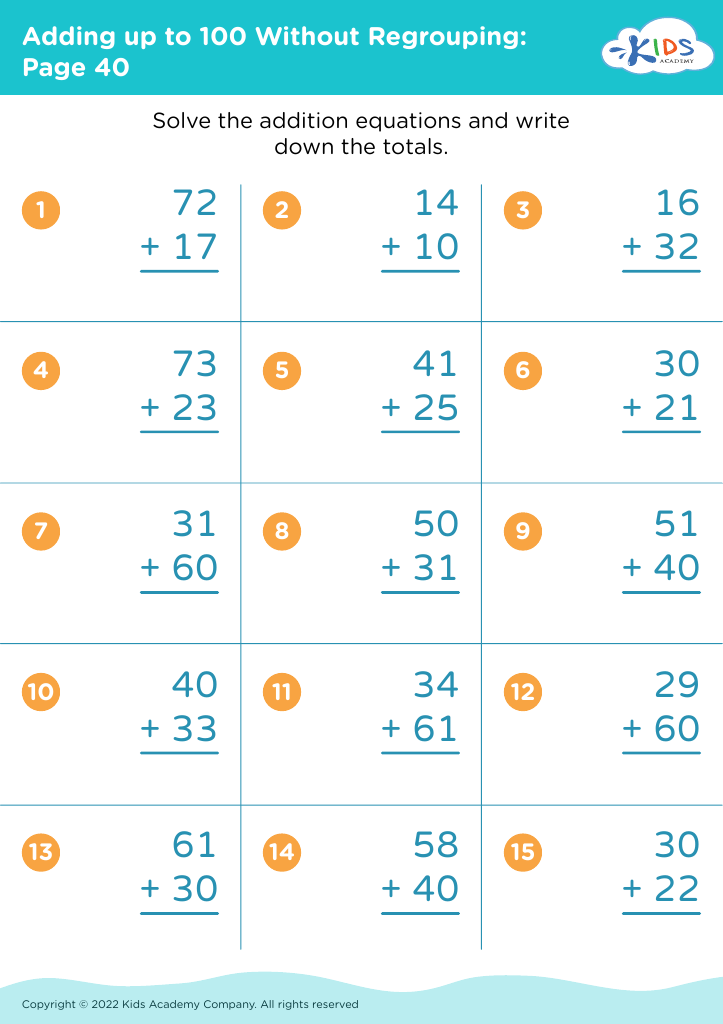
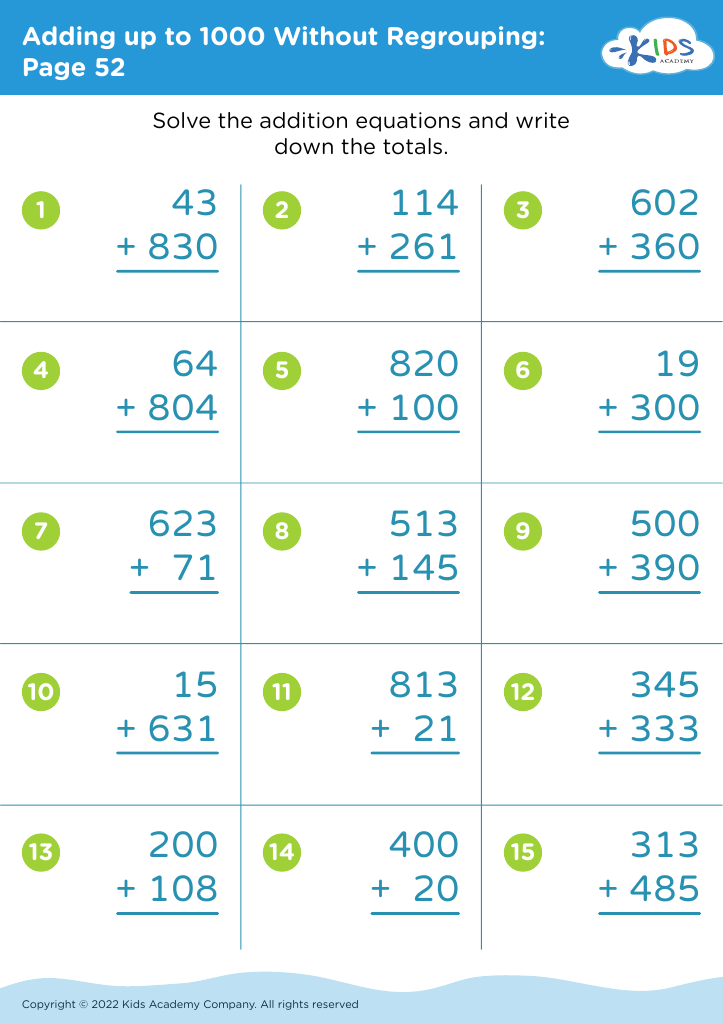
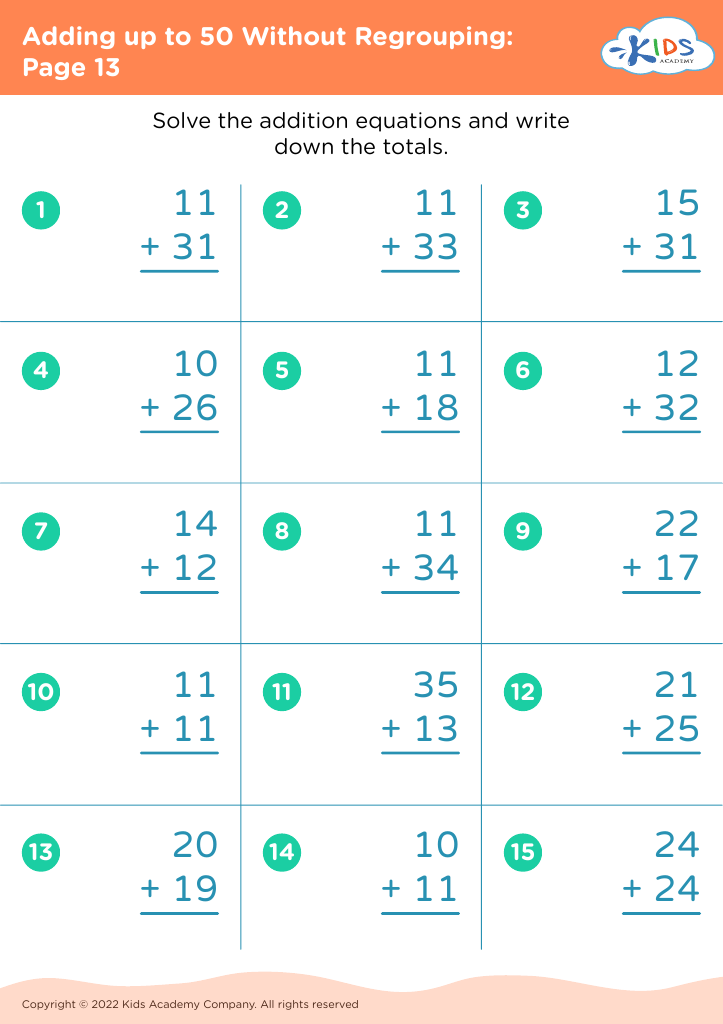








Understanding number sequences and addition for children aged 8-9 is crucial for several reasons. At this age, students are transitioning from basic arithmetic to more complex mathematical concepts. Analyzing number sequences helps develop their ability to recognize patterns, which is foundational for higher-level math skills, including algebra.
Number sequences serve as the building blocks for many mathematical concepts, including operations like addition. When children can write and understand sequences, they not only grasp how numbers relate but also learn to add efficiently and accurately. This skill fosters problem-solving abilities and promotes critical thinking.
Moreover, mastering sequences encourages mental math, enabling children to compute sums in their heads. This can enhance their confidence and allow them to tackle larger, more complex problems with ease. Moreover, understanding number sequences enhances students' ability to work with multiplication and division, as these concepts are interconnected.
By concentrating on number sequences and addition, parents and teachers lay a strong mathematical foundation that will support students throughout their academic journey. Such foundational skills also contribute to a child's overall competence and confidence in mathematics, ultimately impacting future educational opportunities and success. It’s substantiated that early intervention and support in these areas have long-term benefits.








