
Visual perception Addition Worksheets for Ages 8-9
4 filtered results
Difficulty Level
Grade
Age
-
From - To
Subject
Activity
Standards
Boost your child's math skills and visual perception with our engaging Addition Worksheets designed for ages 8-9. These worksheets combine fun and learning by challenging kids to solve addition problems while enhancing their ability to visually process information. Each worksheet features vibrant images and puzzles that require careful observation and calculation, fostering critical thinking and attention to detail. Ideal for home and classroom use, our worksheets make math practice exciting and effective. Help your child develop essential math skills and visual acuity with our expertly crafted addition exercises. Download today and watch your young learner thrive!
Favorites
With answer key
Interactive
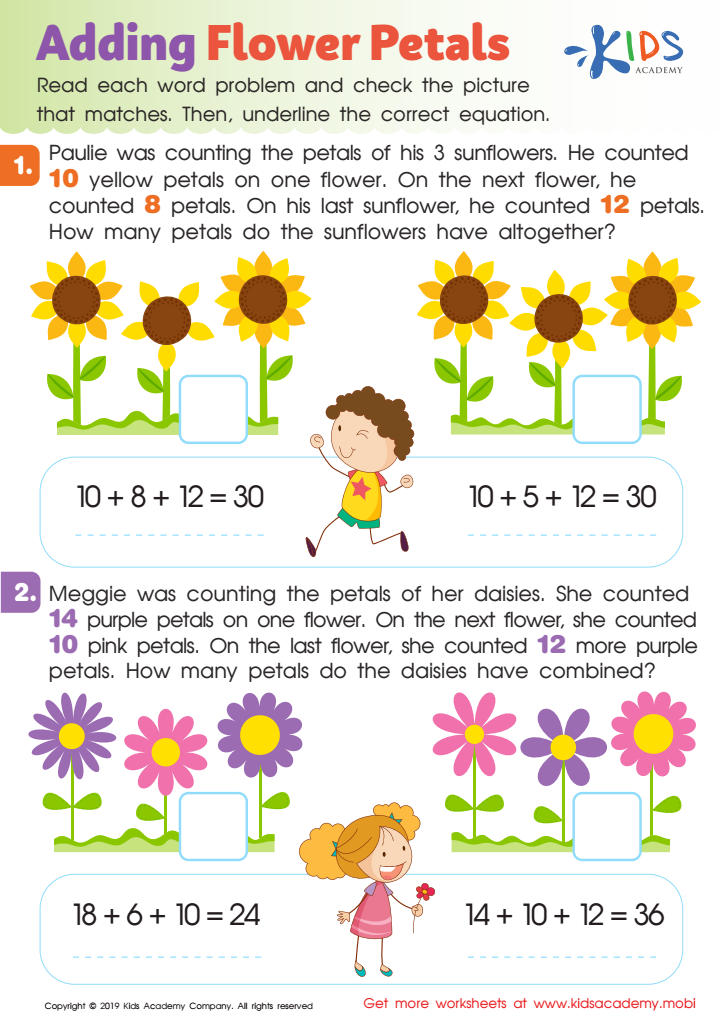
Adding Flower Petals Worksheet
This free worksheet helps little mathematicians learn to understand word problems. They'll read each one and match it to the corresponding picture. Important info is highlighted, teaching kids to look for key info when solving problems. Then they'll underline the correct number equation that matches the picture. A great way to practice problem-solving skills!
 Assign to My Students
Adding Flower Petals Worksheet
Worksheet
Join Kids Academy for Free
Who is primarily going to use this learning content?








Visual perception plays a crucial role in a child's overall development, particularly in academic and everyday activities. For children aged 8-9, focusing on enhancing visual perception skills—such as the ability to distinguish differences in shapes, sizes, and spatial relationships—is critical. This age is an essential growth period for numerous cognitive skills.
Firstly, strong visual perception skills significantly influence reading abilities. Children use these skills to recognize letters, words, and their configurations on a page. Comprehending visual layouts helps them navigate text effectively, boosting reading fluency and comprehension.
Secondly, these skills are vital in mathematics. Visual perception aids in understanding geometry, interpreting graphs, and solving word problems by improving spatial awareness. For example, recognizing patterns and symmetry supports grasping arithmetic concepts like addition and subtraction.
Moreover, good visual perceptual abilities assist with fine motor skills, hand-eye coordination, and tasks like writing or playing sports. These are important not just for academic success but also for overall confidence and social interaction.
Thus, educators and parents should prioritize activities that promote visual perception development, such as puzzles, drawing, and interactive games. Doing so will lay a foundation for better academic performance and a more profound understanding of the world, setting the stage for ongoing learning and achievement.








