
Understanding base ten Math Worksheets for Ages 8-9
3 filtered results
Difficulty Level
Grade
Age
-
From - To
Subject
Activity
Standards
Discover engaging base ten math worksheets designed specifically for children ages 8-9! Our resources help young learners grasp the essential concepts of place value and number representation with ease. These worksheets encourage hands-on practice, utilizing visual aids to reinforce the understanding of tens and units. Ideal for enhancing math comprehension, they cater to various learning styles, featuring interactive activities and exercises that promote critical thinking. Perfect for classroom use or homeschooling, these worksheets lay a strong foundation in mathematics. Start fostering your child's confidence and competency in base ten with our thoughtfully crafted printable materials! Explore the potential of mastering math skills today!
Favorites
With answer key
Interactive
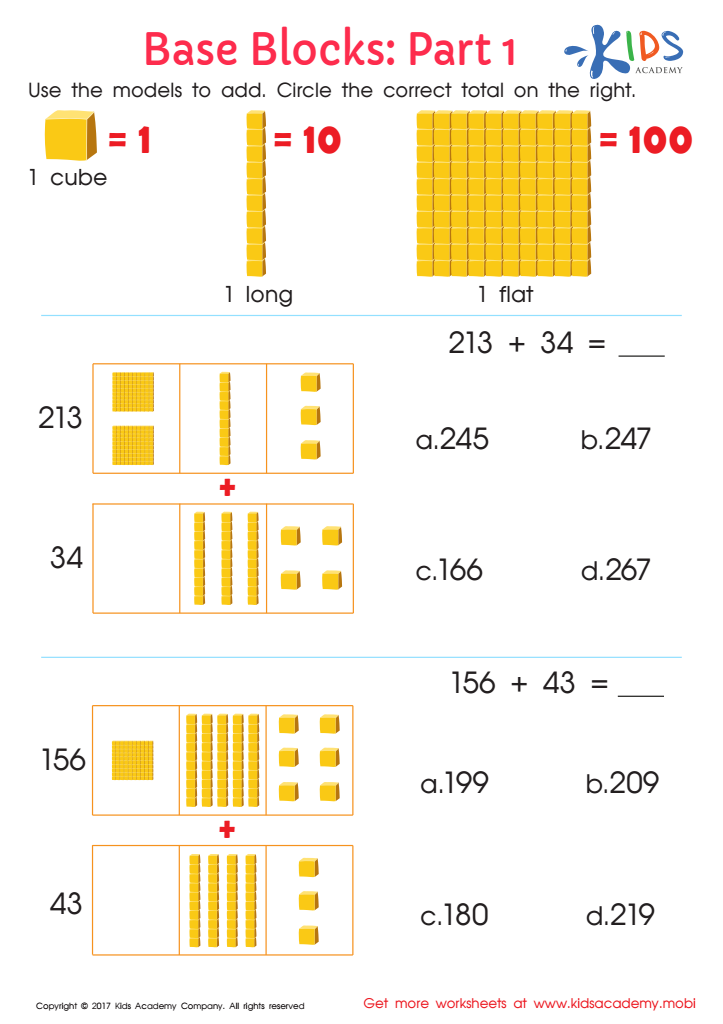
Base Ten Blocks Worksheet: Part 1
They promote numeracy and are a great substitute when kids don't have access to physical blocks.
 Assign to My Students
Base Ten Blocks Worksheet: Part 1
Worksheet
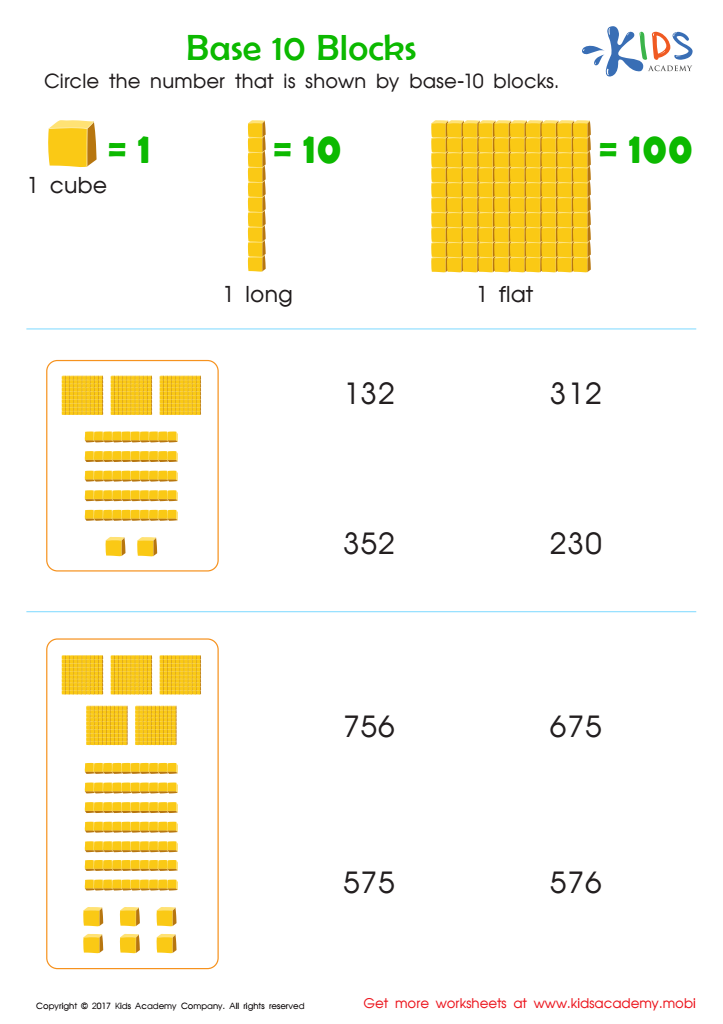
Base Ten Blocks Worksheet
When school ends, your child can still practice place value at home with this base ten blocks worksheet. They'll count and circle the right number, gaining mastery of the concept. It's a fun, easy way to hone their skills!
Base Ten Blocks Worksheet
Worksheet
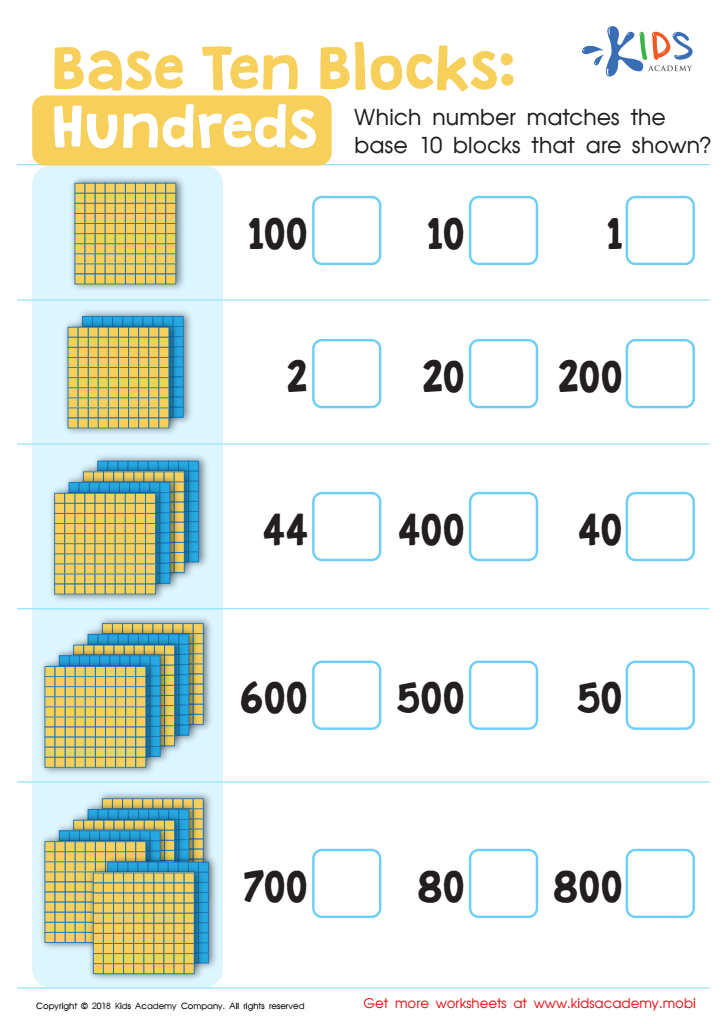
Base Ten Blocks: Hundreds Worksheet
Help your child overcome their dislike of math by guiding them with this base ten blocks worksheet. Count the blocks and answer the questions together. Ask them which number matches the base ten blocks shown. This will help them solve math problems more easily.
Base Ten Blocks: Hundreds Worksheet
Worksheet
Join Kids Academy for Free
Who is primarily going to use this learning content?








Understanding base ten math is crucial for children aged 8-9 as it serves as the foundation for their mathematical abilities and problem-solving skills. At this age, children are transitioning from basic arithmetic to more complex concepts, making a solid grasp of base ten essential. Base ten is the numbering system we use every day, relying on groups of ten to represent values. Mastery in this area enables students to comprehend place value, which is vital for addition, subtraction, multiplication, and division.
Parents and teachers should care because a strong understanding of base ten helps children develop critical thinking skills and an intuitive grasp of larger numbers. It aids in selecting appropriate strategies for computational tasks and enhances their confidence in tackling mathematical challenges. Moreover, a depth of understanding in base ten can facilitate connections to more advanced mathematical concepts encountered in later grades, such as decimals and percentages.
In essence, investing time in base ten understanding not only equips children with immediate skills for their schoolwork but also lays the groundwork for future success in mathematics, shaping their overall cognitive development and fostering a lifelong appreciation for the subject.








