Understanding symmetry Math Worksheets for Ages 8-9 - Page 2
27 filtered results
-
From - To
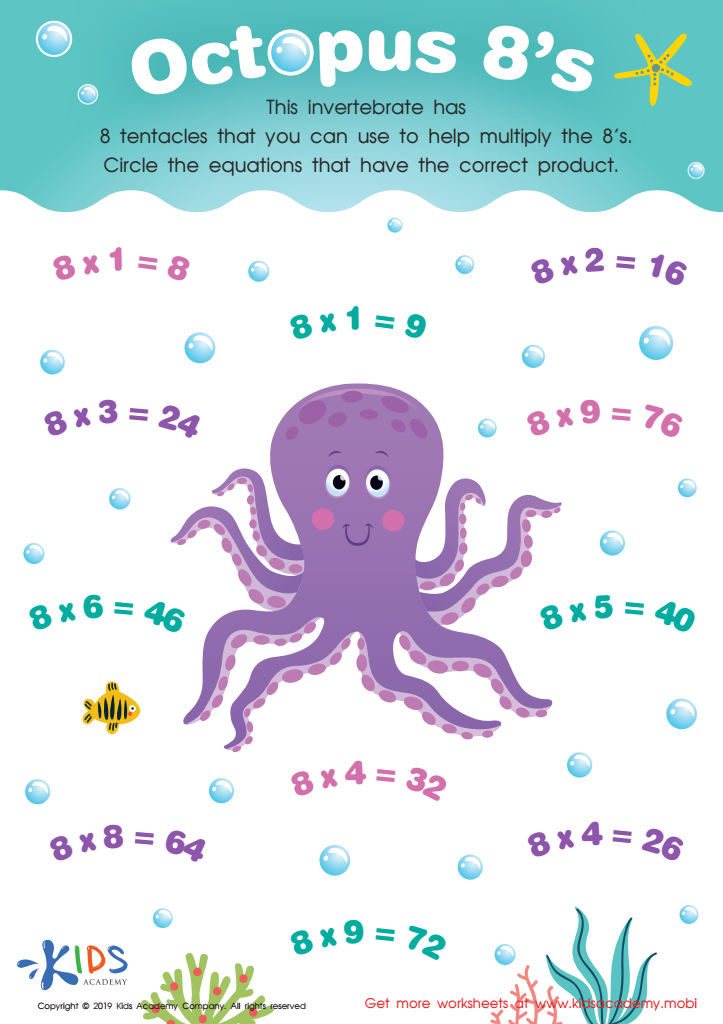
Octopus 8’s Worksheet
 Assign to My Students








Understanding symmetry is essential for children aged 8-9, as it forms a foundational concept in mathematics and fosters critical thinking skills. At this age, children are naturally curious and eager to explore patterns, shapes, and relationships in their environment. Teaching symmetry enhances their spatial awareness and cognitive development, helping them to recognize and describe various forms in geometry.
Moreover, symmetry extends beyond mathematics into art, nature, and everyday life—creating connections that make learning more engaging. For instance, exploring the symmetry in a butterfly's wings can ignite a child's interest in science and nature, integrating cross-disciplinary knowledge.
Additionally, mastering symmetry promotes problem-solving skills. When children learn to identify lines of symmetry and symmetrical properties, they develop their ability to analyze situations and visualize solutions—skills that are vital in their overall academic journey and future!
Ultimately, parents and teachers should prioritize understanding symmetry because it nurtures creativity, encourages perseverance in problem-solving, and fosters a love for learning. By integrating symmetry into their teaching, caregivers can create enriching experiences that make math enjoyable and relevant, instilling essential skills that children will carry throughout their lives.








