
Understanding time Math Worksheets for Ages 8-9
7 filtered results
Difficulty Level
Grade
Age
-
From - To
Subject
Activity
Standards
Explore our comprehensive "Understanding Time Math Worksheets for Ages 8-9," designed to enhance children's time-keeping skills in a fun and engaging way. These age-appropriate worksheets focus on essential concepts, including reading clocks, recognizing time intervals, and solving real-life time-related problems. With colorful illustrations and interactive exercises, children will enjoy mastering half-hours, quarter-hours, and more. Our worksheets are perfect for reinforcing classroom learning or supplementing home study. Help your child gain confidence in their math abilities while developing a crucial life skill. Dive into our collection and watch your child excel in understanding time confidently!
Favorites
With answer key
Interactive
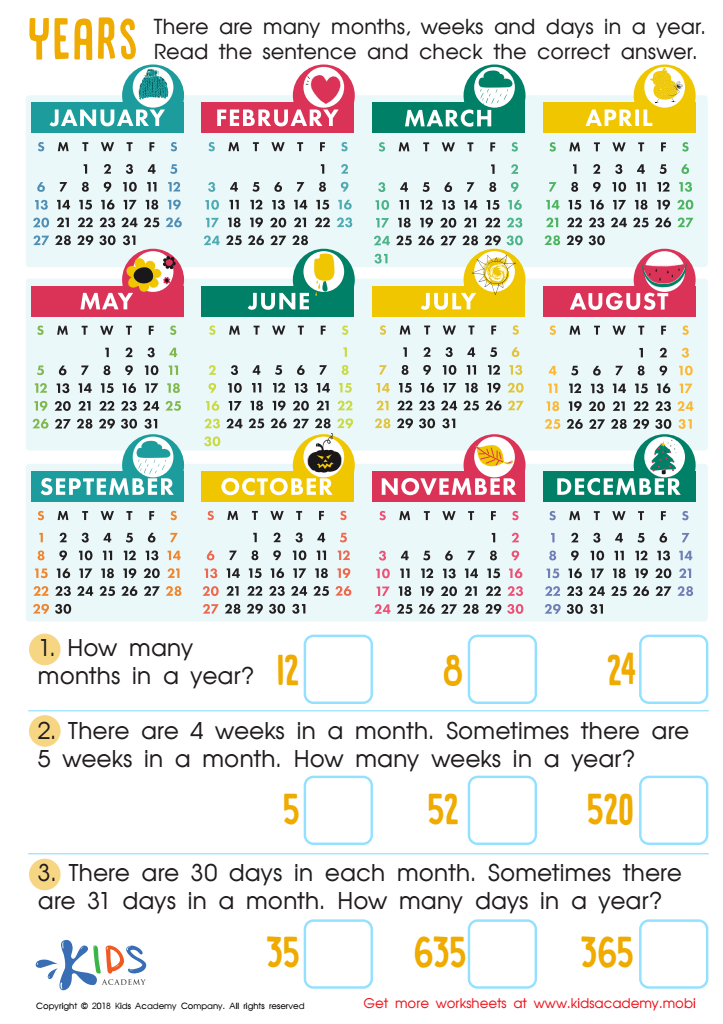
Years Worksheet
This worksheet is a great way to test your children's knowledge of the calendar. Ask them if they can name the days of the week and months in a year. Read and discuss the questions with them and help them find the right answers. Encourage them to check their answers.
 Assign to My Students
Years Worksheet
Worksheet
Join Kids Academy for Free
Who is primarily going to use this learning content?






.jpg)

Understanding time math is crucial for children aged 8-9 as it lays the foundation for essential life skills and enhances overall mathematical proficiency. At this developmental stage, students begin to grasp more complex concepts, including measurement and the relationship between different units of time (seconds, minutes, hours).
Mastering time math helps children manage their schedules, making them more independent and responsible. For instance, they learn how to read clocks, interpret timetables, and calculate durations, which are skills they will use throughout their lives, from time management at school to planning their daily activities.
Moreover, time math integrates other math concepts, such as addition and subtraction, which encourages students to practice problem-solving in diverse contexts. It fosters critical thinking as they learn to analyze and interpret information.
Involving parents and teachers in this process ensures that children receive consistent support, reinforcing their understanding both at home and in school settings. Highlighting the importance of time math fosters a sense of curiosity and appreciation for mathematical concepts, enhancing their overall academic confidence and success. Ultimately, comprehension of time nurtures essential life skills that students will rely on well into adulthood.








