Visual fraction representation Math Worksheets for Ages 8-9
3 filtered results
-
From - To
Enhance your child's understanding of fractions with our engaging Visual Fraction Representation Math Worksheets, designed specifically for ages 8-9. These worksheets transform abstract mathematical concepts into interactive visual experiences, helping young learners grasp fractional relationships through visually appealing illustrations and real-world examples. From pie charts to number lines, our resources cater to various learning styles, promoting confidence in math. Each worksheet includes clear instructions and progressively challenging problems to ensure students master visual fraction concepts effectively. Perfect for classroom or at-home learning, these worksheets are a valuable tool to support your child's mathematical journey and foster a strong foundation in fractions.
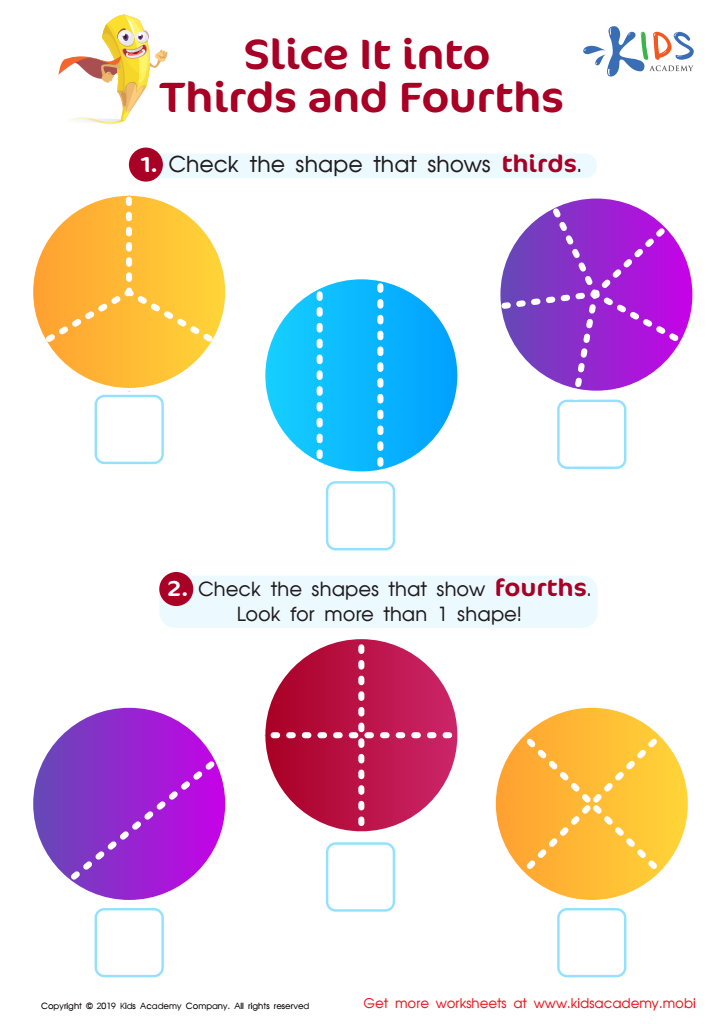
Slice in Thirds Fourths Worksheet
 Assign to My Students
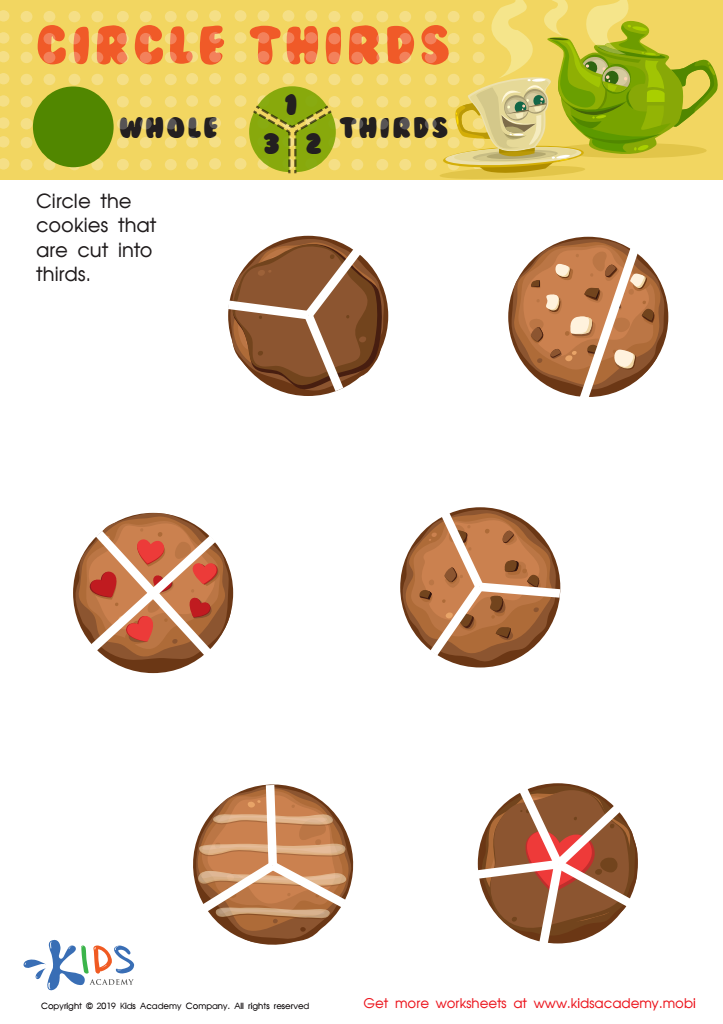
Circle Thirds Worksheet








Parents and teachers should prioritize visual fraction representation for children aged 8-9 because it serves as a critical foundational skill in mathematical understanding. Visual aids, such as pie charts, number lines, and area models, enable young learners to grasp abstract concepts more concretely. At this educational stage, children are moving from concrete operational thought to more abstract reasoning, and visual representations help bridge that gap.
Understanding fractions through visual means allows students to perceive the relationships and equivalencies among different fractions, fostering number sense and promoting problem-solving skills. When children can visualize fractions, they are better equipped to add, subtract, and compare them, which forms the basis for more complex mathematical concepts in later grades.
Additionally, engaging with visual fraction representations can enhance student interest and motivation in math. The use of colorful and interactive tools helps make learning enjoyable. It encourages critical thinking and provides opportunities for collaboration among peers. By emphasizing visual representation in teaching and at home, parents and educators can create a supportive environment that nurtures a positive attitude towards math, ultimately equipping children with essential skills needed for their academic careers. This focus on visuals will lead to greater confidence and success in their ongoing mathematical journeys.








