Basic Math Skills Building Vocabulary Worksheets for Ages 8-9
4 filtered results
-
From - To
Unlock your child's mathematical potential with our "Basic Math Skills Building Vocabulary Worksheets" for ages 8-9. Designed to bridge the gap between reading and math, these worksheets introduce essential math vocabulary through engaging exercises. From addition and subtraction to shapes and measurements, each worksheet is crafted to enhance vocabulary that is crucial for understanding math concepts. By integrating reading and math skills, children will build a stronger foundation for future learning. Our meticulously curated worksheets offer fun and interactive ways to practice, ensuring that your child finds joy in learning while boosting their math confidence. Visit Kids Academy for enriching educational resources!
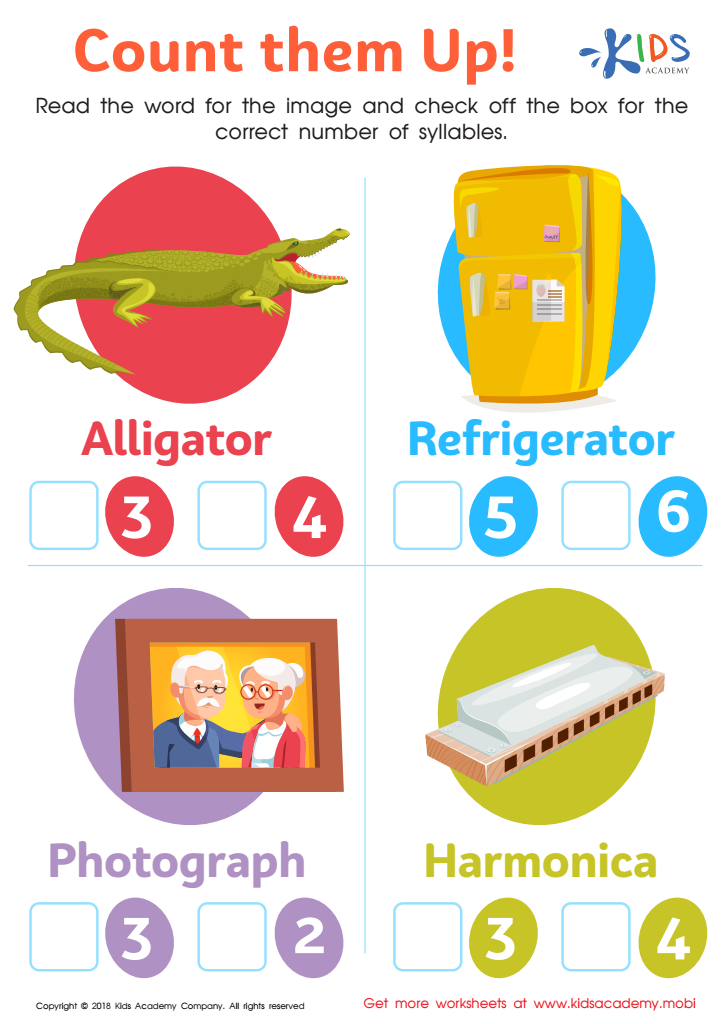
Count Them Up Worksheet
 Assign to My Students



















Parents and teachers should prioritize building basic math skills and vocabulary for children aged 8-9 because this foundational knowledge is crucial for future academic success and everyday problem-solving. Nearly all subjects and a variety of daily tasks involve some form of math, whether it's calculating expenses, measuring ingredients in a recipe, or understanding time. Introducing mathematical concepts and terminology at a young age sets children up for confidence and competence in higher-level math.
Having a robust math vocabulary allows children to better understand instructions, articulate their thought processes, and engage more effectively in classroom discussions. When they understand terms like "addition," "subtraction," "multiplication," and "division," they can more easily grasp new concepts and perform operations without hesitation. This not only enhances their comprehension but also their ability to apply what they've learned in practical scenarios.
Moreover, strengthening these skills contributes positively to cognitive development, strategic thinking, and logical problem-solving abilities. Math forms the basis of STEM (Science, Technology, Engineering, and Mathematics) careers, which are in high demand. Encouraging children to engage with math at a young age equips them with critical thinking tools that will serve them throughout their education and into their professional lives.
Ultimately, investing in math skills and vocabulary at this early stage can help bridge gaps, reduce anxiety around the subject, and lay a solid foundation for lifelong learning and success.








