Fraction identification Worksheets for 8-Year-Olds
6 filtered results
-
From - To
Discover our engaging "Fraction Identification Worksheets" tailored for 8-year-olds, designed to make learning fractions fun and accessible. These printable worksheets from Kids Academy help young learners grasp the fundamentals of fractions through interactive exercises and visually appealing activities. Ideal for classroom use or at-home practice, each worksheet focuses on identifying, comparing, and interpreting fractions, ensuring your child builds a solid mathematical foundation. By integrating these worksheets into your child's routine, you'll promote confidence and proficiency in a crucial area of math education. Begin the journey to mastering fractions with our easy-to-use, expertly crafted resources.
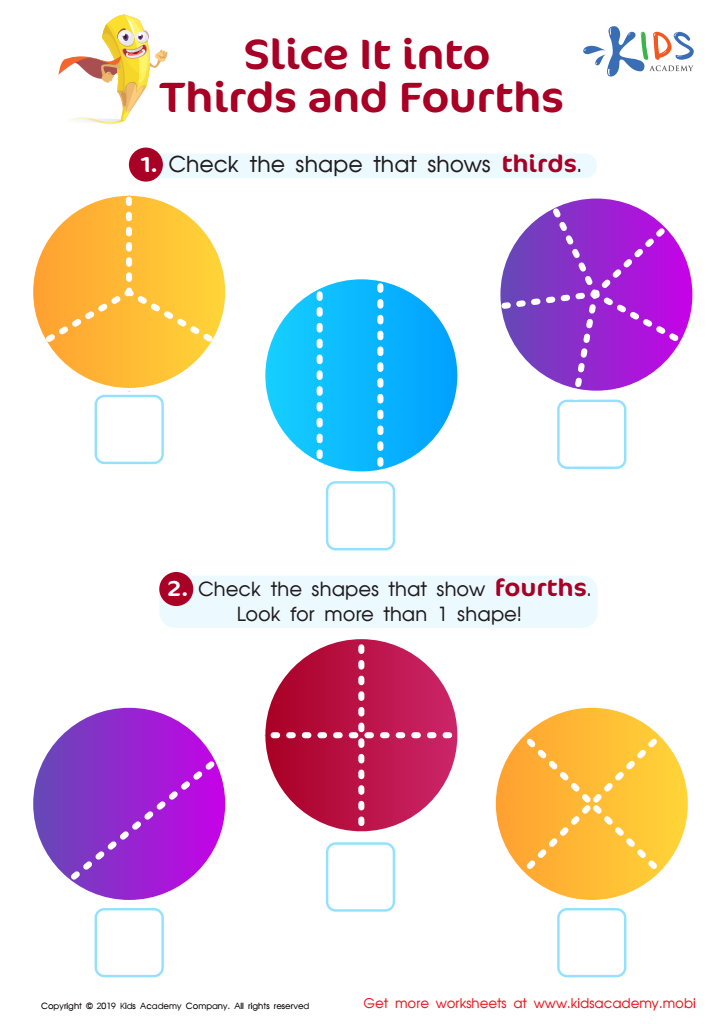
Slice in Thirds Fourths Worksheet
 Assign to My Students







Understanding fractions is a crucial mathematical skill for 8-year-olds, forming a foundational building block for more advanced math concepts. Parents and teachers should prioritize fraction identification for several reasons:
First, fraction knowledge enhances a child’s numerical comprehension. It moves them from understanding whole numbers to grasping parts of a whole, boosting their overall numeracy. This foundation is not just crucial academically but is also widely applicable in everyday life, such as in cooking, shopping, and even time management.
Second, fractions are integral to later mathematical subjects, including algebra, geometry, and statistics. Early mastery simplifies future learning processes, preventing difficulties that might arise in more complex topics. Developing these skills early on contributes to a sense of confidence and competence in mathematics, countering any anxieties or negative attitudes that may develop otherwise.
Moreover, fraction identification promotes critical cognitive skills. Problems involving fractions need logical reasoning and problem-solving abilities, strengthening a child's analytical thinking. By mastering fractions, students learn precision, logic, and the ability to see relationships between numbers.
In summary, by comprehending fractions at a young age, children gain indispensable skills that ensure their success in both academic and real-world contexts, laying a solid groundwork for future mathematical understanding and intellectual growth.








