Counting practice Adding up to 1000 Without Regrouping Worksheets for 8-Year-Olds
4 filtered results
-
From - To
Welcome to our Counting Practice Worksheets designed specifically for 8-year-olds! Our engaging activities focus on helping children master addition skills up to 1000 without regrouping. With a variety of exercises, your child will strengthen their understanding of numbers and enhance their confidence in basic math operations. These worksheets promote independent learning, supporting kids to practice counting and addition through fun and interactive formats. Perfect for home or classroom use, these resources aid in reinforcing foundational math skills, ensuring students are well-prepared for more advanced concepts. Explore our comprehensive collection today—where learning math is enjoyable and effective!
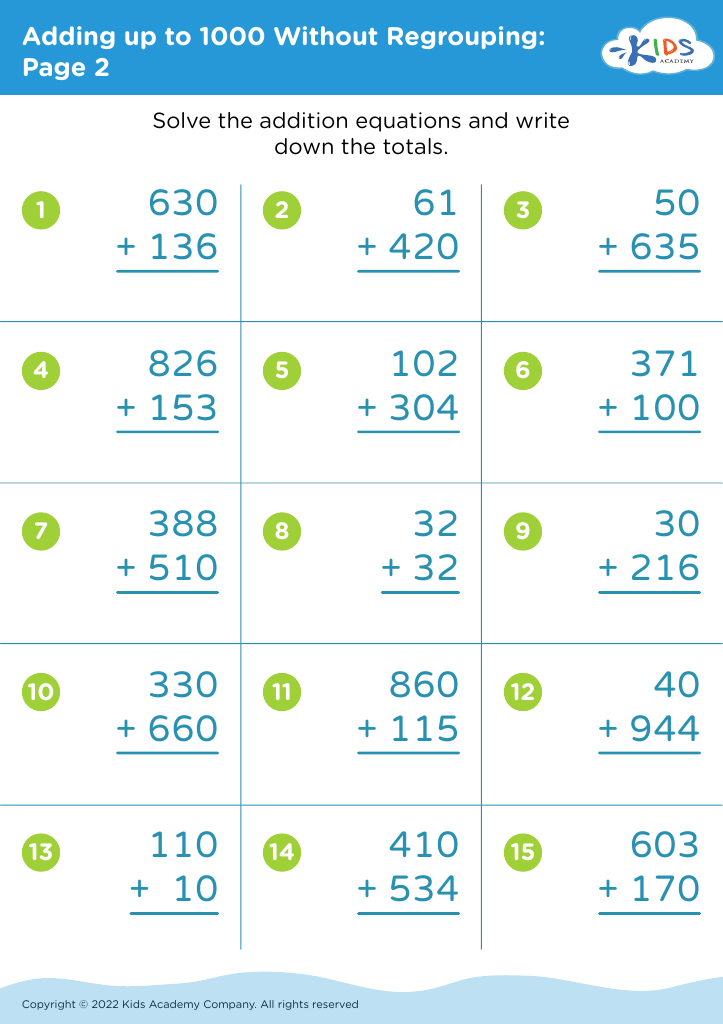
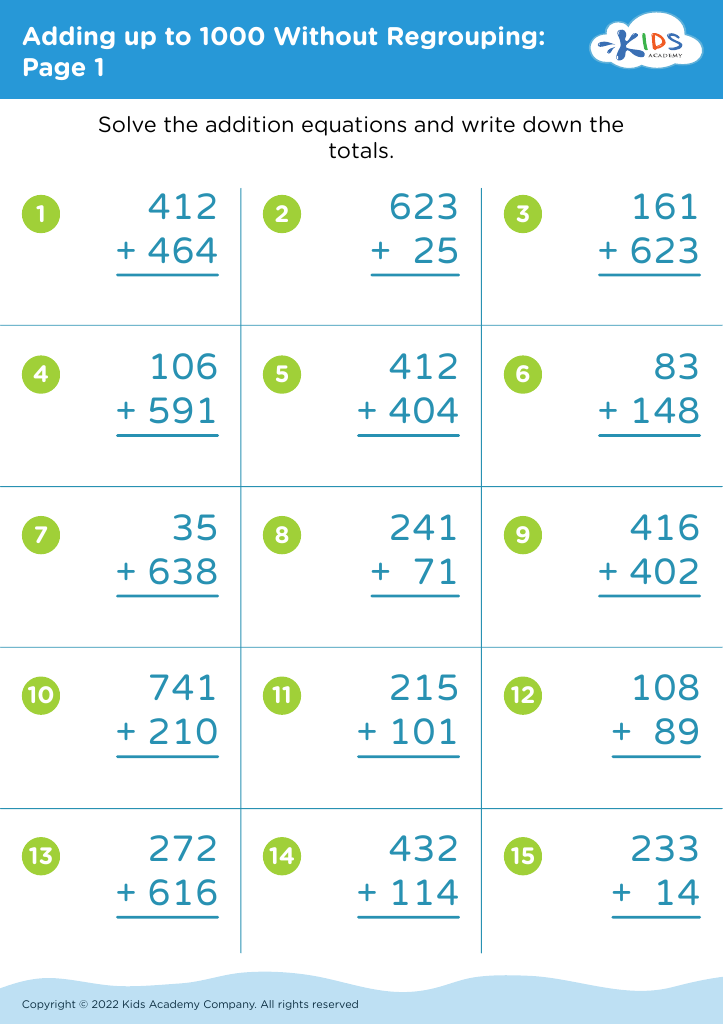
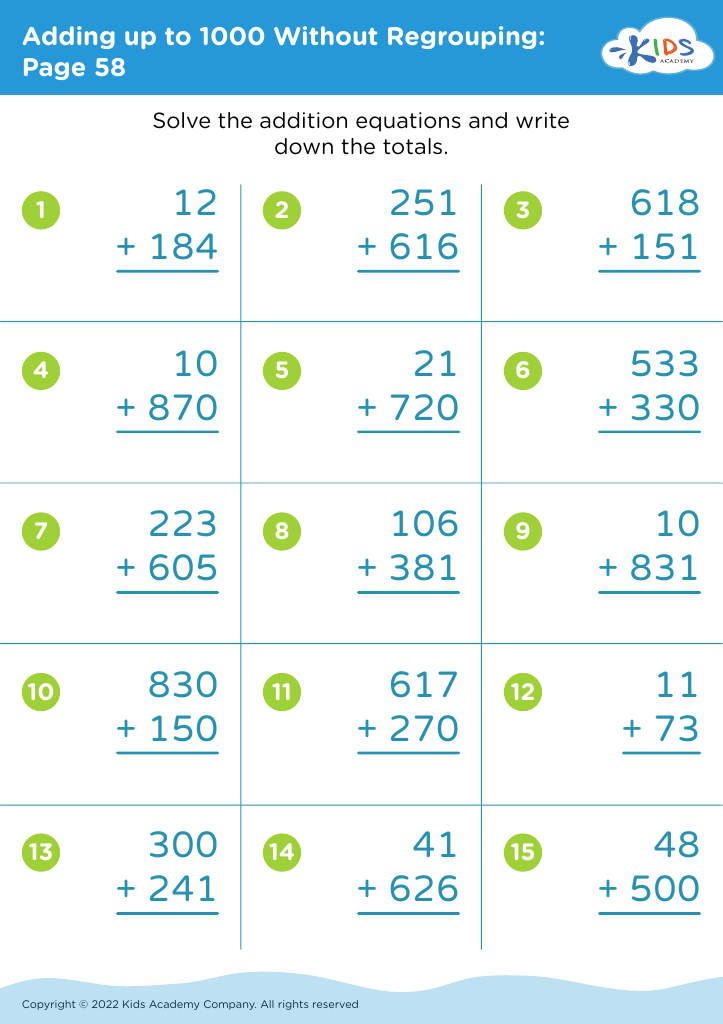
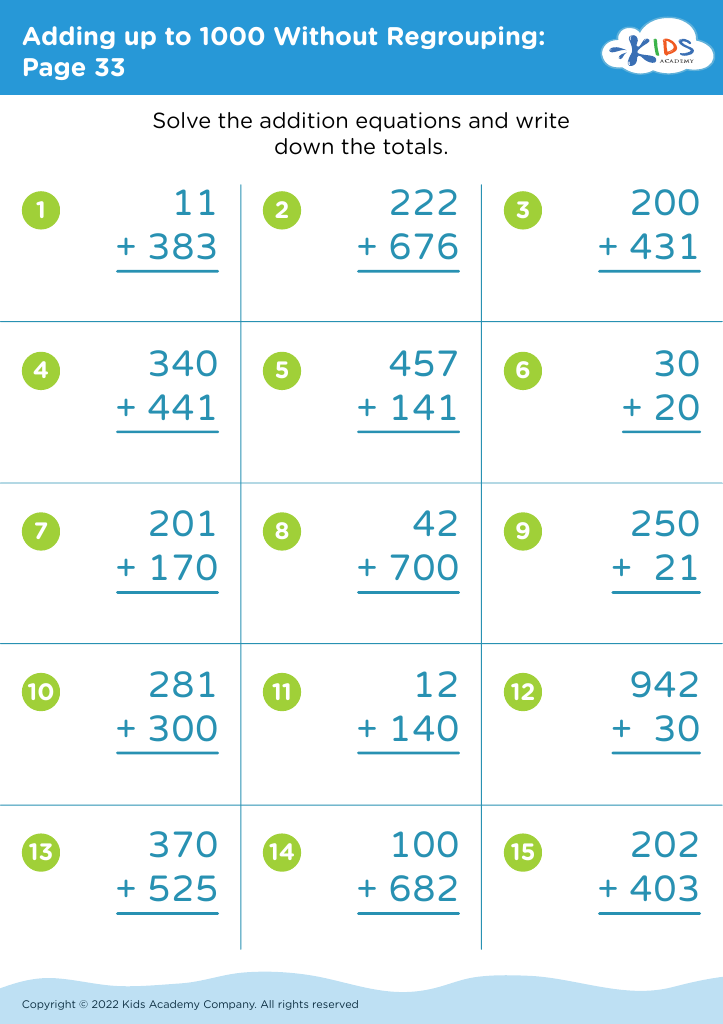


Counting practice, particularly focusing on adding up to 1000 without regrouping, is crucial for 8-year-olds as it lays the groundwork for essential mathematical skills. At this age, children are in a pivotal stage of their cognitive development, where their ability to understand numbers and operations begins to deepen. Mastering addition without regrouping promotes a strong number sense, which allows students to visualize and comprehend the concepts of place value, magnitude, and basic arithmetic operations.
Furthermore, establishing confidence in these foundational skills helps to alleviate math-related anxiety that can develop later on. When children regularly practice counting and addition, they not only improve their computational skills but also enhance their problem-solving abilities, enabling them to tackle more complex mathematical concepts as they progress through school.
Parents and teachers should actively encourage this practice, as it supports both academic success and life skills. Proficient counting and addition skills are not just applicable to classroom learning but are also fundamental in everyday tasks, such as shopping and budgeting. By nurturing these skills early on, we create a strong mathematical foundation for children, ensuring they are better prepared for future challenges in math and beyond.