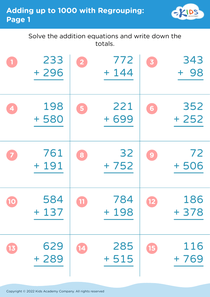
Develop counting skills Adding up to 1000 Without Regrouping Worksheets for 8-Year-Olds
3 filtered results
-
From - To
Enhance your child's math proficiency with our "Develop Counting Skills: Adding Up to 1000 Without Regrouping" worksheets, specially designed for 8-year-olds. These engaging resources help build a strong numerical foundation by allowing kids to practice addition in a fun, interactive way. Focusing on adding numbers without regrouping, these worksheets cultivate confidence and proficiency in counting up to 1000. With colorful illustrations and age-appropriate exercises, your child will enjoy mastering essential math skills, preparing them for more complex concepts ahead. Explore our comprehensive collection that promotes a love for learning while sharpening counting and addition abilities in a captivating manner!
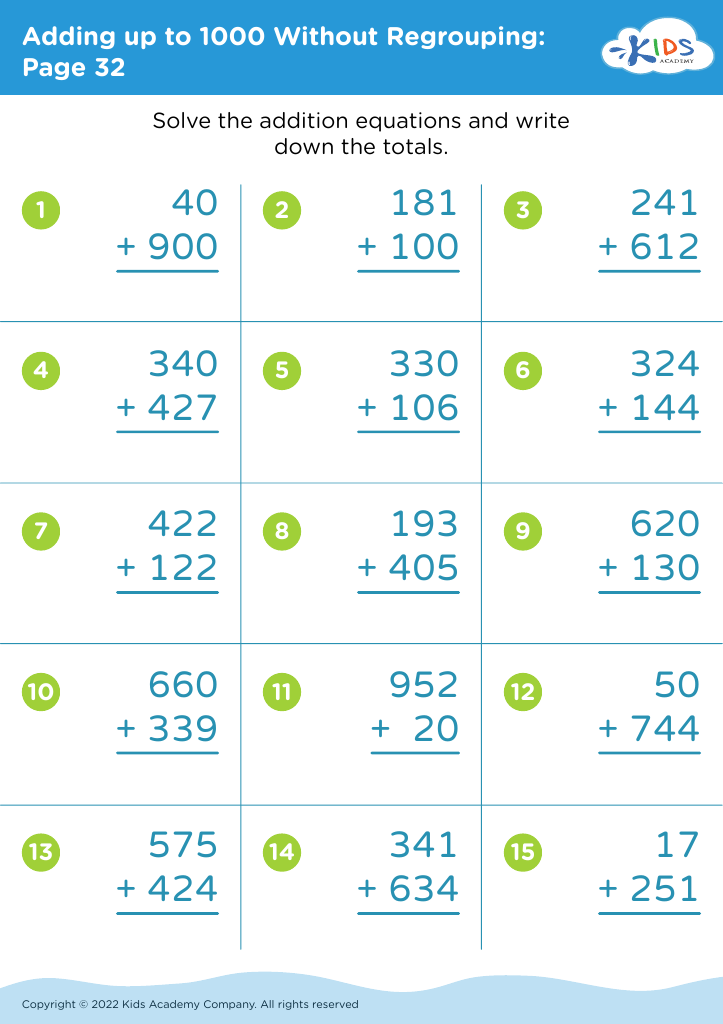
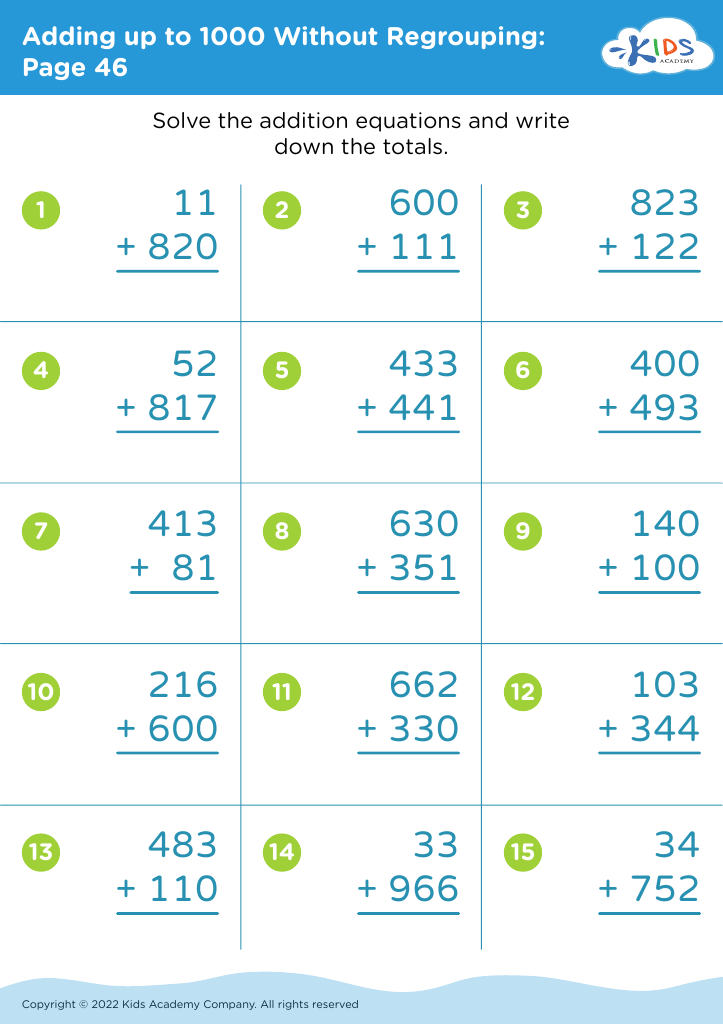
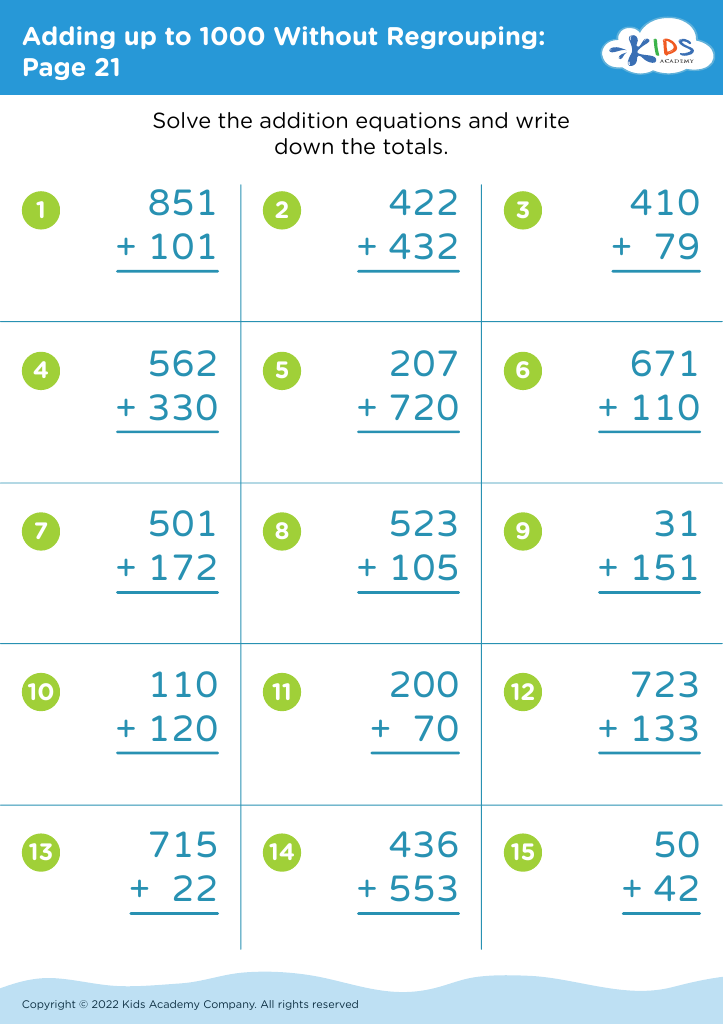


Developing counting skills, particularly the ability to add up to 1000 without regrouping, is crucial for 8-year-olds as these skills form the foundation for more advanced mathematical concepts. At this age, students are transitioning from basic arithmetic to more complex problem-solving situations. Mastery of counting and addition enhances their number sense, helps them understand place value, and builds confidence in handling numbers.
For parents and teachers, cultivating these skills can significantly impact a child's overall academic performance. Early success in math is linked to greater achievement later on, influencing a child's attitude towards math and learning in general. Strong counting abilities allow children to solve everyday problems, from budgeting their allowance to making sense of time and measurements.
Additionally, developing these skills without regrouping promotes mental math strategies, empowering students to perform computations quickly and accurately. This skill can also enhance critical thinking, as children learn to approach problems systematically. Understanding how to add up to 1000 equips students not only for their current curriculum but also prepares them for future topics, such as subtraction, multiplication, and division, where foundational counting skills will be crucial. Thus, parental and teacher support in mastering these skills is essential for fostering a positive and productive learning experience.