Improving math skills Adding up to 1000 Without Regrouping Worksheets for 8-Year-Olds
3 filtered results
-
From - To
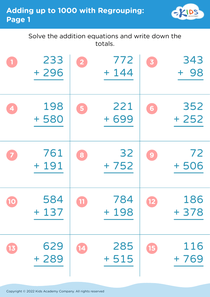
Boost your child's math proficiency with our "Improving Math Skills: Adding up to 1000 Without Regrouping Worksheets" designed for 8-year-olds. These engaging printable worksheets help young learners build confidence and accuracy in addition by focusing on three-digit numbers without the need for regrouping. Using a variety of fun activities, our resources reinforce fundamental math concepts and encourage independent practice. Perfect for classroom use or at-home learning, these worksheets support continuous improvement and make math enjoyable. Equip your child with essential skills, and watch them excel in mathematics effortlessly. Download now and start your educational journey today!
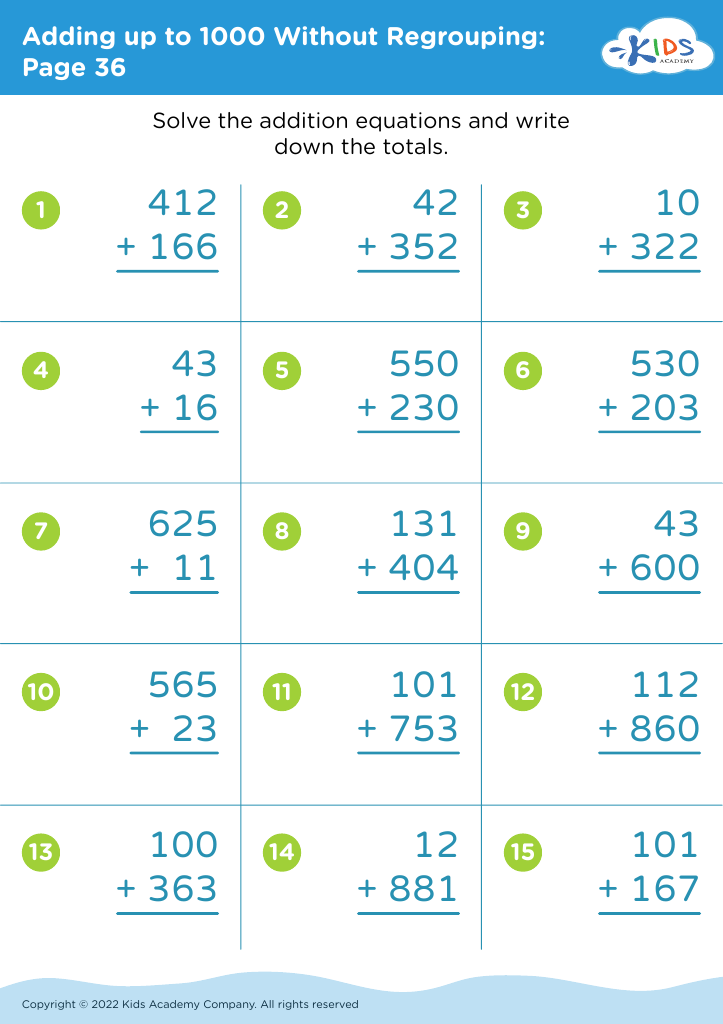
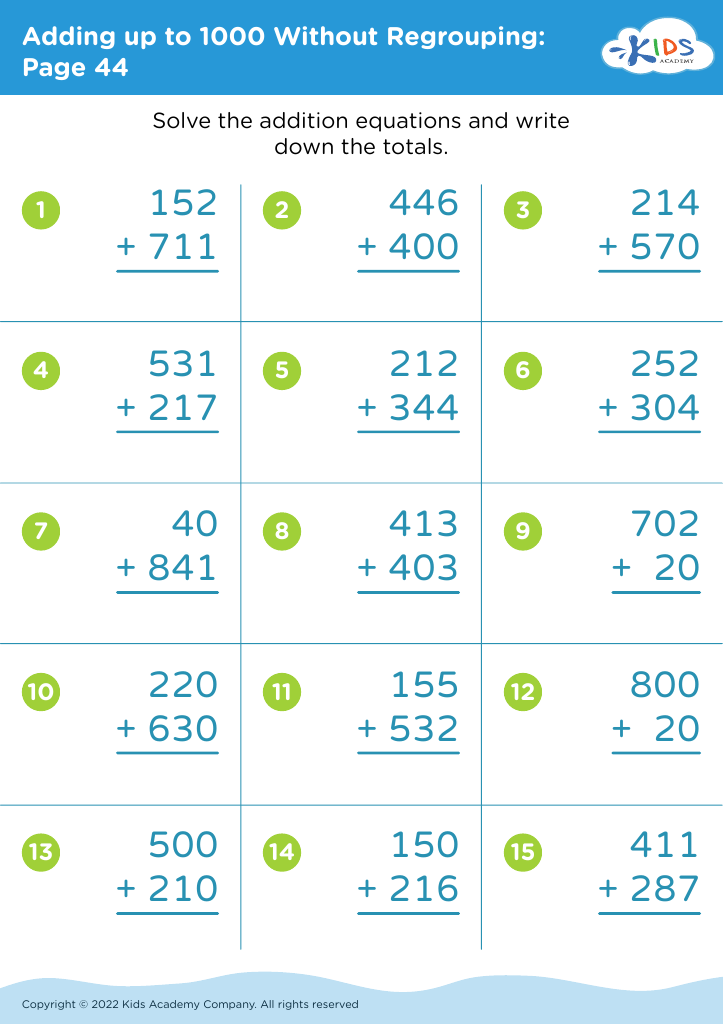
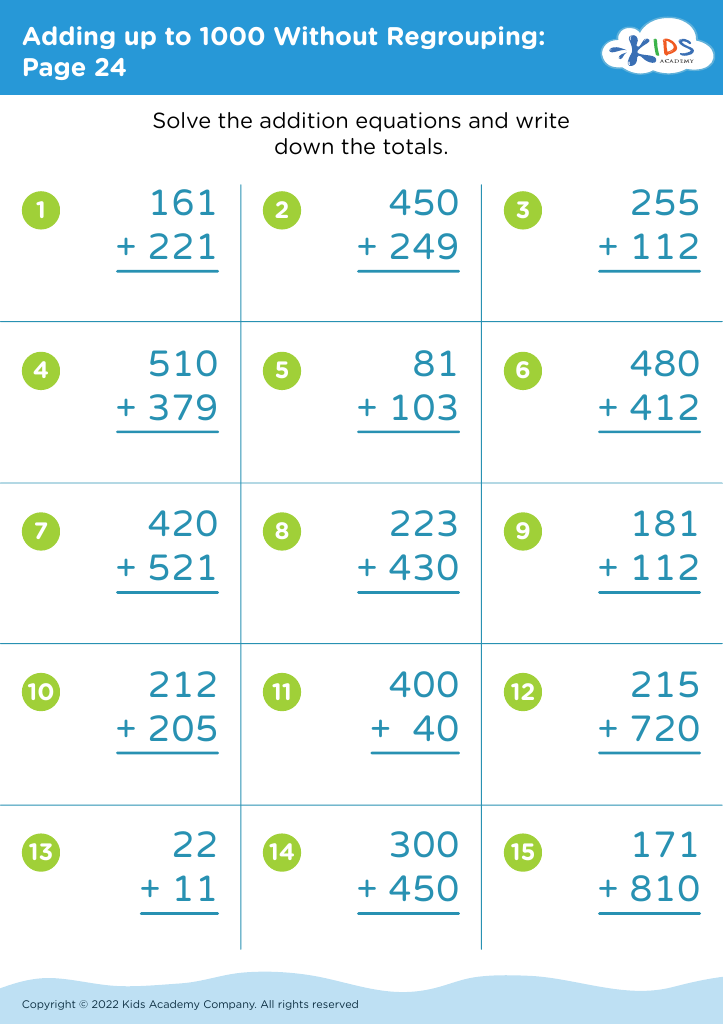


Improving math skills for 8-year-olds, specifically adding up to 1000 without regrouping, is a crucial step in early education that sets a foundation for future learning. This stage typically coincides with the second grade, a period marked by significant cognitive development and expanding academic skills. Mastering addition up to 1000 helps children enhance their number sense, allowing them to understand and manage larger numbers with ease, which is fundamental for more advanced arithmetic such as subtraction, multiplication, and division.
By focusing on addition without regrouping, children learn to approach problems methodically, increasing their confidence and accuracy. This foundational skill boosts problem-solving abilities and logical thinking, essential competencies in both academic and real-world scenarios. Furthermore, these activities reinforce endurance and attention to detail, skills necessary for more complex mathematical operations later on.
From a parent's or teacher's perspective, paying attention to this area of learning early on can prevent future challenges. Incorporating fun and engaging activities into practice ensures students remain motivated and interested in mathematics. In turn, this early proficiency can foster a life-long appreciation for math, increasing the likelihood of academic success, better career opportunities, and a well-rounded intellectual development. Ensuring strong math skills at this critical stage paves the way for thriving learners who are prepared to tackle advanced mathematical concepts.