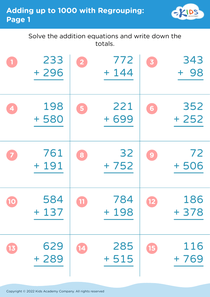
Recognize patterns Adding up to 1000 Without Regrouping Worksheets for 8-Year-Olds
3 filtered results
-
From - To
Our "Recognize Patterns Adding up to 1000 Without Regrouping Worksheets for 8-Year-Olds" provide an engaging way to strengthen math skills. Ideal for 2nd and 3rd graders, these worksheets help children practice addition up to 1000 without the complexity of regrouping. Focusing on pattern recognition, the activities enhance critical thinking and problem-solving skills. Perfect for classroom or at-home learning, the colorful and interactive sheets ensure young learners understand basic arithmetic concepts while having fun. Boost your child's confidence in math with our expertly crafted, easy-to-follow worksheets tailored for budding mathematicians!
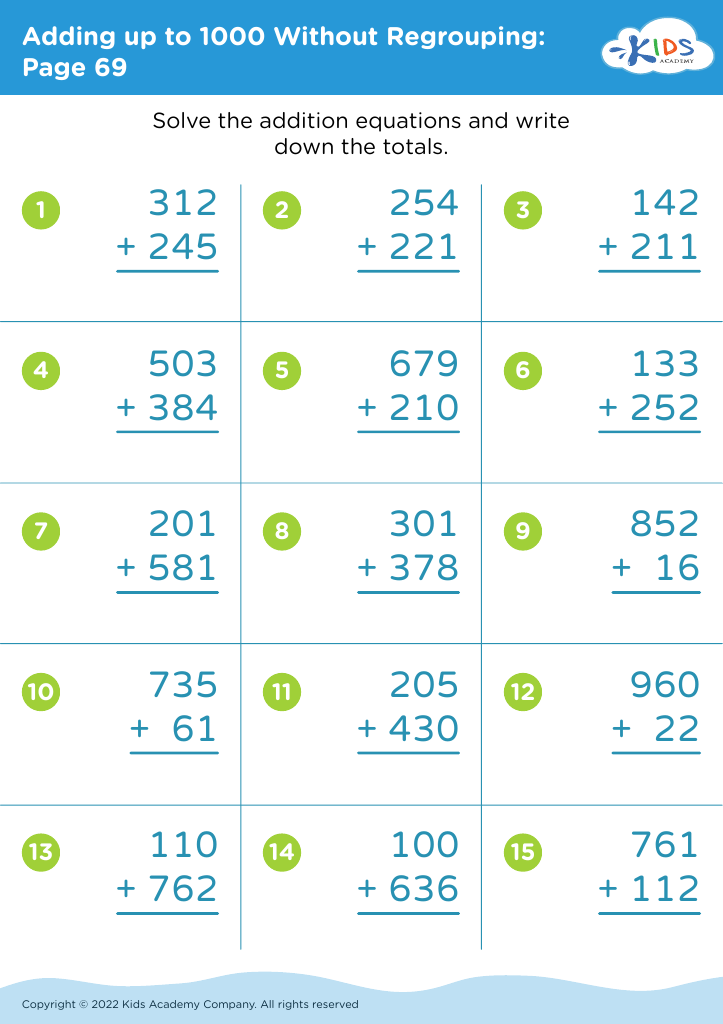
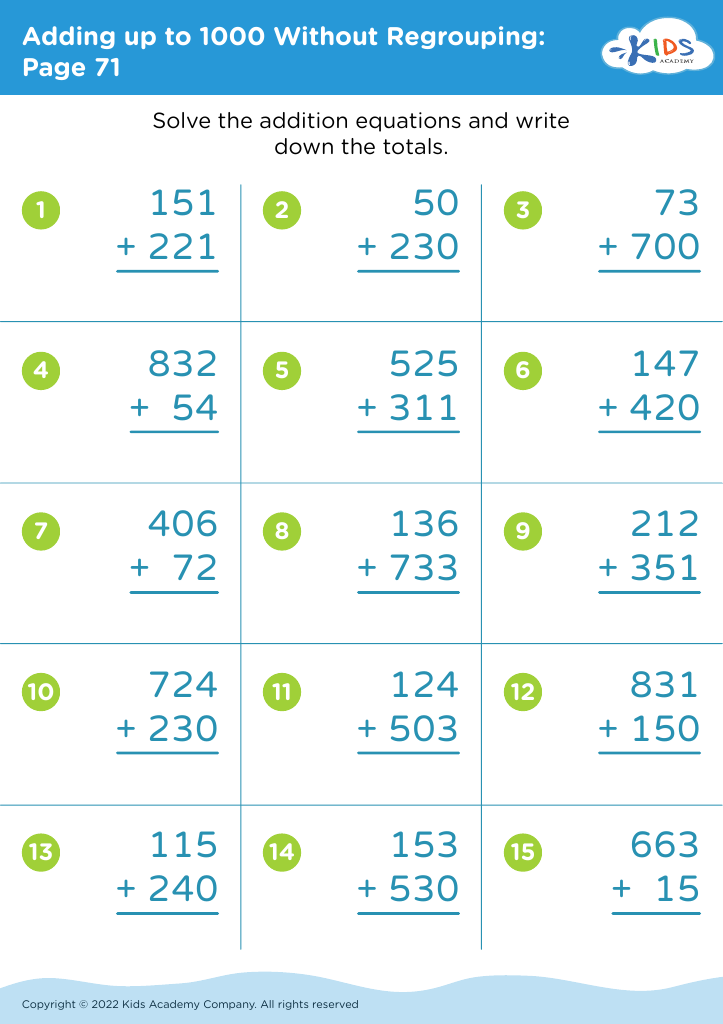
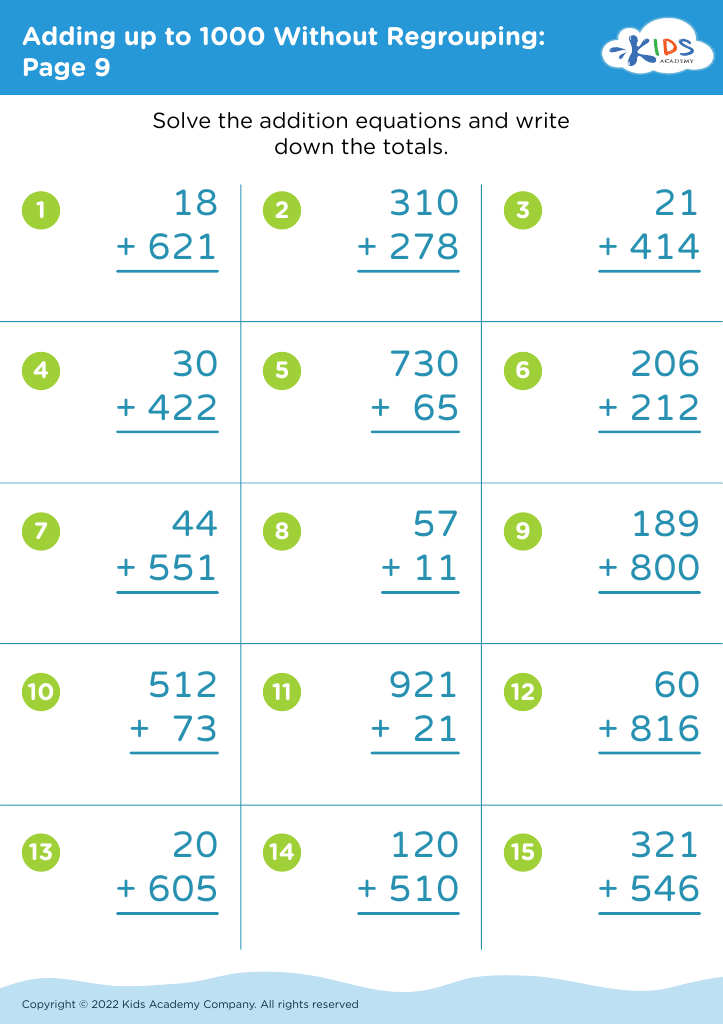


Recognizing patterns in adding up to 1000 without regrouping for 8-year-olds is crucial because it builds foundational arithmetic skills and cognitive development. At this age, children are transitioning from basic addition to more complex operations. Understanding these patterns helps them make connections between numbers, facilitating mental math abilities and fluency in computation. When children recognize patterns, such as the incremental progression in sums that don't require regrouping, they gain confidence in handling larger numbers systematically and correctly.
Moreover, this understanding enhances problem-solving skills and logical thinking. It provides them with tools to approach mathematical problems strategically. By recognizing patterns, they can predict outcomes and verify their work, leading to increased accuracy and speed.
For parents and teachers, supporting this learning process means fostering a positive attitude towards math. It encourages children by showing them that math is logical and not just a series of memorized steps. Developing these skills early can set a strong foundation for more advanced mathematical concepts and analytical thinking that will be essential in future academic and real-life scenarios.
Finally, pattern recognition in addition organizes their thinking processes, which can translate into better organization and analytical skills in other subjects. Engaging children in recognizing these patterns makes math more intuitive, less intimidating, and ultimately, more enjoyable.