Basic Addition Skills Adding up to 1000 Worksheets for 8-Year-Olds
3 filtered results
-
From - To
Welcome to our engaging collection of "Basic Addition Skills Adding up to 1000 Worksheets" designed specifically for 8-year-olds! These worksheets aim to strengthen young learners' addition skills, making math both fun and accessible. With varying levels of difficulty, children can practice adding numbers both with and without regrouping, enhancing their confidence and proficiency. Each worksheet encourages critical thinking while ensuring mastery of essential math concepts. Ideal for classroom use or at-home practice, these printable resources foster a positive learning environment. Empower your child to explore addition up to 1000 and watch their skills soar! Printable and ready for instant downloading!
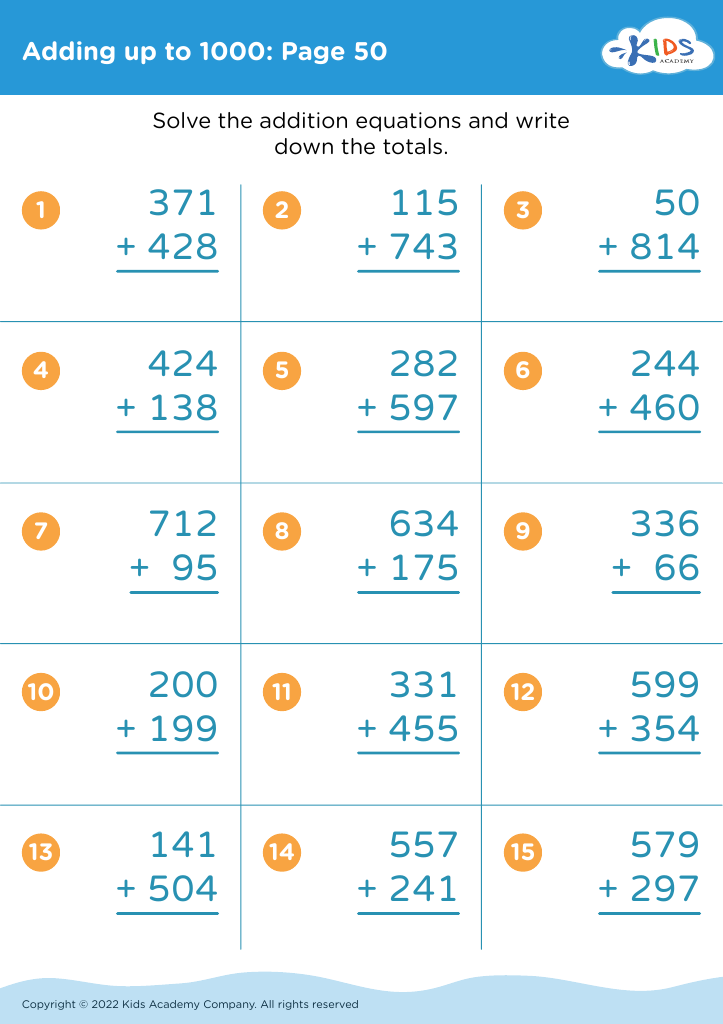
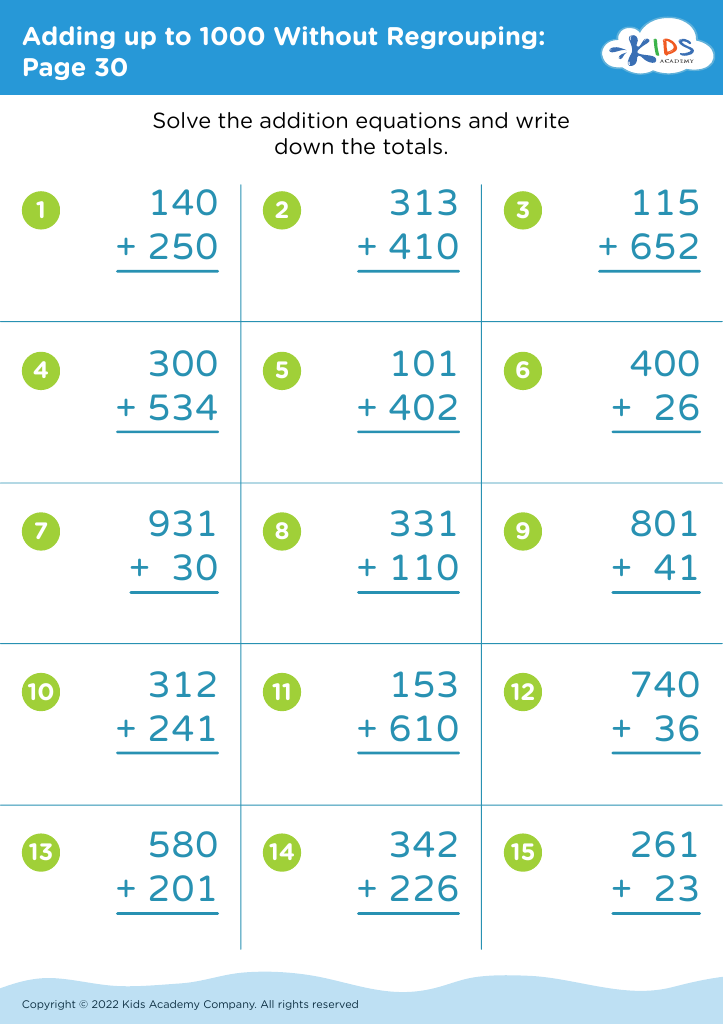
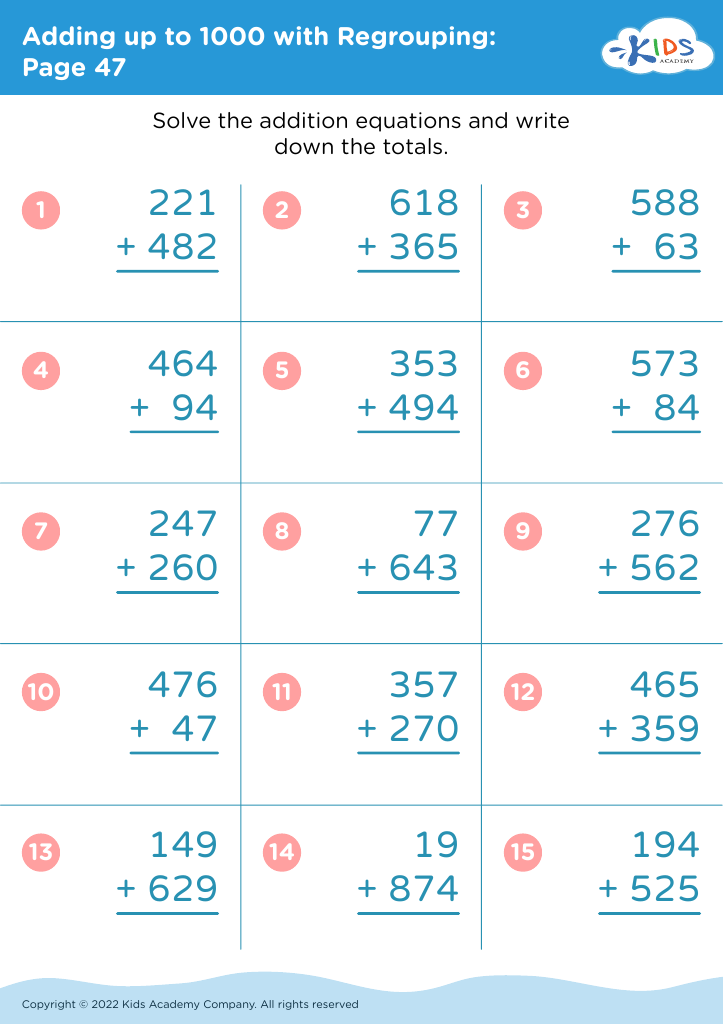



Parents and teachers should prioritize basic addition skills up to 1000 for 8-year-olds because these skills serve as a foundational component of a child's mathematical development. Mastering addition enhances cognitive abilities related to problem-solving, logical reasoning, and critical thinking. At this age, children are transitioning from simple arithmetic to more complex mathematical concepts, making it crucial for them to develop fluency in adding multi-digit numbers.
Strong addition skills promote confidence and reduce math-related anxiety, allowing children to approach future math challenges with a positive attitude. In practical terms, being adept at addition helps children not just in formal education, but also in everyday situations—like budgeting their allowance, understanding time, or measuring ingredients in cooking.
Moreover, the ability to add numbers up to 1000 equips children with skills needed for higher mathematics, including subtraction, multiplication, and division. By mastering these basilar skills, children pave the way for academic success in various subjects and develop an authentic understanding of number sense.
Hence, encouraging proficiency in basic addition lays the groundwork for a child's lifelong relationship with math, equipping them with essential tools for their academic journey and beyond.








