Understand multiplication Adding up to 1000 Worksheets for 8-Year-Olds
3 filtered results
-
From - To
Introduce your 8-year-old to the foundational skills of multiplication with our "Understand Multiplication Adding Up to 1000" worksheets. These curated activities are set to blend fun and learning, helping children grasp multiplication principles while honing their addition skills. Designed for young learners, each worksheet provides engaging exercises that are both educational and enjoyable. With a strong focus on comprehension, these worksheets support seamless progression in math, ensuring young students build confidence in multiplying while simultaneously tackling sums up to 1000. Empower your child’s mathematical journey today with these expertly crafted resources.
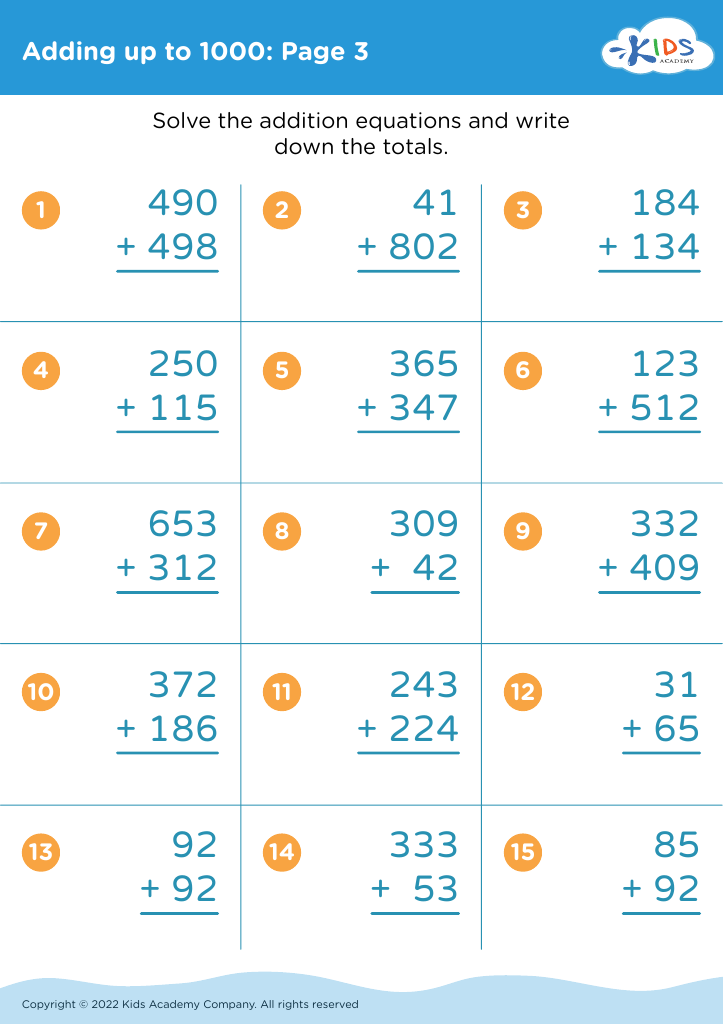
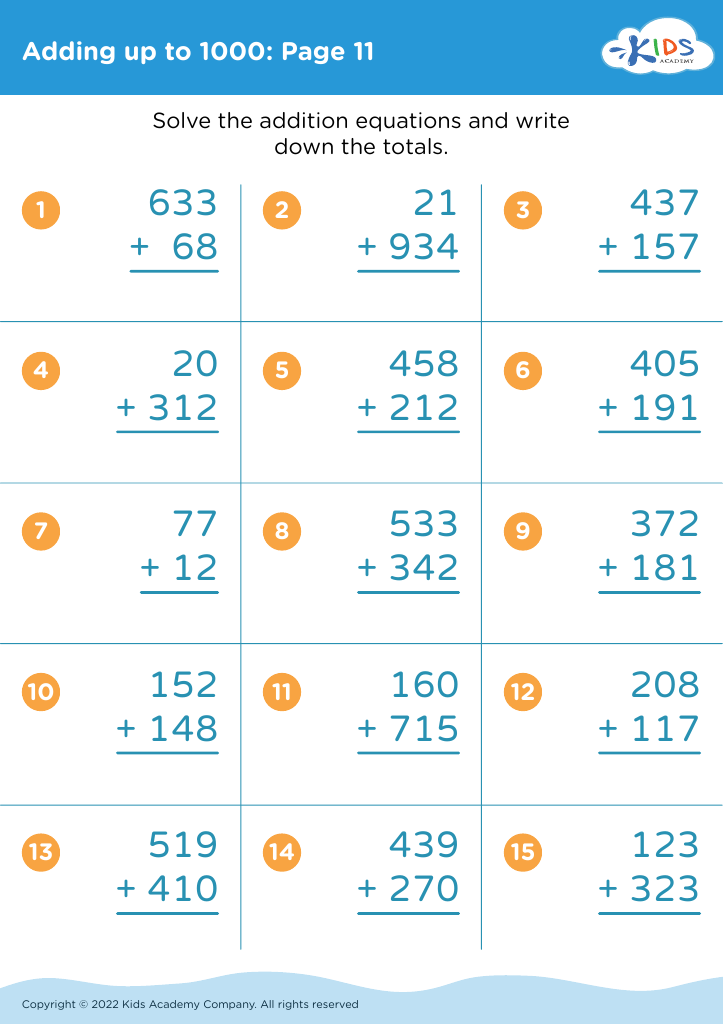
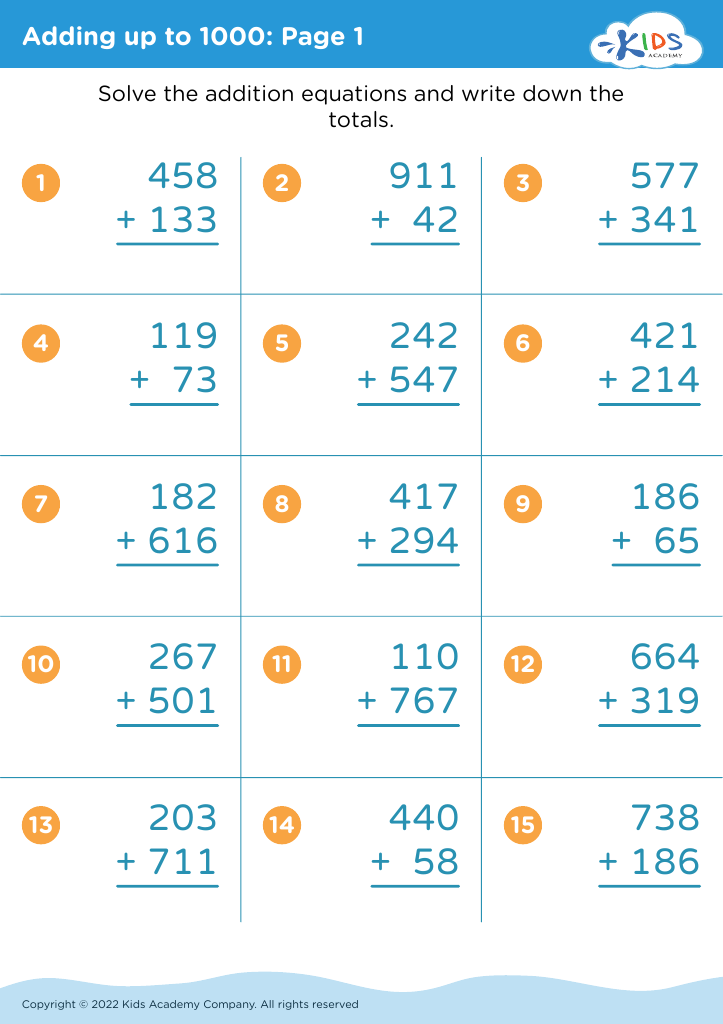



Understanding multiplication and adding up to 1000 are foundational math skills that significantly benefit 8-year-olds. Mastery of these concepts forms the basis for more advanced mathematics, critical thinking, and problem-solving skills.
For parents and teachers, investing in ensuring that children grasp these two concepts can pay significant dividends. Multiplication is not just about memorizing tables; it helps kids understand the concept of grouping and scaling, which is fundamental in real-world applications such as measuring ingredients in recipes, calculating total cost of multiple items, and even more complex areas like physics and engineering later on. Introducing these at an early stage makes the transition to more intricate mathematical operations seamless.
Adding up to 1000, meanwhile, hones a child's skills in addition and subtraction, which are necessary not only in academic settings but also in everyday activities such as managing money or time. It helps children gain number sense, the intuitive understanding of numbers and their relationships, which is critical for effective mental math and efficient problem-solving.
Moreover, early mastery boosts a child's confidence, motivating them to tackle challenging subjects with a positive mindset. Ensuring a firm grasp on these topics establishes a robust educational foundation, fostering a lifelong appreciation and competence in mathematics. Therefore, it is imperative for both parents and teachers to nurture and support children's learning in these crucial areas.








