Understanding quantity Adding up to 1000 Worksheets for 8-Year-Olds
3 filtered results
-
From - To
Discover our "Understanding Quantity: Adding Up to 1000 Worksheets" designed specifically for 8-year-olds. These engaging, educational resources help young learners grasp the concept of quantity while honing their addition skills to sum up to 1000. Featuring colorful illustrations and varied problem types, the worksheets promote interactive learning and cater to different learning styles. Parents and teachers can use these materials to foster confidence and a deeper understanding of numbers in a fun and approachable way. Empower your child with the skills they need to master addition while having a blast with our thoughtfully crafted worksheets! Ideal for home practice or classroom activities.
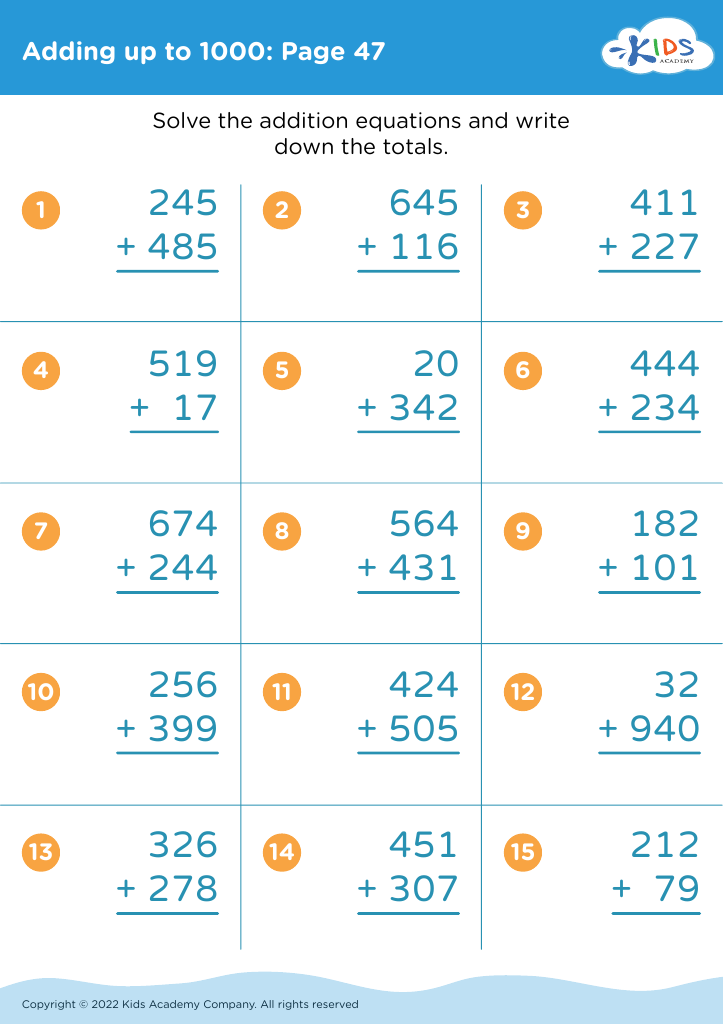
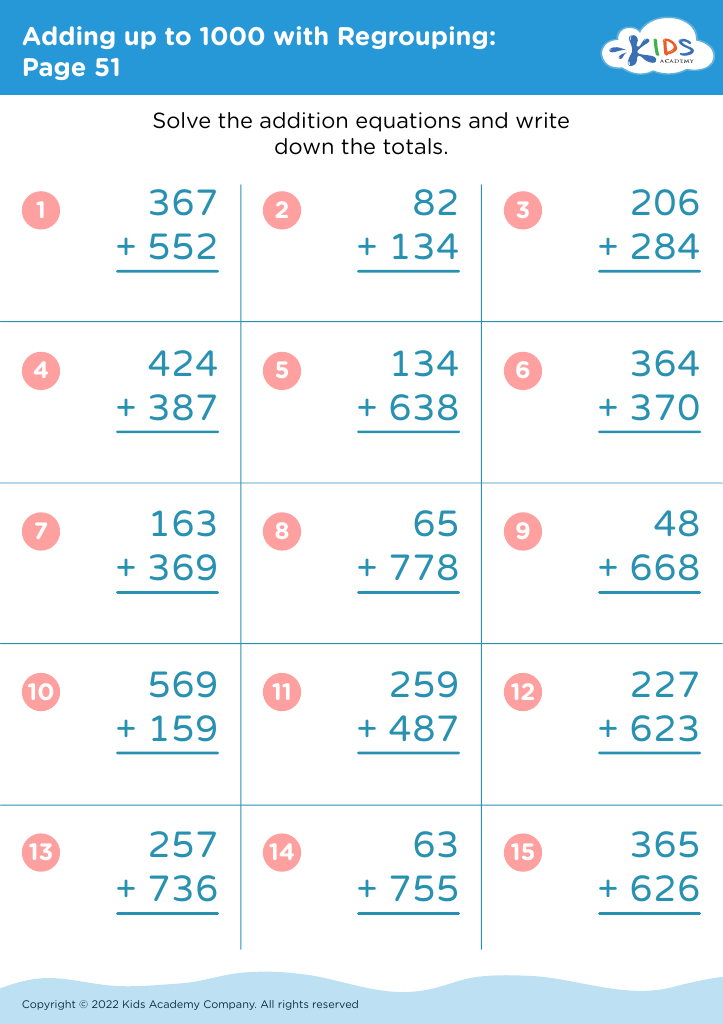
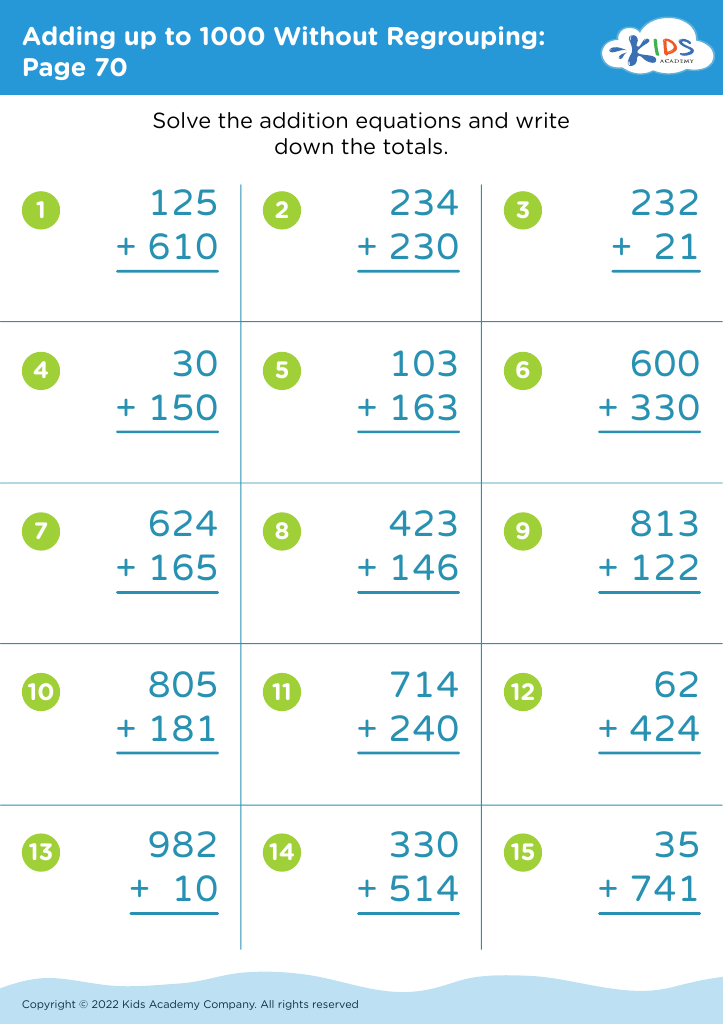



Understanding quantity and the concept of adding up to 1000 is crucial for 8-year-olds as it lays the foundation for essential mathematical skills. At this age, children transition from concrete to abstract thinking, enabling them to comprehend larger numbers and more complex operations.
First, grasping quantities fosters a sense of number sense, which helps children relate numbers to real-life situations, such as counting, measuring, and budgeting. This understanding nurtures critical thinking and problem-solving skills necessary for their academic growth and everyday decision-making.
Second, mastering addition up to 1000 enhances mental calculation abilities. This skill equips students to tackle more challenging math concepts in the future, such as multiplication, division, and fractions, while establishing confidence in their mathematical capabilities.
Furthermore, cultivating these skills can greatly reduce math anxiety. When children feel comfortable with numbers, they are more likely to engage positively with mathematics, setting the stage for future success.
Lastly, understanding quantities and addition allows for richer interactions in collaborative settings, where teamwork and sharing of ideas thrive. Thus, by focusing on these foundational skills, parents and teachers play an integral role in developing proficient and confident mathematicians.








