Addition Practice Adding up to 50 Without Regrouping Worksheets for 8-Year-Olds
6 filtered results
-
From - To
Enhance your child's addition skills with our "Addition Practice Adding up to 50 Without Regrouping Worksheets" designed for 8-year-olds. These engaging and educational worksheets provide a solid foundation in fundamental math by focusing on adding numbers up to 50 without the need for regrouping. Perfect for independent practice or classroom use, they help children build confidence and mathematical proficiency. Our worksheets promote critical thinking and problem-solving skills through fun and interactive exercises. Ideal for young learners eager to improve their addition capabilities, these worksheets make learning math enjoyable and rewarding. Start boosting your child's addition skills today!
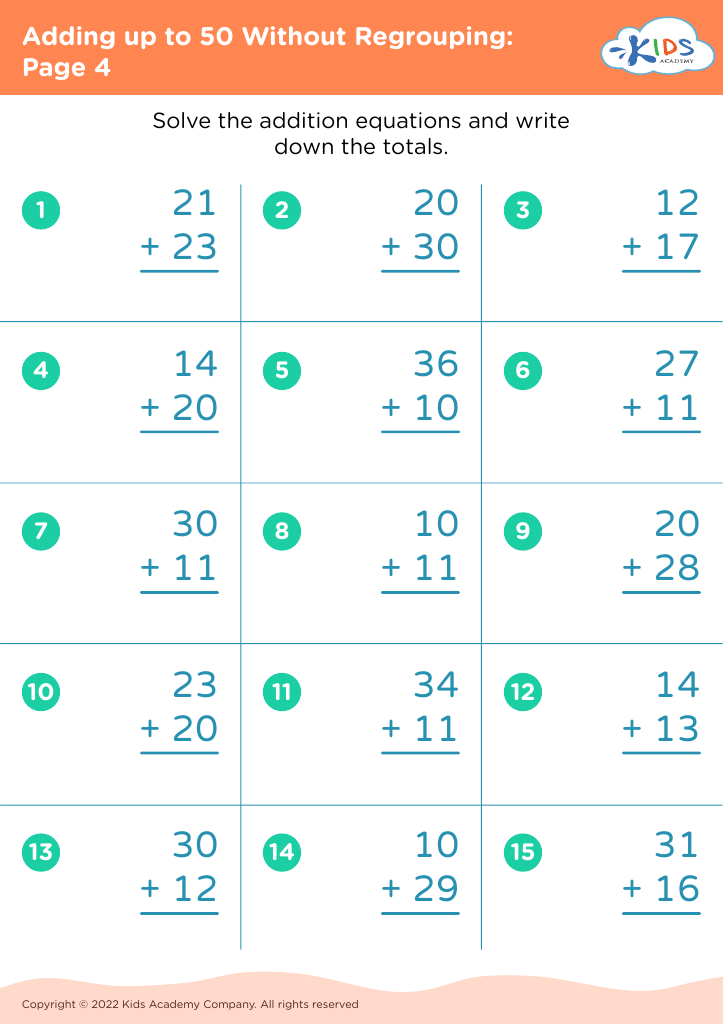
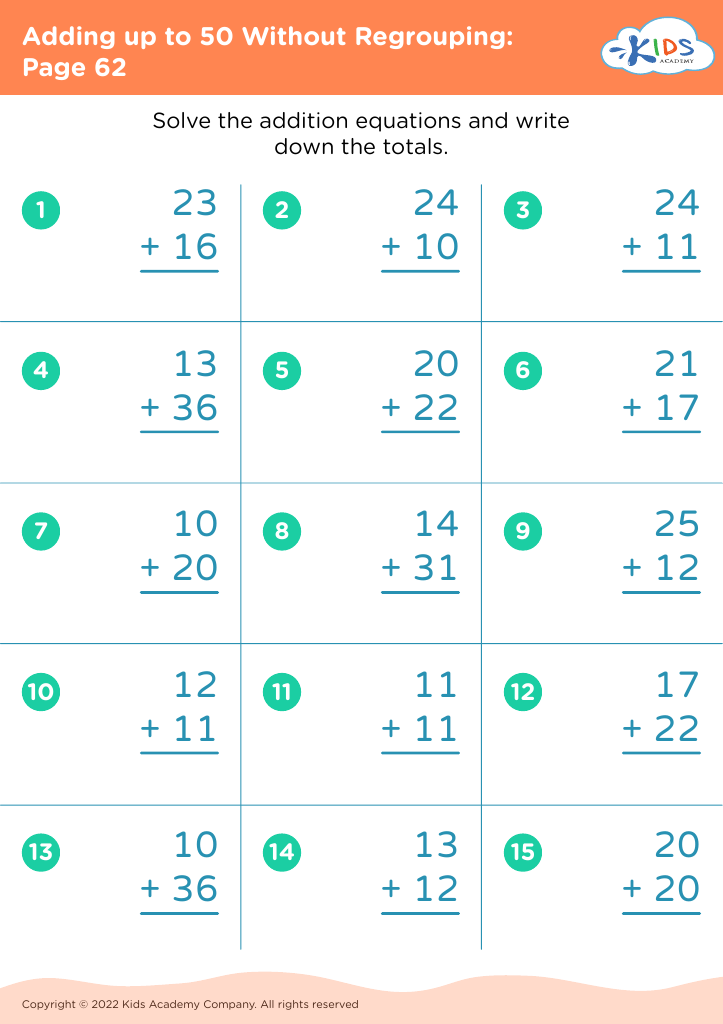
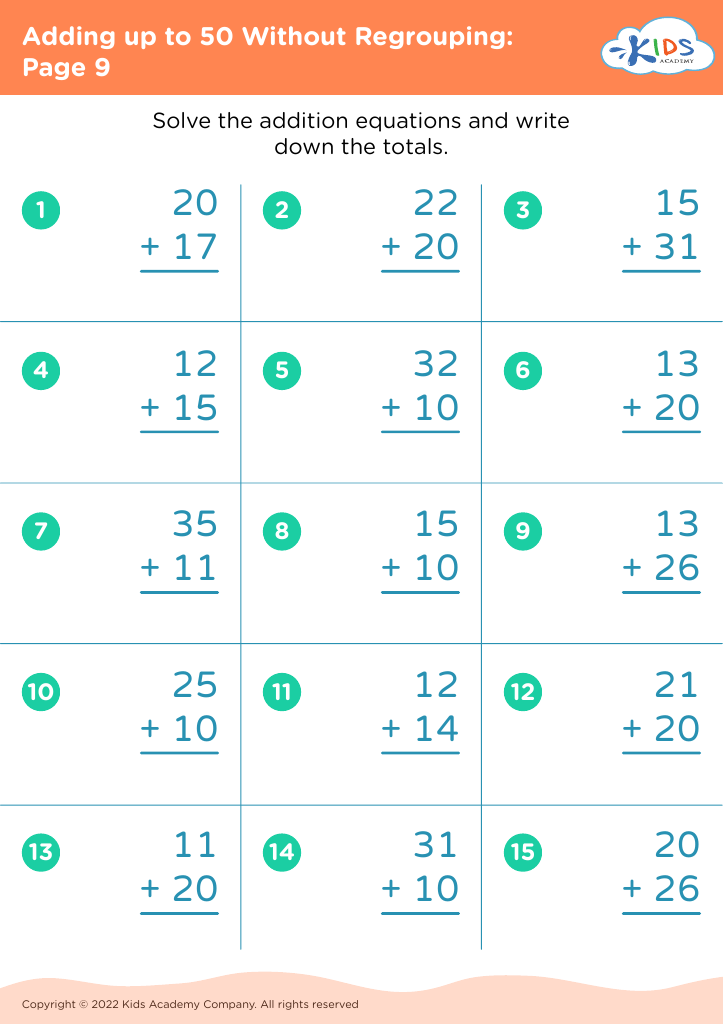
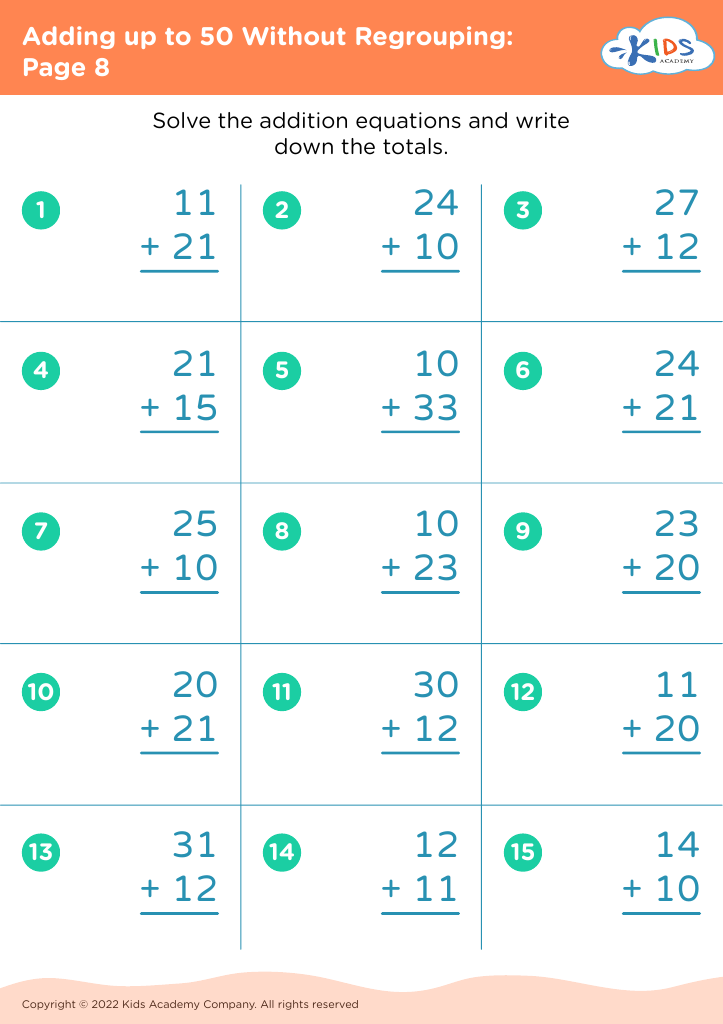
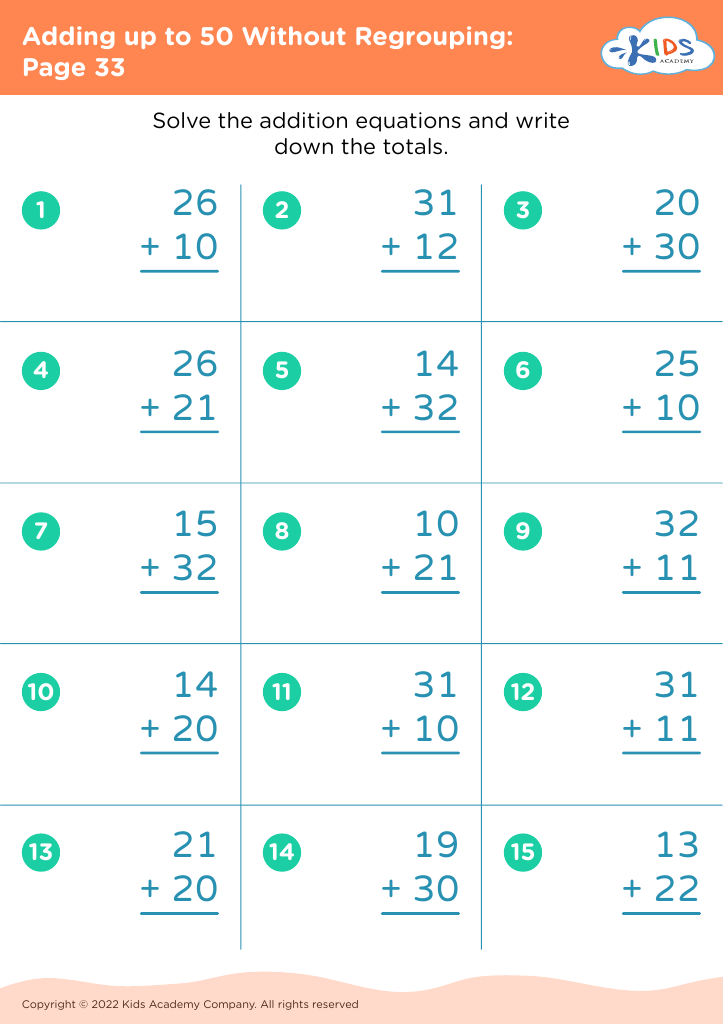
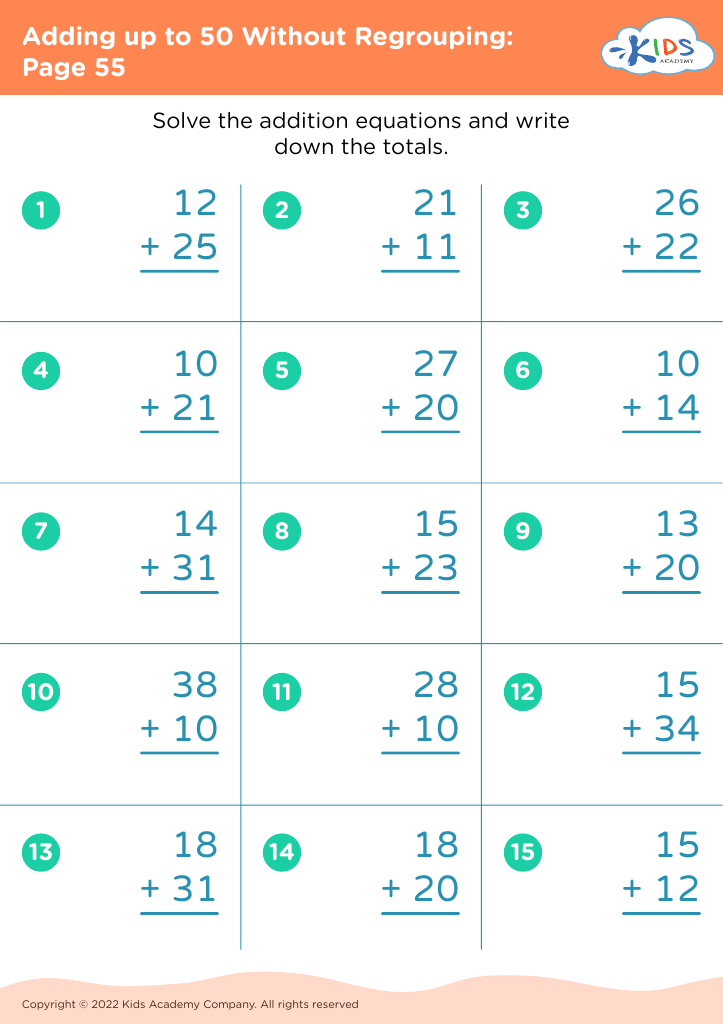


Parents and teachers should care about facilitating addition practice for 8-year-olds, specifically without regrouping and up to 50, for several compelling reasons. At around this age, children are typically in second or third grade, a critical phase where foundational math skills are being consolidated.
First, mastering addition within this range strengthens mental arithmetic skills, vital for everyday tasks and future math challenges. Activities that reinforce these skills foster confidence and reduce math anxiety, promoting a positive attitude towards learning.
Second, addition practice without regrouping simplifies the learning process, focusing on straightforward calculations that build fundamental understanding. Accomplishing these essential tasks strengthens a child’s number sense, making it easier for them to transition to more complex operations involving higher numbers and regrouping.
Moreover, consistent practice enhances concentration, logical thinking, and problem-solving abilities. As students repeatedly work through addition problems within a comfortable range, they develop increased accuracy and speed, which are necessary for more advanced mathematics. It also lays a strong foundation for other primary math concepts, such as subtraction, multiplication, division, and understanding place value.
Finally, engaging parents in their child's learning through addition practice can encourage an educational partnership, showing the child that learning is valued both at school and home. Overall, promoting addition practice adding up to 50 without regrouping creates a strong mathematical base, setting the stage for future academic success.