Numerical reasoning Addition & Subtraction Worksheets for 8-Year-Olds
3 filtered results
-
From - To
Explore our engaging Numerical Reasoning Addition & Subtraction Worksheets designed specifically for 8-year-olds! These worksheets promote critical thinking and problem-solving by blending foundational math skills with real-world scenarios. Children will enhance their ability to apply addition and subtraction in diverse contexts, boosting their numerical reasoning while having fun. Our interactive exercises cater to various learning styles, ensuring that every child can grasp these essential concepts effectively. Ideal for both classroom and home learning, these resources help build confidence in young learners. Dive into our extensive collection and watch your child's mathematical skills flourish through enjoyable, challenging activities!
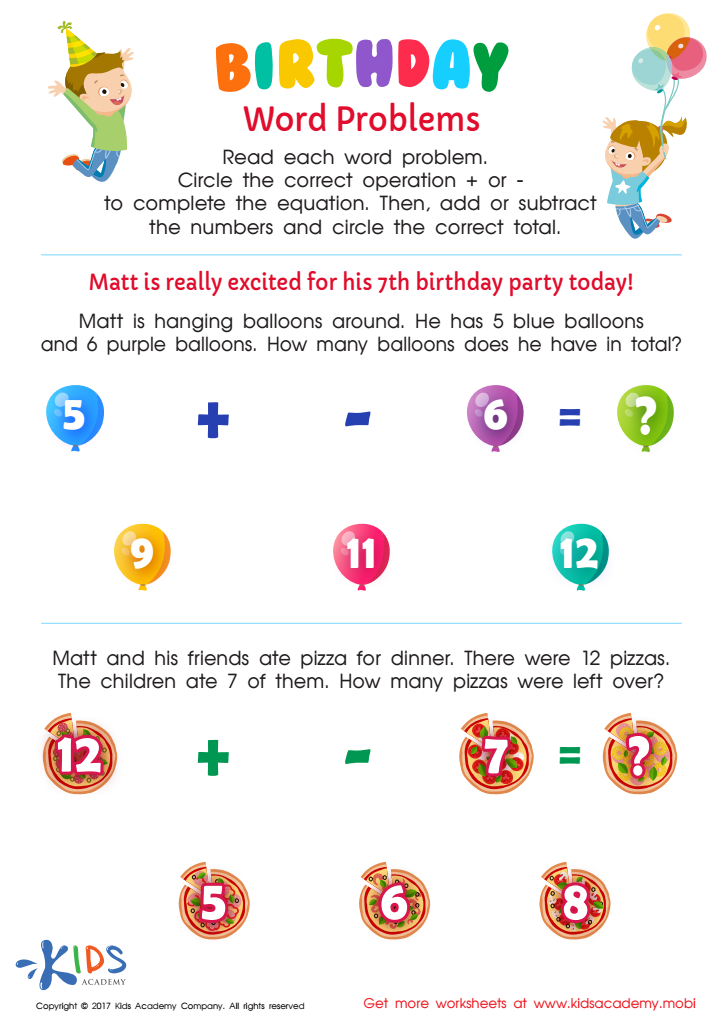
Birthday Word Problems Substraction Worksheet
 Assign to My Students








Parents and teachers should prioritize numerical reasoning in addition and subtraction for 8-year-olds as it lays the foundation for critical thinking and problem-solving skills essential in mathematics and daily life. At this age, many children transition from concrete arithmetic to more abstract concepts. Mastery in in addition and subtraction enables them to tackle more complex operations, such as multiplication and division, which are introduced in later grades.
Engaging children in numerical reasoning develops their ability to analyze situations, recognize patterns, and make logical connections. This cognitive skill cultivates a sense of confidence and independence in mathematical tasks, ultimately influencing their overall academic performance.
Moreover, strong addition and subtraction skills contribute to practical life skills like budgeting, shopping, and cooking, reinforcing the real-world application of mathematics. When educators and parents work together to nurture these skills through interactive games, storytelling, and relatable situations, they can make learning enjoyable while enhancing retention.
Furthermore, supporting children in mastering these basic mathematical operations can help identify any potential learning difficulties early on, allowing for timely intervention. Ultimately, fostering strong numerical reasoning at this formative stage instills a love for learning and paves the way for future academic success.








