
Enhance vocabulary skills Math Worksheets for 8-Year-Olds
5 filtered results
Difficulty Level
Grade
Age
-
From - To
Subject
Activity
Standards
Boost your child's math vocabulary and problem-solving abilities with our expertly designed math worksheets for 8-year-olds. These fun and engaging worksheets not only develop essential math skills but also enhance your child's understanding of key math terms and concepts. Perfect for young learners, each activity features age-appropriate exercises that simultaneously challenge and delight, ensuring they grasp foundational vocabulary while having fun. Empower your child with the language of math to succeed in their educational journey. Visit us and discover countless ways to make learning math enjoyable and effective today!
Favorites
With answer key
Interactive
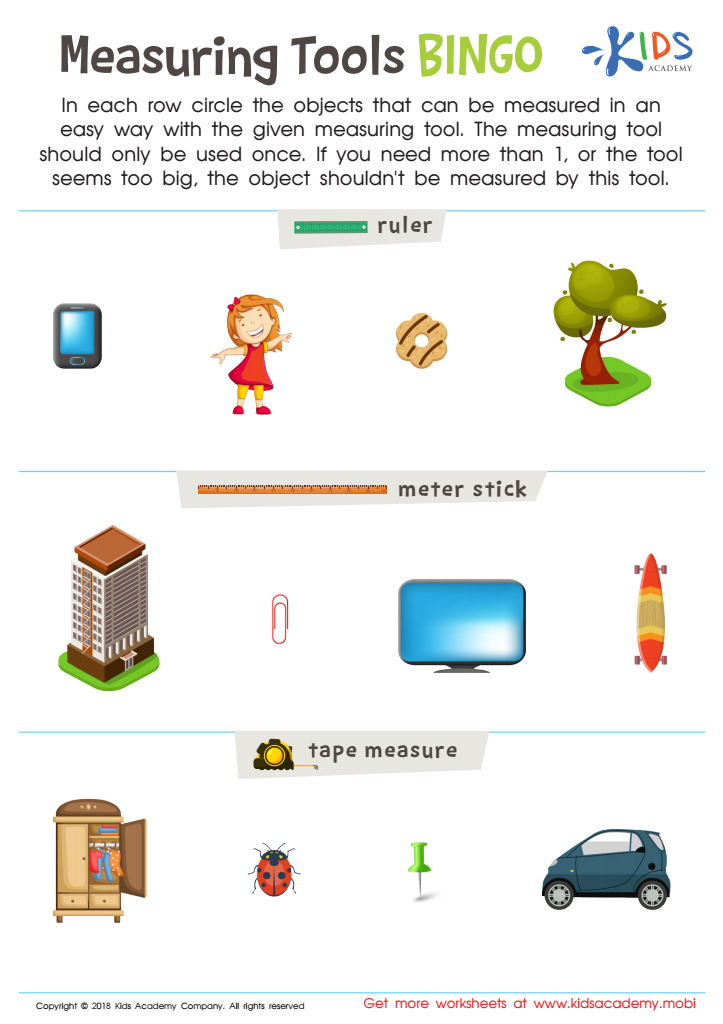
Measuring Tools Bingo Worksheet
Circling the objects that can be measured with the given tool in each row is the task for your child. The tool must be able to accurately measure what's pictured - if it's too large, it's not suitable.
 Assign to My Students
Measuring Tools Bingo Worksheet
Worksheet
Join Kids Academy for Free
Who is primarily going to use this learning content?








Enhancing vocabulary skills in math for 8-year-olds is crucial because it builds a strong foundation for both their academic success and overall cognitive development. Understanding mathematical terminology allows children to grasp concepts more easily and follow instructions accurately. This foundational knowledge directly impacts their ability to solve problems effectively and to communicate their thought processes clearly, both of which are essential skills in any learning environment.
When children are comfortable with math vocabulary, they can more readily engage with new topics, participate in class discussions, and develop critical thinking skills. Words like "addend," "difference," "product," and "quotient" are not just terms but gateways to understanding more complex ideas. Without a robust vocabulary, students might struggle to interpret problems correctly or feel discouraged, which can hinder their progress and confidence in math overall.
Moreover, math vocabulary reinforces literacy skills by emphasizing reading comprehension and language usage in different contexts. This dual enhancement—language through math—ensures a more well-rounded intellectual development. Parents and teachers who focus on vocabulary acquisition provide children with the tools they need for lifelong learning and the ability to tackle more advanced subjects with assurance and enthusiasm. Thus, math vocabulary is not merely a collection of terms but a vital component of educational growth.








