Understanding seasons Math Worksheets for 8-Year-Olds
4 filtered results
-
From - To
Discover the joy of learning with our "Understanding Seasons Math Worksheets for 8-Year-Olds." These engaging worksheets from Kids Academy blend math skills with fun, season-themed activities. Perfectly designed for young learners, each sheet enhances mathematical abilities through exciting, age-appropriate exercises. Children will enjoy tackling problems that cover essential concepts like addition, subtraction, and measuring while connecting with seasonal changes. Our worksheets not only foster a love for math but also promote critical thinking and problem-solving skills. Ideal for both classroom and home use, these printables make learning math enjoyable and relevant. Visit Kids Academy now to start your educational journey!
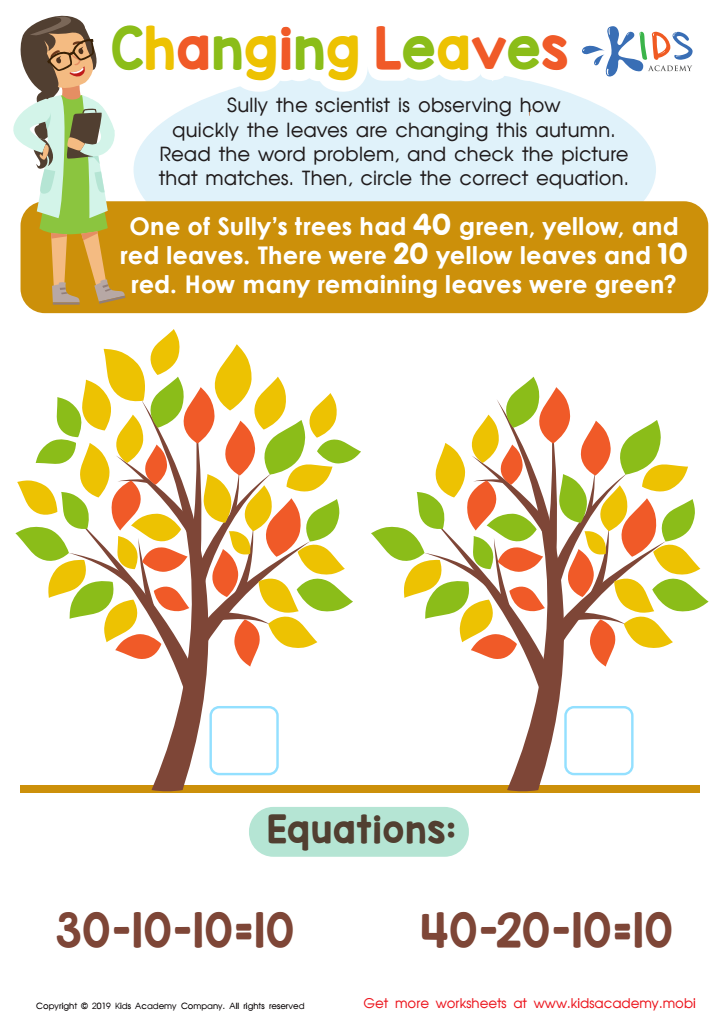
Changing Leaves Worksheet
 Assign to My Students







Understanding seasons and their mathematical implications is crucial for 8-year-olds because it interconnects various domains of learning, fostering a holistic educational experience. Parents and teachers should prioritize this because it cultivates a deeper understanding of Earth’s natural cycles, enriching both scientific literacy and environmental awareness. By grasping why seasons occur, children learn fundamental concepts in astronomy, such as Earth's orbit around the sun and the axial tilt.
Integrating math into understanding seasons enhances analytical skills. Activities like measuring daylight hours, tracking temperature changes, and observing how shadows vary can help solidify addition, subtraction, fractions, and data interpretation skills. This hands-on application of math in a real-world context demonstrates its relevance beyond the classroom, fostering enthusiasm and curiosity.
Moreover, comprehending seasons helps children develop a sense of time and planning skills by observing long-term changes and patterns. This foundation is essential for future subjects like geography, biology, and meteorology, creating a continuum of learning.
By engaging children in this integrative approach, parents and teachers not only improve cognitive abilities but also nurture a lifelong appreciation for the natural world, paving the way for more informed and environmentally-conscious citizens. Overall, understanding seasons isn't just about science or math; it's about creating interconnected, meaningful learning experiences that stick with children.








