Identifying shapes Worksheets for 9-Year-Olds
4 filtered results
-
From - To
Discover engaging "Identifying Shapes Worksheets for 9-Year-Olds" designed to make geometry fun and educational! These printable worksheets from Kids Academy challenge students to recognize, classify, and analyze various geometric shapes, enhancing their visual-spatial skills. Perfect for classroom or home use, each worksheet is crafted by educators to build essential math foundations. Your child will enjoy interactive activities that balance learning with play, boosting their confidence and knowledge. Transform math lessons into exciting adventures with our expertly designed worksheets, and watch your 9-year-old's understanding of shapes soar. Explore now and bring shapes to life!
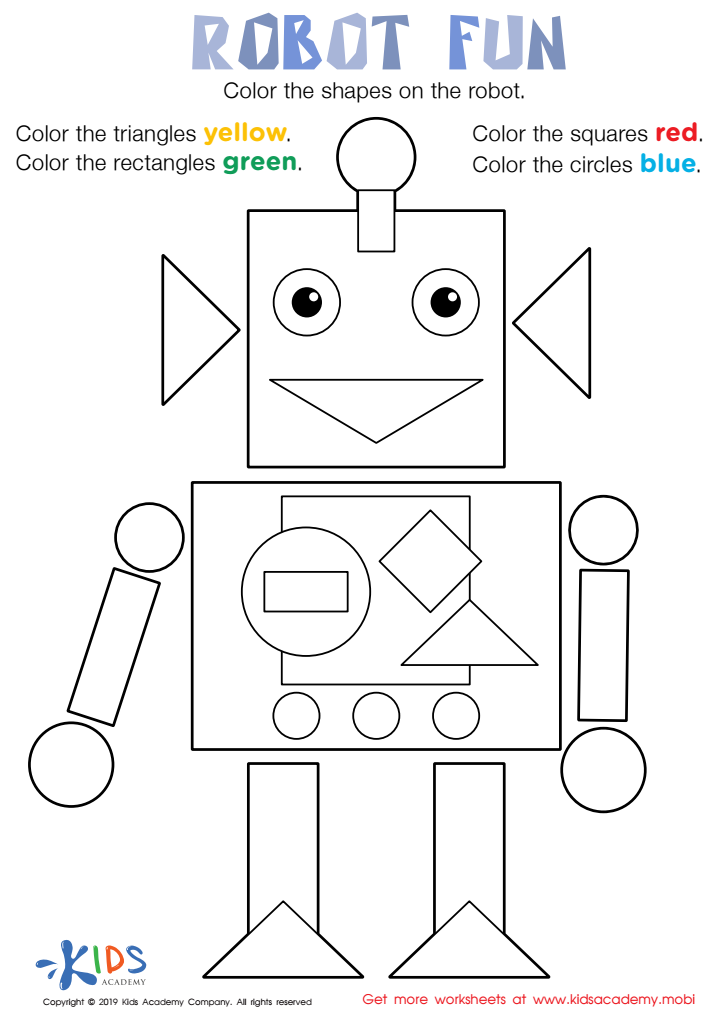
Robot Fun Worksheet
 Assign to My Students



.jpg)


Identifying shapes is a foundational skill that plays a critical role in a 9-year-old's cognitive and academic development. Recognizing and understanding shapes is not limited to mere visual discrimination; it's a building block for more complex mathematical and geometrical concepts. When children identify shapes, they enhance their spatial awareness, a skill indispensable for problem solving in daily life and in future STEM fields.
Shapes serve as the introduction to geometry, allowing children to grasp concepts like symmetry, area, and volume, ultimately leading to improved mathematical thinking. Additionally, shape recognition helps improve other crucial cognitive skills, such as pattern recognition and logical reasoning, which are vital for overall academic success. For instance, understanding the properties of different shapes can significantly aid in tasks such as organizing information, understanding graphs, and solving puzzles.
Beyond the academic realm, identifying shapes sharpens fine motor skills and hand-eye coordination, which are necessary for writing and various other activities. Socially and emotionally, mastering shape recognition boosts a child's confidence as they feel more competent in classroom tasks and real-world environments. Hence, it is essential for parents and teachers to nurture this skill, as it not only supports academic proficiency but also contributes to holistic development.








