
Real-life application Addition & Subtraction Worksheets for 9-Year-Olds
3 filtered results
Difficulty Level
Grade
Age
-
From - To
Subject
Activity
Standards
Our "Real-life Application Addition & Subtraction Worksheets for 9-Year-Olds" provide engaging activities that connect math lessons to everyday situations. Ideal for third graders, these worksheets help children enhance their arithmetic skills through realistic problems. By using scenarios they can relate to, students practice addition and subtraction in contexts like shopping, cooking, and budgeting. This practical approach not only boosts their mathematical proficiency but also demonstrates the value of math in the real world. Designed by education experts, these worksheets are perfect for both classroom and at-home learning, making math both fun and relevant.
Favorites
With answer key
Interactive
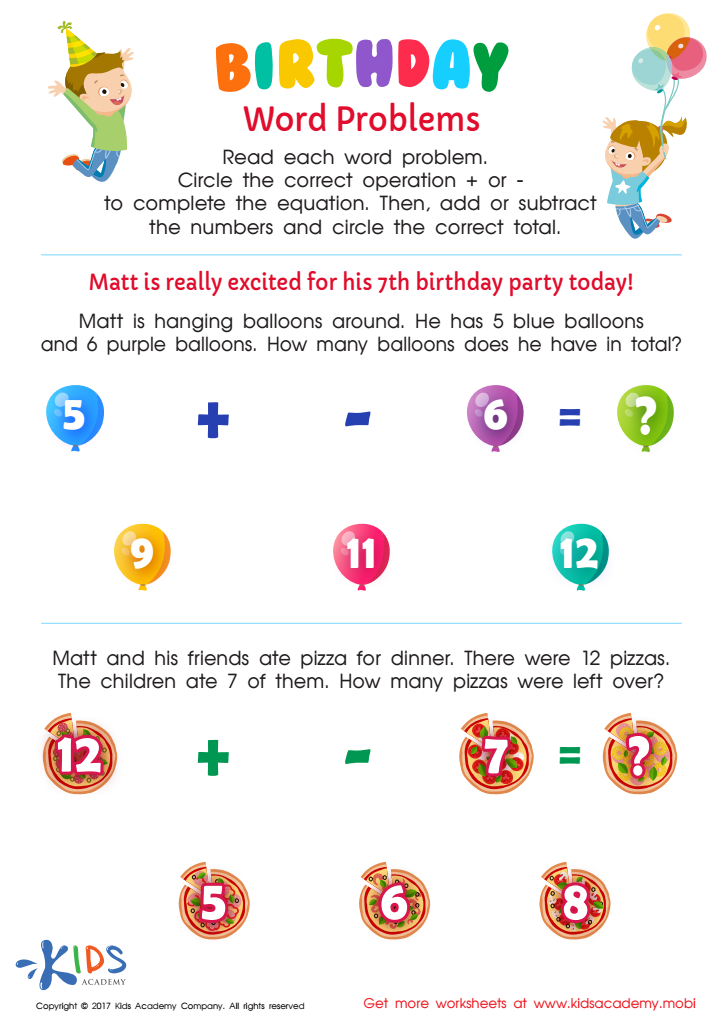
Birthday Word Problems Substraction Worksheet
This worksheet, Birthday Word Problems, is a great way to improve your child's math and literacy skills. It features tricky subtraction equations based on a birthday celebration - perfect for kids who love birthdays!
 Assign to My Students
Birthday Word Problems Substraction Worksheet
Worksheet
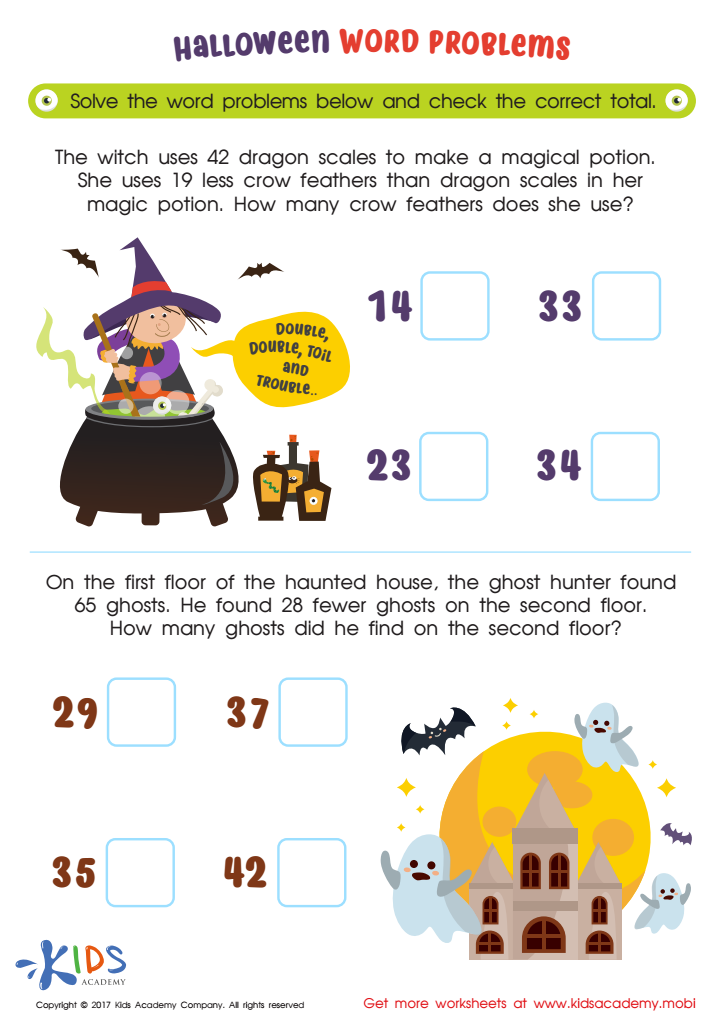
Halloween Word Problems Printable
Ghosts, witches, and other spooky characters make these problems exciting and interactive. Get ready to have some math fun!
Halloween Word Problems Printable
Worksheet
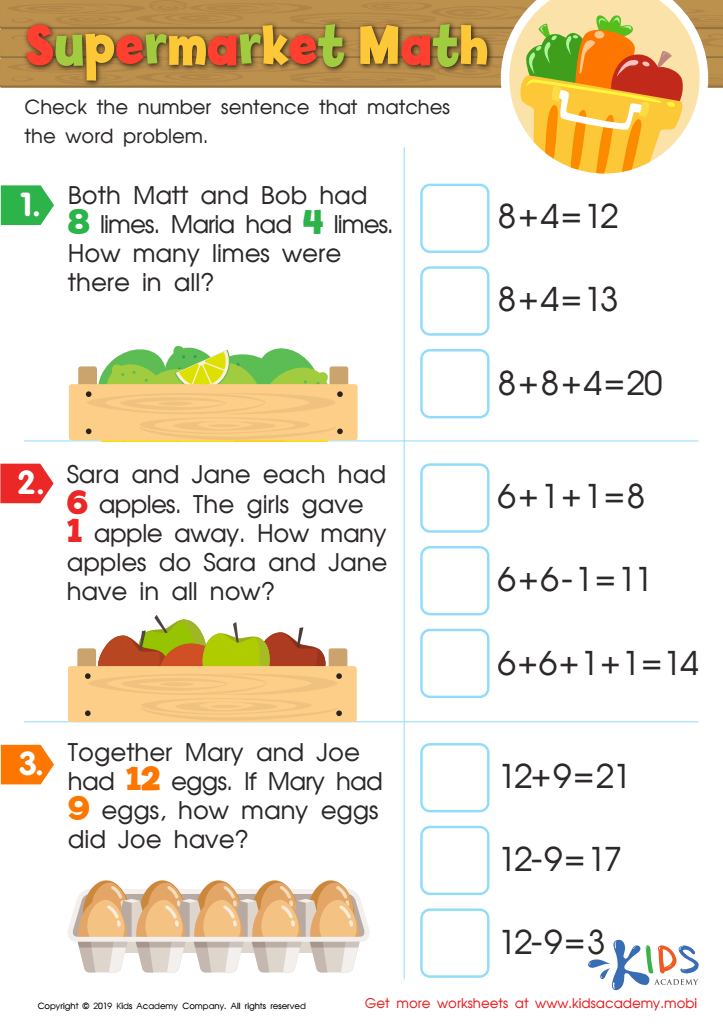
Supermarket Math Worksheet
Take your kids to the supermarket and ask what they're looking forward to buying. Help them solve the three questions in the worksheet by interpreting each one into an equation, then choose the right answer.
Supermarket Math Worksheet
Worksheet
Join Kids Academy for Free
Who is primarily going to use this learning content?








Parents and teachers should care about real-life application addition and subtraction for 9-year-olds because it lays the groundwork for essential life skills and encourages deeper comprehension of mathematical concepts. When children see how addition and subtraction are woven into everyday activities, such as shopping, cooking, and planning, they recognize the subject's practical value and build motivation to engage and succeed academically.
Understanding real-life application also enhances problem-solving abilities. For instance, a child who knows how to budget an allowance or calculate change during a purchase gains skills in logical reasoning and resource management. This hands-on experience fosters independence and confidence in handling day-to-day tasks.
Fostering these skills aligns with cognitive development at this age, supporting meaningful retention. Through engaging scenarios, children are less likely to view math as abstract or disconnected from their world. Real-life applications turn math into interactive narratives, bridging the gap between theoretical learning and practical implementation.
Furthermore, demonstrating the utility of addition and subtraction encourages perseverance. When children encounter challenges in mathematics, relatable applications remind them of previous successes and functional aspects, driving more determined and consistent effort.
In summary, the real-life application of addition and subtraction serves to empower 9-year-olds with practical knowledge, foster cognitive development, increase academic motivation, promote independence, and bolster problem-solving capabilities critical for their future.








