Critical thinking skills Addition Worksheets for 9-Year-Olds
3 filtered results
-
From - To
Enhance your 9-year-old's critical thinking skills with our engaging addition worksheets! Designed specifically for young learners, these worksheets encourage children to explore, analyze, and solve various addition problems while stimulating their cognitive abilities. Our carefully crafted exercises challenge students to think critically about numbers, develop problem-solving strategies, and improve their mathematical reasoning. Each worksheet combines fun activities with educational content, ensuring a well-rounded learning experience. By integrating critical thinking into addition practice, childen will build a solid foundation for future mathematics success. Explore our collection of printable worksheets today and empower your child with the skills they need for academic achievement!
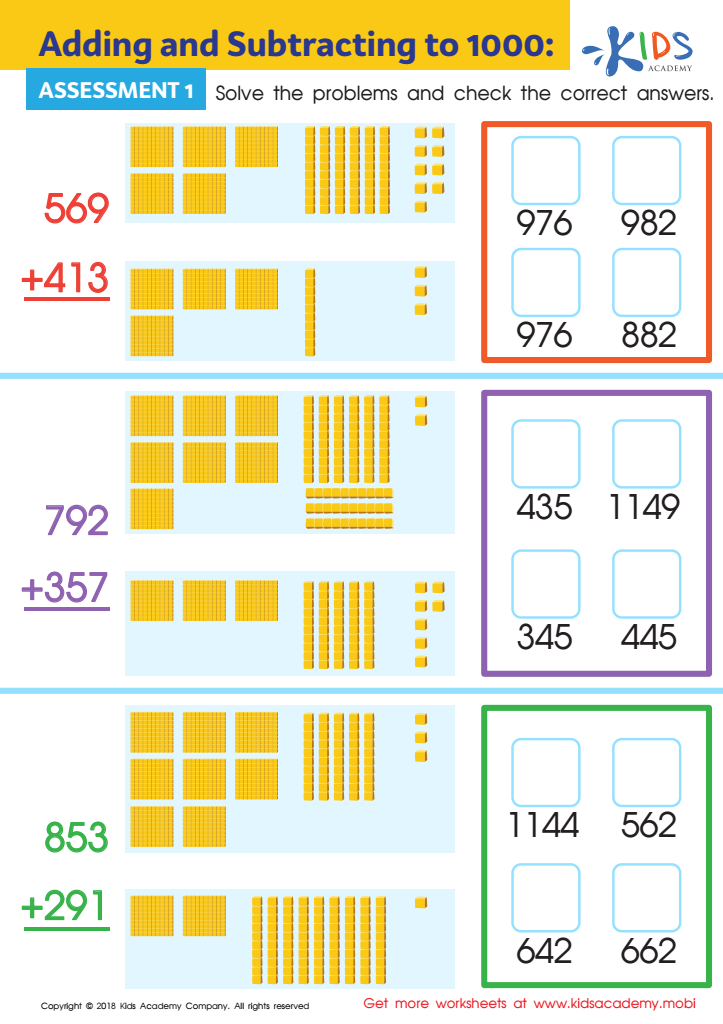
Adding and Subtracting to 1 Worksheet: Assessment 1
 Assign to My Students





.jpg)


Critical thinking skills are vital for 9-year-olds as they significantly impact a child's academic and personal growth. At this age, children begin to think more independently and can analyze information rather than simply memorizing it. Encouraging critical thinking helps them make informed decisions, solve problems creatively, and understand the importance of evidence in forming opinions.
For parents and teachers, nurturing critical thinking enhances students' ability to engage with complex subjects across various disciplines. In subjects like mathematics, critical thinking encourages children to explore diverse methods to reach a solution, fostering a deeper understanding of concepts like addition rather than rote memorization of facts. This kind of engagement builds a strong foundation for future learning.
Additionally, critical thinking skills prepare children for real-world challenges, helping them navigate social situations and ethical dilemmas. It promotes resilience as they learn to assess situations, weigh options, and formulate responses.
By prioritizing critical thinking in educational practices and home environments, parents and teachers equip children with essential tools that promote lifelong learning, adaptability, and success in an increasingly complex world. This investment in their development creates critically thoughtful individuals, capable of contributing positively to society.








