Sorting Worksheets for Ages 4-5 - Page 2
25 filtered results
-
From - To
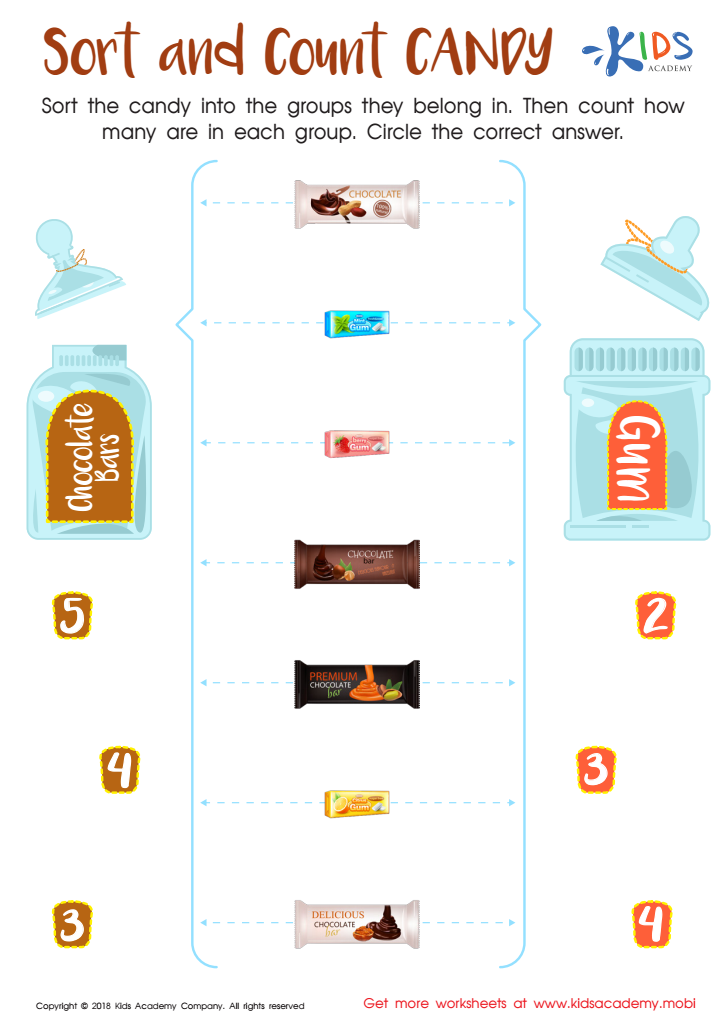
Sort and Count Candy Worksheet
 Assign to My Students








Why Worksheets on Sorting for Ages 4-5 are Invaluable
In the foundational years of learning, ages 4 to 5, children's minds are incredibly receptive to new concepts and ideas. This makes it the ideal time to introduce essential skills such as sorting. Worksheets on sorting for ages 4-5 are particularly beneficial for several reasons.
Firstly, sorting activities help develop critical thinking and problem-solving skills. Through sorting, young learners begin to understand categorization—a fundamental aspect of logical reasoning. They learn to group objects based on similarities and differences, laying the groundwork for mathematical thinking and scientific classification.
Secondly, these worksheets enhance observational skills. Children become more attentive to details as they discern which characteristics determine the grouping of items. This keen observation is crucial not only in academic pursuits but in everyday life.
Moreover, sorting worksheets for ages 4-5 are designed to be engaging and interactive. They often incorporate colorful images and relatable objects, making the learning process enjoyable and less intimidating for young minds. This fosters a positive attitude towards learning and education, a mindset that is beneficial throughout their schooling years.
Lastly, these activities support the development of fine motor skills. As children manipulate pieces to sort them appropriately, they refine their hand-eye coordination and dexterity.
In conclusion, worksheets on sorting for ages 4-5 are invaluable tools in the educational journey of young learners. They lay a solid foundation for critical thinking, enhance observational skills, promote engagement, and support physical development—all through the simple yet profound activity of sorting.








