Easy Two-step Word Problems Worksheets for Ages 4-5
5 filtered results
-
From - To
Introducing our Easy Two-step Word Problems worksheets, the perfect learning printables for children aged 4-5 years! Designed to ignite curiosity and enhance early math skills, these worksheets guide young learners through the fundamentals of problem-solving in a fun and interactive way. Each sheet is carefully crafted to build confidence in two-step reasoning with simple, age-appropriate questions that captivate and challenge young minds. With vibrant illustrations and clear instructions, our worksheets make learning engaging and accessible. Watch your child's numerical and logical skills flourish with our thoughtfully developed educational resources!
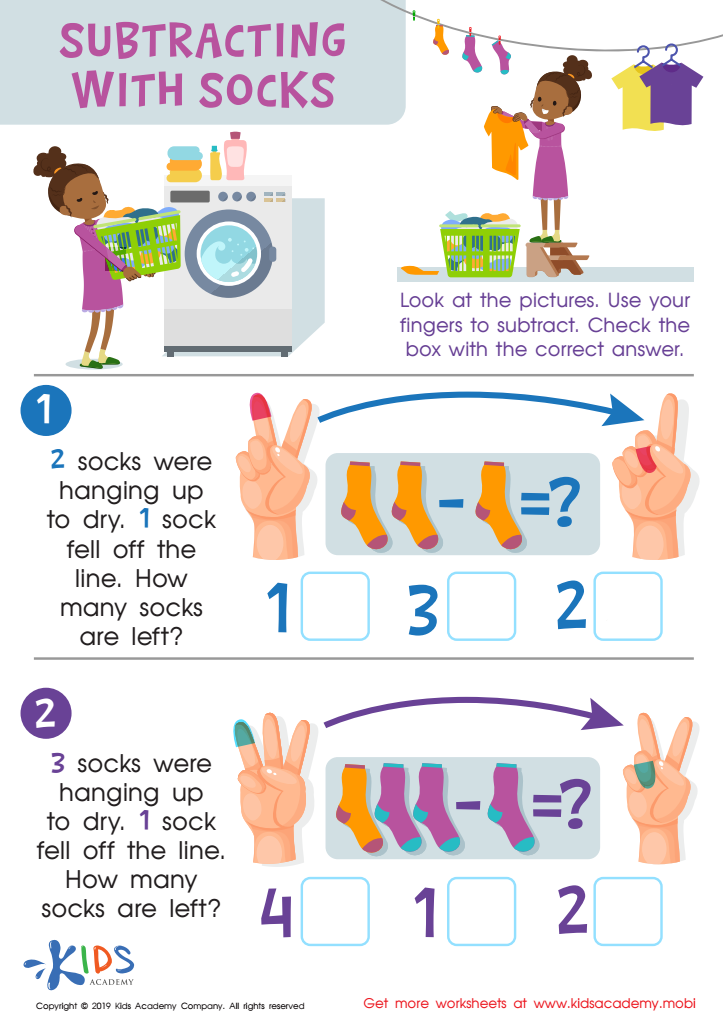
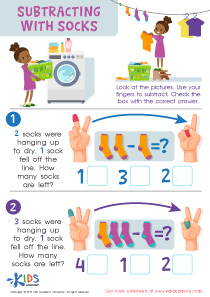
Subtracting Socks Worksheet
 Assign to My Students
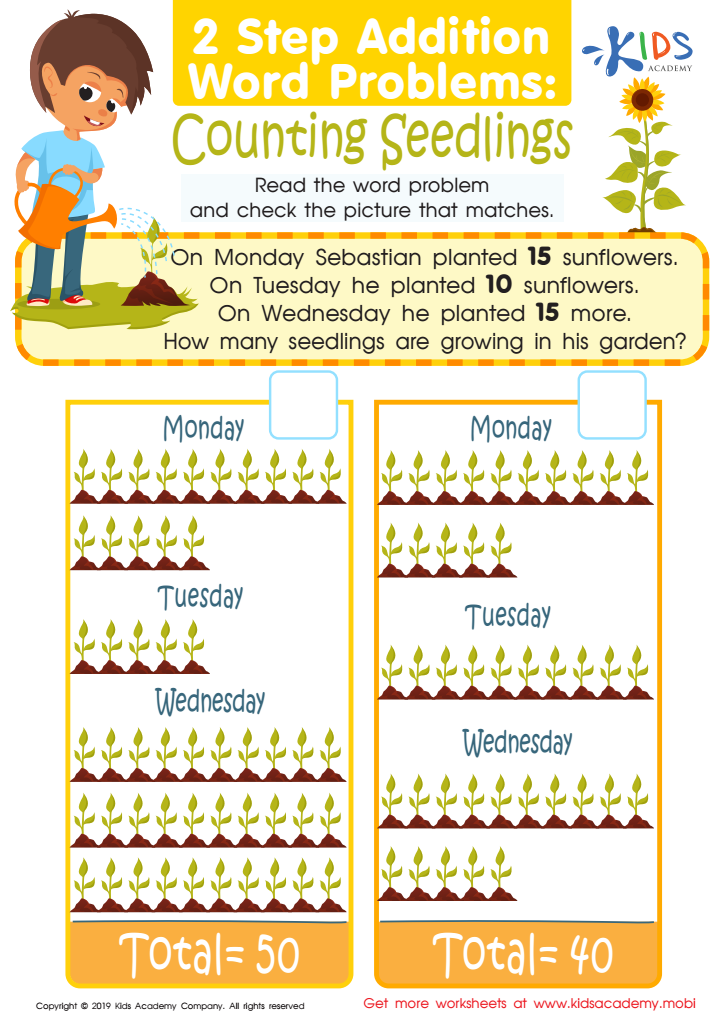
Counting Seedlings Worksheet
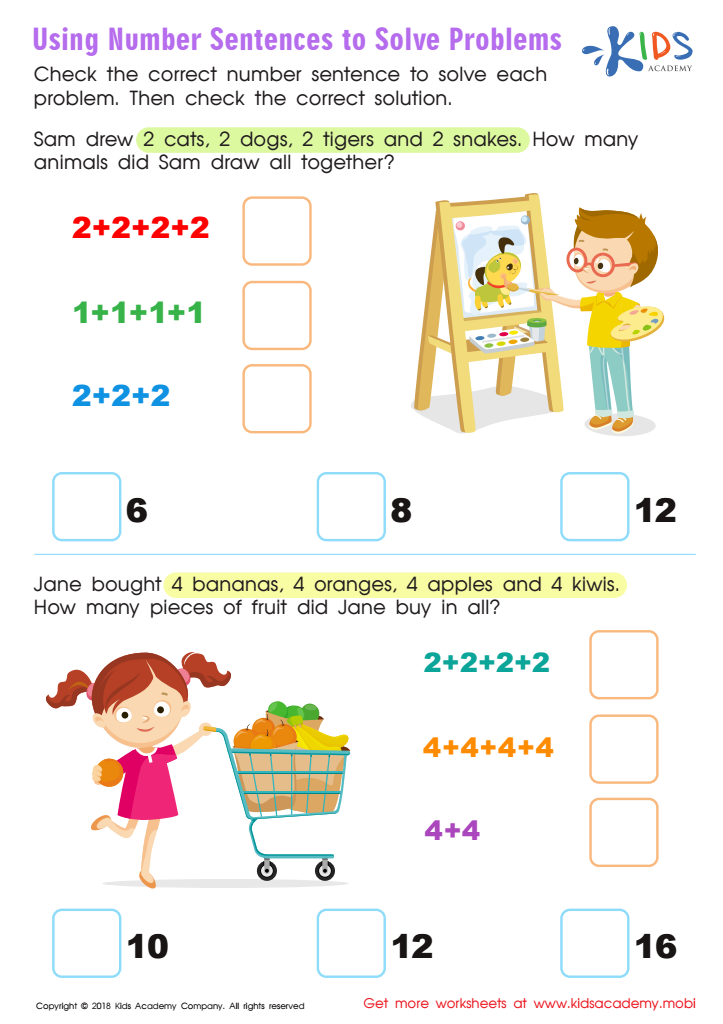
Using Number Sentences to Solve Problems Worksheet
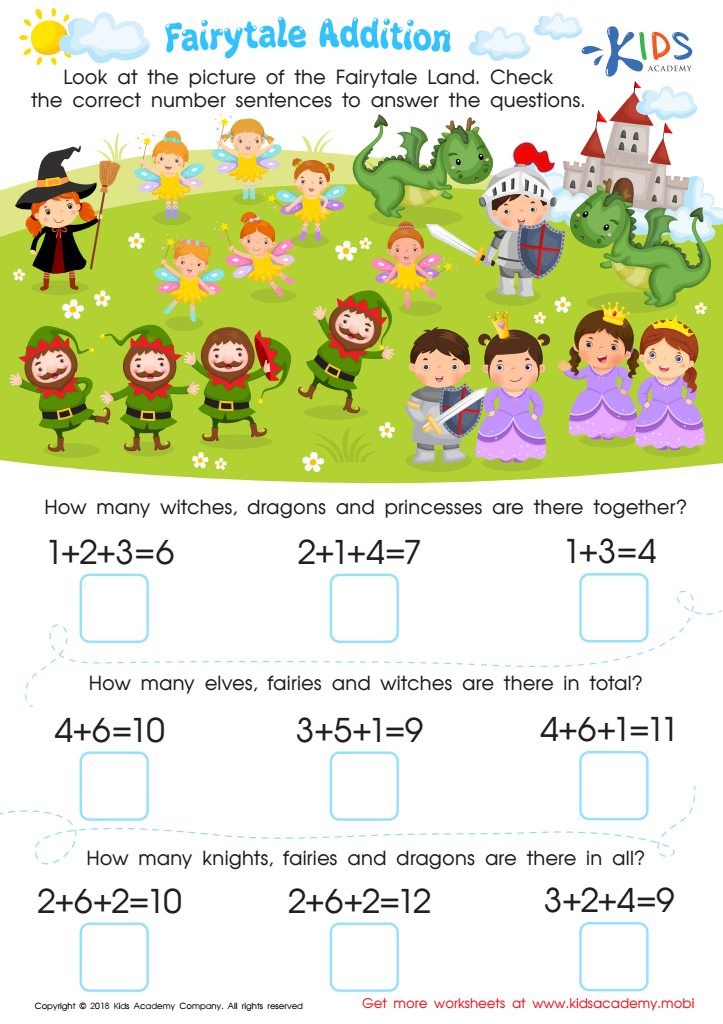
Fairytale Addition Worksheet
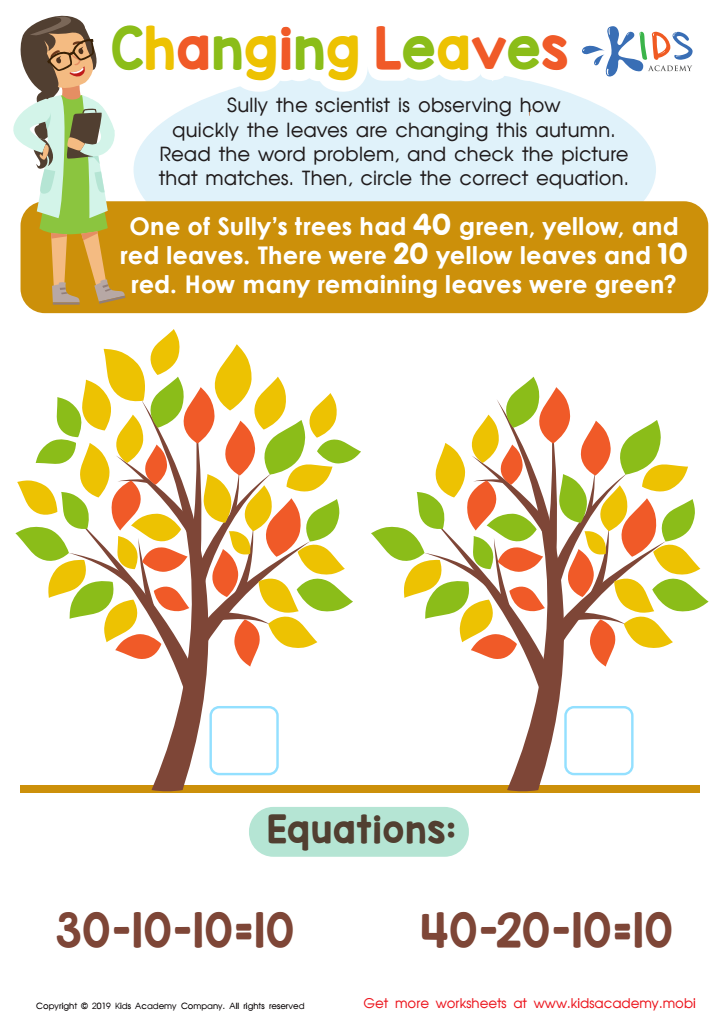
Changing Leaves Worksheet



Easy worksheets on two-step word problems are an excellent resource for young children, especially those aged 4-5 years, to develop their early math and problem-solving skills. These tools are particularly useful when incorporated into learning online worksheets, which offer a flexible and interactive approach to education.
Why Are Easy Worksheets on Two-step Word Problems Useful?
-
Building Foundation for Math Skills: Two-step word problems are essential in laying the groundwork for more complex mathematical concepts. At ages 4-5, children are just beginning to understand numbers and basic arithmetic such as addition and subtraction. Easy worksheets help break down these concepts into manageable steps, ensuring that young learners grasp the logic behind each mathematical operation.
-
Enhancing Problem-Solving Abilities: Problem-solving is a critical skill that goes beyond mathematics. By working through two-step word problems, children learn to think sequentially and logically. They first have to understand the problem, figure out what is being asked, and then determine the steps necessary to arrive at a solution. This process enhances their analytical thinking and reasoning skills, which are valuable in all areas of learning.
-
Promoting Reading and Comprehension Skills: Two-step word problems require children to read and comprehend the question before they can solve it. This practice integrates literacy into math learning, promoting an interdisciplinary approach that benefits young learners. As they interpret the problems, they improve their reading comprehension and vocabulary, making them better communicators.
-
Interactive Learning Experience: With the advent of learning online worksheets, two-step word problems become even more engaging for kids. Digital platforms often incorporate animations, interactive elements, and instant feedback, which enhance the learning experience. Children feel like they are playing a game, which keeps them engaged and motivated to solve more problems.
-
Instant Feedback and Adaptability: Learning online worksheets provide immediate feedback, a crucial feature for young learners. When children understand what mistakes they’ve made right away, it becomes easier for them to learn the correct concepts and avoid repeating errors. Additionally, online platforms can adapt the difficulty of problems based on the child’s performance, providing a personalized learning experience that caters to the individual needs of each student.
-
Parental and Teacher Involvement: Easy worksheets on two-step word problems also facilitate greater involvement from parents and teachers. Online resources allow educators and parents to track the child’s progress, identify areas where they might be struggling, and provide targeted help to improve their understanding and skills. This collaborative approach not only supports the child's learning but also enables adults to be more effectively involved in the educational journey of their young ones.
-
Encouraging Independence and Confidence: As children work through easy worksheets on two-step word problems, they gradually build confidence in their ability to tackle challenges independently. This sense of achievement is crucial for their self-esteem and encourages them to take on new and more complex tasks. Mastering each problem gives them a feeling of accomplishment that fuels their desire to learn and grow.
-
Preparation for Future Educational Success: Early exposure to structured problem-solving, as provided by these worksheets, prepares children for the academic demands of higher grades. Skills developed through solving two-step word problems — such as logical thinking, persistence, and the ability to follow complex instructions — are foundational for success in subjects such as science, technology, and engineering, aside from advanced mathematics.
-
Fun and Engaging Learning: Making learning fun is a critical aspect of educational activities for young children. Easy worksheets on two-step word problems can be designed with colorful images, familiar scenarios, and playful contexts that resonate with the young mind. This approach helps in maintaining a child’s interest and attention, making learning a delightful experience rather than a chore.
-
Accessibility and Convenience: Learning online worksheets are incredibly accessible. They can be accessed from any device with an internet connection, whether it's a computer, tablet, or smartphone. This makes it convenient for children to practice problem-solving skills at home or on the go, fitting easily into different lifestyles and schedules.
Conclusion
Easy worksheets on two-step word problems are more than just an educational resource; they are a comprehensive tool that supports the holistic development of young children. By integrating these worksheets within learning online platforms, educators and parents can provide an engaging, interactive, and adaptable learning environment. This not only enhances the children's mathematical and literacy skills but also nurtures a lifelong love for learning and exploration. As we continue to embrace digital education tools, the importance of such resources in early childhood education becomes increasingly apparent, paving the way for a generation of well-rounded, confident, and skilled learners.