Normal Graph Word Problems Worksheets for Ages 7-8
1 filtered results
-
From - To
Introduce your 7-8-year-olds to the fascinating world of graph interpretation with our Normal Graph Word Problems worksheets! Designed to blend fun with learning, these educational homework sheets are perfect for young learners to develop analytical and problem-solving skills. Each sheet is filled with engaging, age-appropriate problems that make children think and learn how to draw conclusions from simple graphs. Ideal for both classroom and home use, these worksheets will build a strong foundation in handling basic data and graph reading, setting the stage for more advanced math skills. Make learning an adventure with our expertly crafted educational tools!
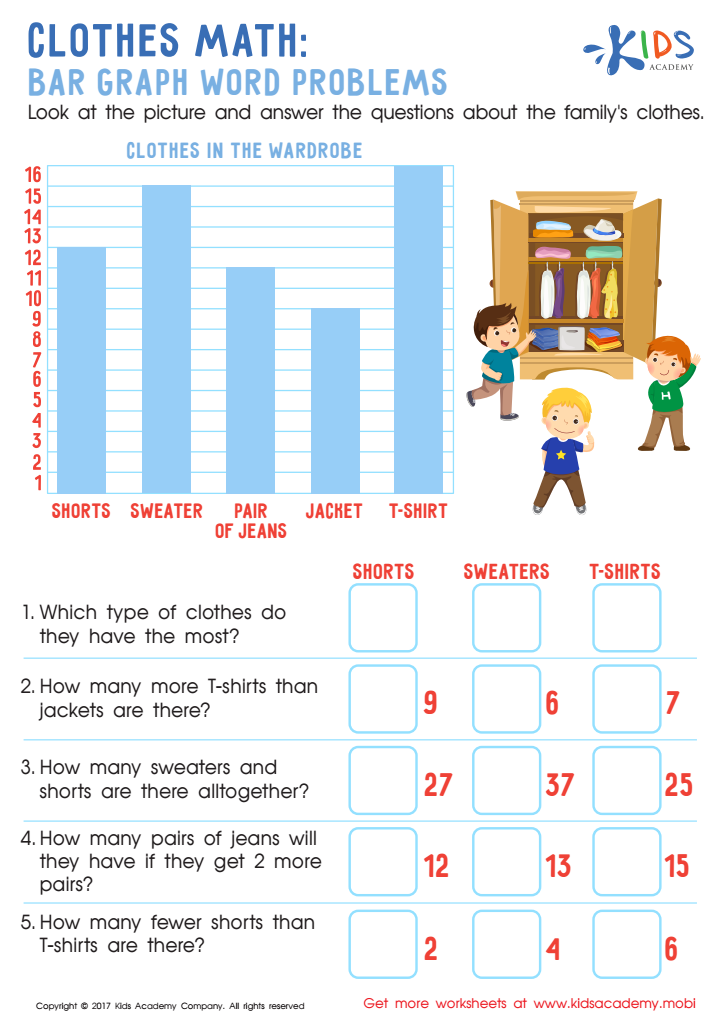
Clothes Math: Bar Graph Word Problems Worksheet
 Assign to My Students



Normal worksheets on Graph Word Problems are an excellent educational tool, particularly for children aged 7-8 years. These school worksheets are meticulously designed to align with key educational goals, helping children develop a strong foundation in both mathematics and critical thinking skills. Let's delve into why these worksheets are so beneficial for young learners.
Firstly, graph word problems are instrumental in introducing children to the concept of data representation and interpretation. At the ages of 7 and 8, children are just beginning to understand the world in more complex ways. Using school worksheets that focus on graph word problems allows them to engage with real-world scenarios where they need to apply their mathematical skills. For instance, a typical problem might ask students to help organize a school event by interpreting a bar graph on student preferences for different activities. This not only makes learning fun but also shows them the practical application of math.
Moreover, these worksheets enhance children's ability to think logically and solve problems. Since graph word problems often involve several steps to reach a solution, children learn to follow a sequence of operations. This is critical as it helps develop their reasoning and analytical skills. As they interpret data from graphs, they learn to draw conclusions and make predictions based on the information presented. This process is crucial in fostering a methodical approach to problem-solving, a skill that will benefit them across all subjects and in everyday life.
Additionally, working with graphs improves children’s numerical skills. They learn about different types of graphs such as bar graphs, line graphs, and pie charts. Each type requires a specific interpretation that enhances their ability to work with numbers and understand concepts such as scale, increments, and data clusters. School worksheets provide structured practice in these areas, ensuring children gain confidence in their numerical abilities while also understanding how to apply these concepts in varied contexts.
Critical to this age group is the development of literacy skills, and graph word problems contribute significantly in this area. These problems often come phrased in a story format, requiring children to extract mathematical questions from a block of text. This not only improves their reading comprehension but also teaches them to identify key mathematical terms and understand their context within a broader narrative. This dual focus on literacy and numeracy enriches their learning experience and helps build multifaceted competence.
Finally, school worksheets on graph word problems are designed to be engaging. They often include colorful graphics and are themed around interesting topics such as sports, holidays, or animals. This captures the imagination of young learners and keeps them engaged with the material , ensuring they remain motivated and interested in the subject matter. Engagement is crucial at this developmental stage, as it encourages a positive attitude towards learning that can persist throughout their educational journey.
Moreover, these types of worksheets often include collaborative elements, encouraging children to work together to solve problems. This can be particularly beneficial as it fosters teamwork and communication skills. Children learn to discuss ideas, explain their reasoning, and listen to others' perspectives, all of which are essential skills both inside and outside the classroom.
Incorporating technology can also enhance the effectiveness of these worksheets. Many educational platforms allow children to interact with graphs digitally, offering a hands-on experience with immediate feedback. This interactive approach can help solidify concepts and make learning about graphs even more dynamic and accessible.
Furthermore, regular practice with graph word problems through school worksheets ensures that children are well-prepared for higher educational levels. Concepts introduced through these worksheets lay the groundwork for more advanced mathematical studies and analytical tasks that they will encounter later in their academic careers.
Parents and teachers can also use these worksheets as a tool for assessment. By observing how children solve these problems, they can identify areas where a child might be excelling or needing extra help. This can guide personalized instruction and targeted interventions, ensuring that each child receives the support they need to succeed.
In conclusion, normal worksheets on graph word problems are more than just paper tasks; they are a comprehensive educational tool that helps children aged 7-8 develop a multitude of skills. From enhancing numerical and literacy skills to fostering critical thinking and problem-solving abilities, these school worksheets prepare children for future academic challenges and real-world situations. Engaging, educational, and essential, these worksheets are a staple in the learning toolkit for young students.