Chess strategy understanding Easy Chess Worksheets for Ages 3-6
3 filtered results
Difficulty Level
Grade
Age
-
From - To
Subject
Activity
Standards
Introduce your little ones to the exciting world of chess with our "Chess Strategy Understanding Easy Chess Worksheets" designed specifically for ages 3-6. These engaging worksheets help cultivate critical thinking and problem-solving skills through fun activities that simplify chess concepts. Children will learn essential strategies, recognize pieces, and develop their strategic mindset while enjoying a playful approach to learning. Our worksheets are colorful, easy to follow, and perfect for both home and classroom use. Start your child’s journey into chess with a foundation that promotes creativity, focus, and cognitive development—all while having a great time! Explore our resources today!
Favorites
With answer key
Interactive
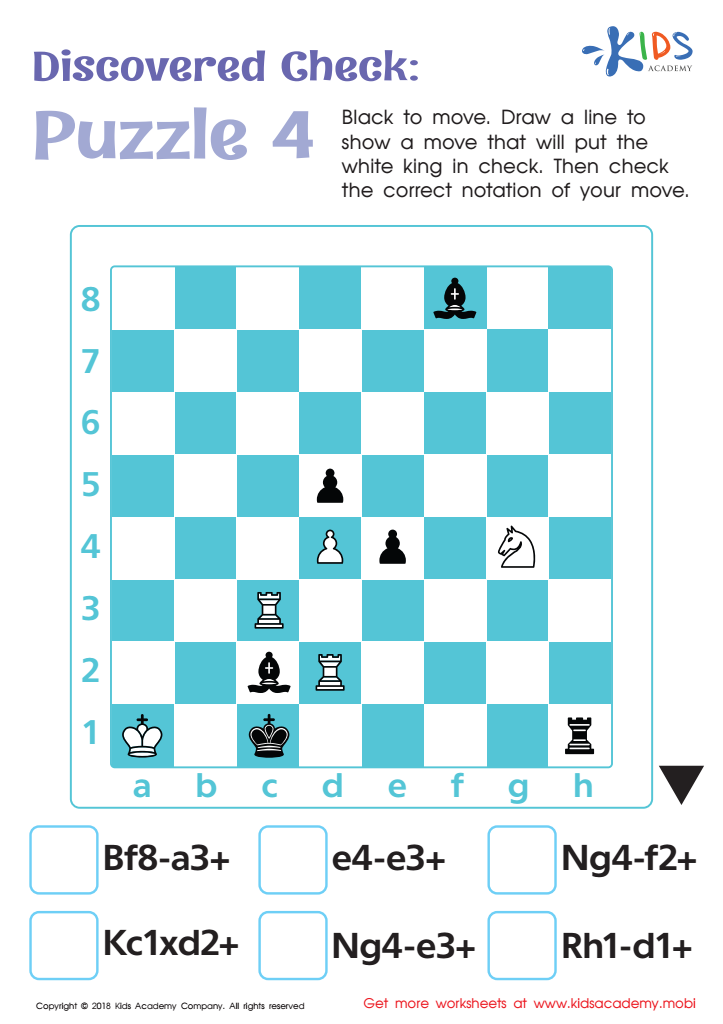
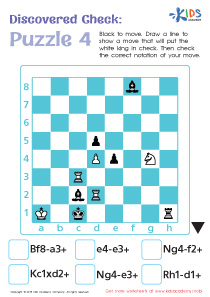
Discovered Check: Puzzle 4 Worksheet
Let your child test their chess skills with this easy worksheet. Have them take control of the black pieces and try to put the white king in checkmate. Ask them to draw a line from their chess piece to the white king, showing the move they'll make, then check the correct answer.
Discovered Check: Puzzle 4 Worksheet
Worksheet

Discovered Check: Puzzle 2 Worksheet
This worksheet exercise will stimulate your child's thinking and let them show off their chess skills. Ask them to use the white pieces and draw a line, pointing to the move that will put the black king in checkmate. Then they should check the correct option. Challenge your child and help them learn more about chess with this fun and educative activity.
Discovered Check: Puzzle 2 Worksheet
Worksheet
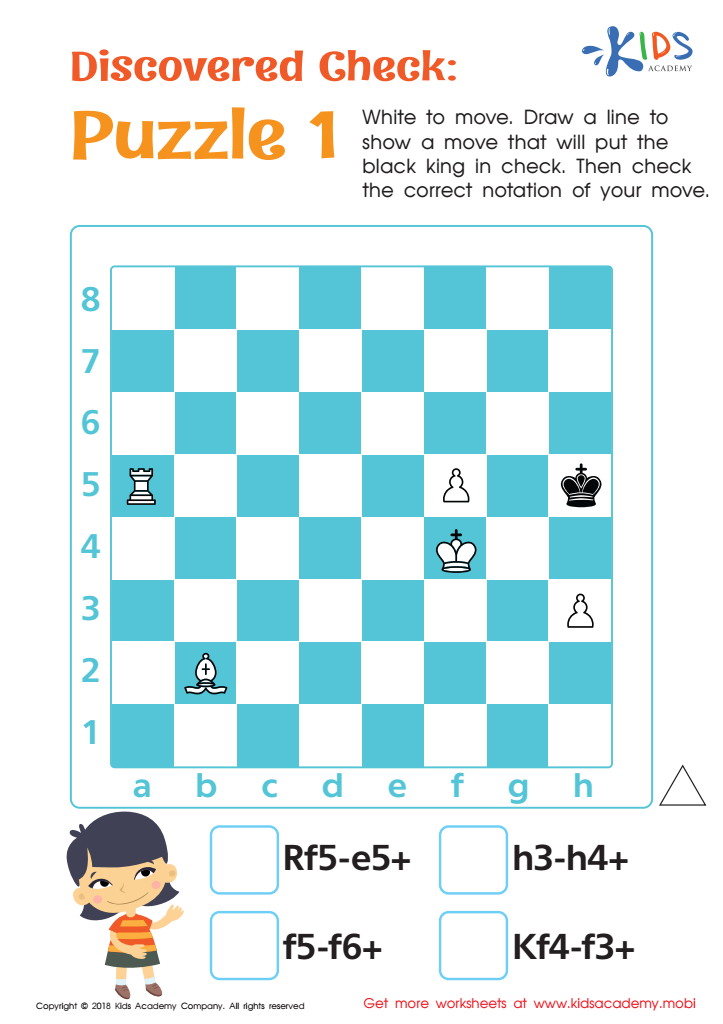
Discovered Check: Puzzle 1 Worksheet
Chess is an excellent way to engage your kids' brains and strengthen thinking skills. This worksheet is ideal for inspiring and growing their interest in the game. Have your child take the white pieces and move them to checkmate the black king. Compare their move against the provided notations to check accuracy.
Discovered Check: Puzzle 1 Worksheet
Worksheet
Join Kids Academy for Free
Who is primarily going to use this learning content?





Teaching young children aged 3-6 the fundamentals of chess strategy is both valuable and enjoyable. Effective chess education enhances critical thinking, problem-solving skills, and encourages patience as children learn to consider multiple moves ahead, fostering an early appreciation for strategy and planning. These skills are transferable beyond the chessboard, aiding cognitive development in subjects like math and science.
Additionally, chess promotes social skills. When children play together, they develop respectful communication, turn-taking, and sportsmanship, laying the groundwork for collaboration and friendship. Engaging with others in chess helps children to navigate winning and losing gracefully, contributing to emotional intelligence.
Moreover, chess is an inclusive activity suitable for diverse backgrounds and abilities, allowing for individualized learning experiences tailored to each child's pace. Introducing chess at an early age taps into children's natural curiosity, making learning fun while reinforcing concentration and focus.
Ultimately, the understanding of chess strategy provides children not only with a game to enjoy but also with life skills that enhance their overall personal growth and academic performance. For parents and teachers, fostering an early affinity for chess can set the stage for lifelong benefits, enriching children's educational journey and life experiences.