Problem-Solving Skills Easy Addition & Subtraction Worksheets for Ages 3-6 - Page 2
25 filtered results
-
From - To
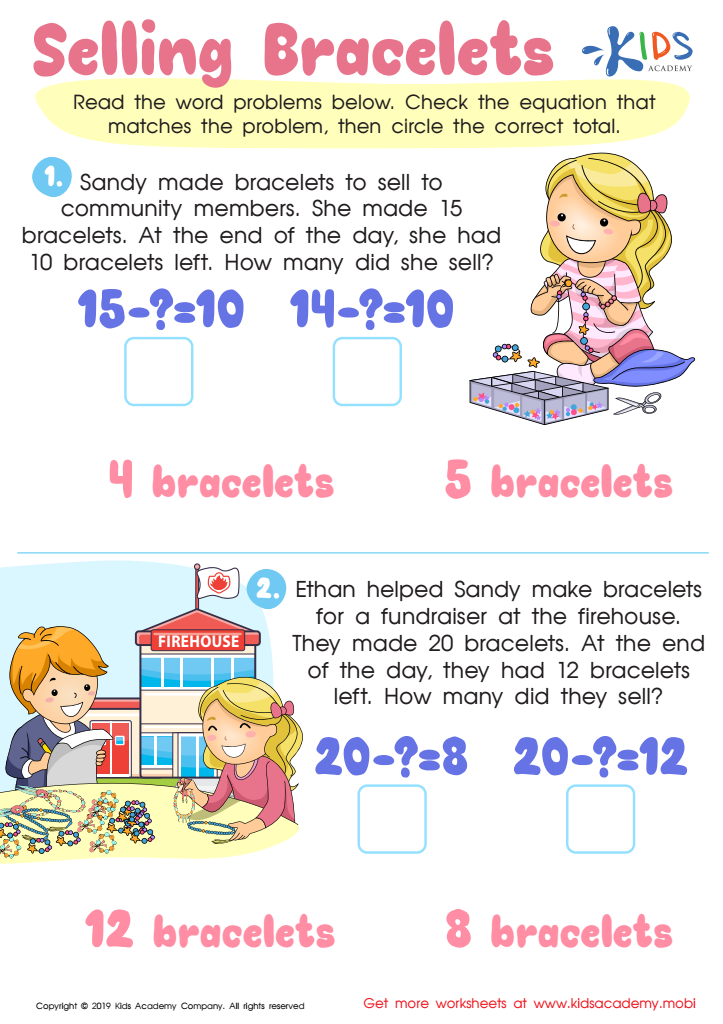
Selling the Bracelets Worksheet
 Assign to My Students








Parents and teachers should pay significant attention to developing problem-solving skills through easy addition and subtraction for children ages 3-6 because it lays a crucial foundation for their cognitive and academic growth. At this formative stage, children's brains are rapidly developing, and engaging them in basic arithmetic promotes critical thinking, logical reasoning, and numerical understanding.
Easy addition and subtraction serve as the building blocks of math, helping young learners grasp fundamental concepts that will be expanded upon as they progress through their education. These early encounters with math foster a positive attitude toward the subject, making it less intimidating and more approachable in later years.
Moreover, problem-solving skills in math are closely related to real-world situations, preparing children for everyday decision-making and analytical tasks. By learning to tackle simple problems, children enhance their perseverance, creativity, and ability to ask questions—all essential life skills.
In addition, mastering these basics builds children's confidence and self-esteem. When children experience success in problem-solving, they feel a sense of accomplishment that motivates them to take on more complex challenges.
Ultimately, nurturing problem-solving skills through early arithmetic improves children's overall academic performance, equips them with essential life skills, and fosters a lifelong love for learning, making it a critical focus for both parents and teachers.








