
Comparing heights Easy Math Worksheets for Ages 3-7
3 filtered results
Difficulty Level
Grade
Age
-
From - To
Subject
Activity
Standards
Discover engaging and educational "Comparing Heights Easy Math Worksheets" designed specifically for children ages 3-7. Our fun and interactive worksheets help young learners develop their math skills by comparing the heights of various objects and characters. Easy-to-follow instructions and whimsical illustrations make learning enjoyable and accessible for preschool and early elementary students. These worksheets encourage critical thinking and visual discrimination, laying the foundation for more advanced math concepts. Perfect for use at home or in the classroom, our "Comparing Heights" worksheets are a delightful way to inspire a love for learning in your child!
Favorites
With answer key
Interactive
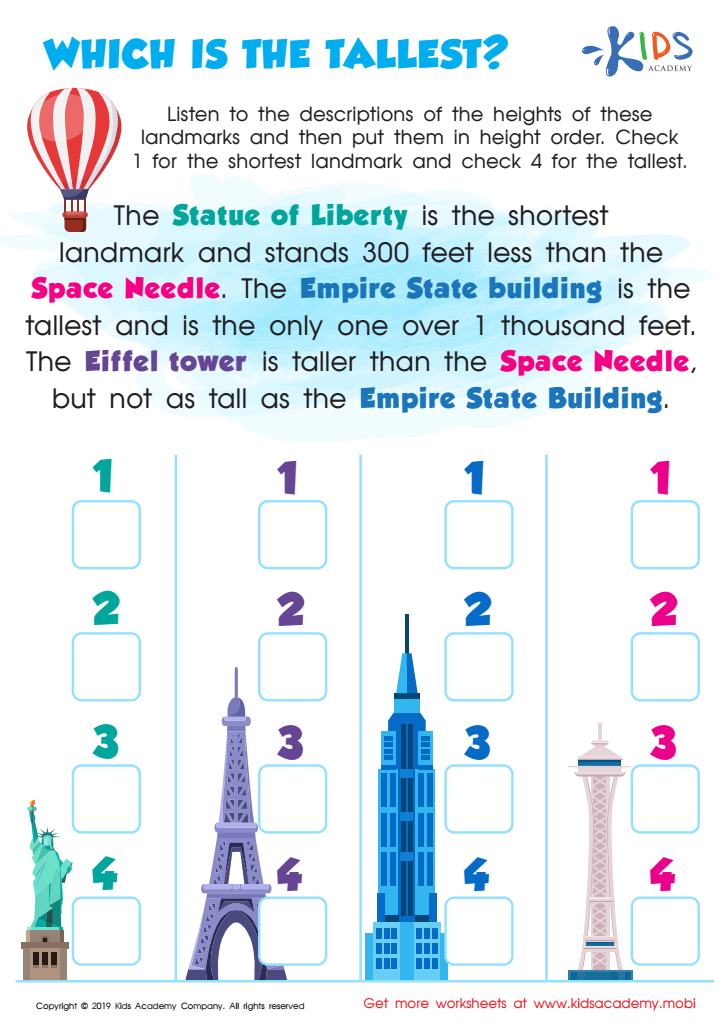
Which is the Tallest? Worksheet
Help your kids arrange the buildings in order of height: highest (4) to lowest (1). Ask them if they can think of other ways things can be measured. Read the texts describing the buildings and check 4 for the tallest and 1 for the shortest.
 Assign to My Students
Which is the Tallest? Worksheet
Worksheet
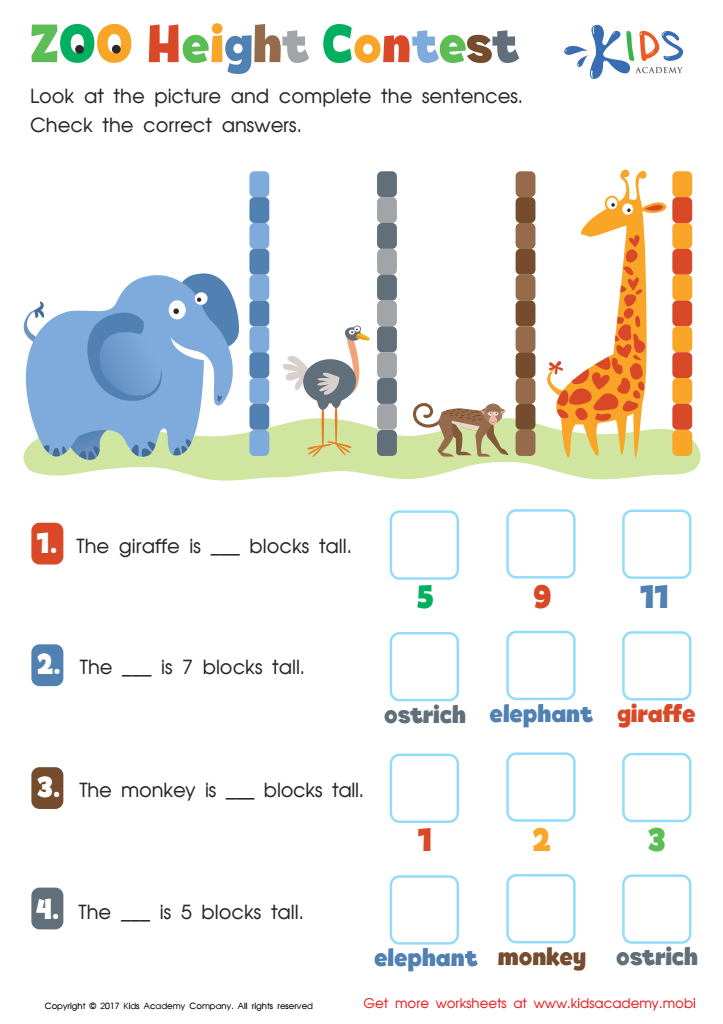
Zoo Height Contest Worksheet
Let's head to the zoo and use colorful blocks to measure your child's favorite animals! With this Kids Academy worksheet, help them practice and prepare for learning measurement. Guide them in looking at the zoo animals and counting blocks to find the height. Then, read the questions and check the box next to the correct answer.
Zoo Height Contest Worksheet
Worksheet
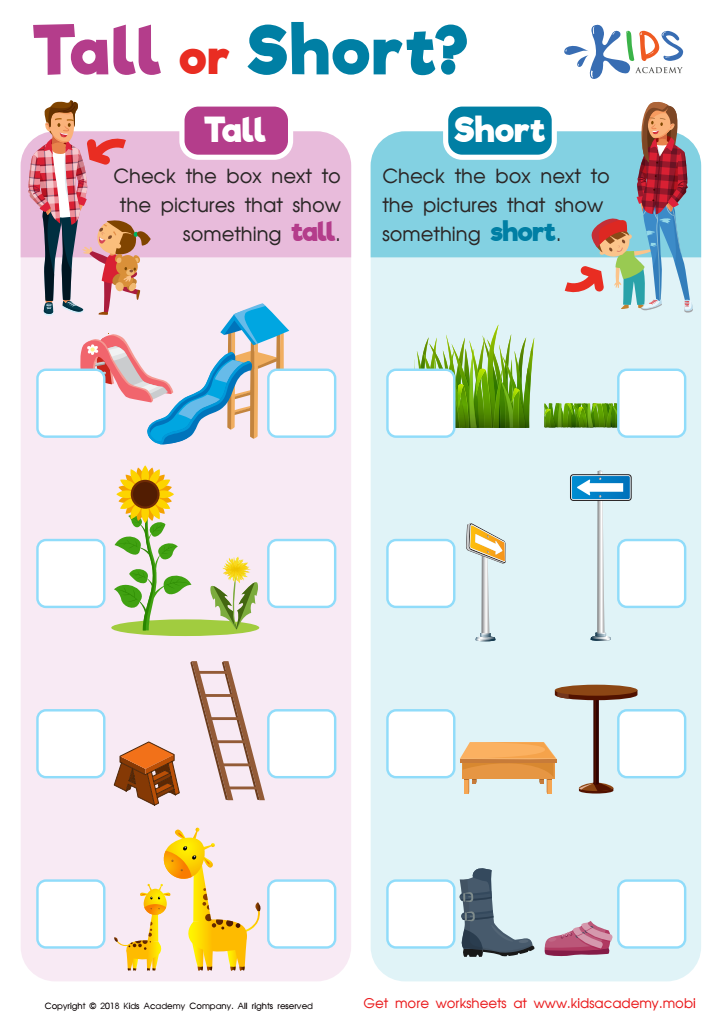
Tall or Short? Worksheet
Comparing tall and short objects is an early math skill. Our free worksheet uses fun colors and pictures to help kids practice. This will give them a head start for higher-level measurement skills, and they'll remember tangible objects for comparison.
Tall or Short? Worksheet
Worksheet
Join Kids Academy for Free
Who is primarily going to use this learning content?








Comparing heights is a foundational skill in early childhood education crucial for kids aged 3-7. At this developmental stage, children are naturally curious about their surroundings and may readily notice and compare the sizes of objects. By encouraging such activities, parents and teachers tap into this curiosity to foster essential cognitive and social growth.
Firstly, comparing heights supports mathematical thinking. It nurtures an understanding of measurement and spatial relationships, key concepts in geometry. Young children learn to use comparative language like "taller," "shorter," or "same height," which lays the groundwork for mathematical reasoning and problem-solving skills.
Secondly, these activities bolster language development. When kids discuss similarities and differences in height, they practice vocabulary, descriptive language, and grammar. For example, phrases like "My toy is taller than yours," teach them effective communication.
Moreover, comparing heights can enhance social skills by promoting cooperation and teamwork. In a group activity, children learn to take turns, share observations, and collaborate towards solving simple problems.
Overall, engaging in height comparison activities is not merely about math; it integrates learning across disciplines and strengthens a child’s holistic development. Parents and teachers should embrace these exercises to support their children's growth, ensuring they develop essential skills in a fun and engaging manner.








