Counting skills Easy Addition and Subtraction Word Problems Worksheets for Ages 3-8

Filters

6 filtered results

Clear all filters
Favorites
With answer key
Interactive

6 filtered results

Difficulty Level

Grade


Discover engaging Counting Skills worksheets focused on easy addition and subtraction word problems for children ages 3-8! Designed to make learning fun, our worksheets provide children with real-life scenarios that enhance their math understanding and boost their problem-solving abilities. Each activity fosters critical thinking as kids practice counting and simple arithmetic in an interactive context. Perfect for home or classroom use, these worksheets promote early math skills and build a strong foundation for future learning. Help your child stay ahead in math with our thoughtfully crafted resources that encourage a love for numbers and promote confidence in their abilities!

Check out this FREE Trial Lesson on Addition and Subtraction Word Problems for age 3-8!

Drawing it Out Addition

Favorites
With answer key
Interactive
  • 3-8
  • Counting skills
  • Addition and Subtraction Word Problems
  • Easy
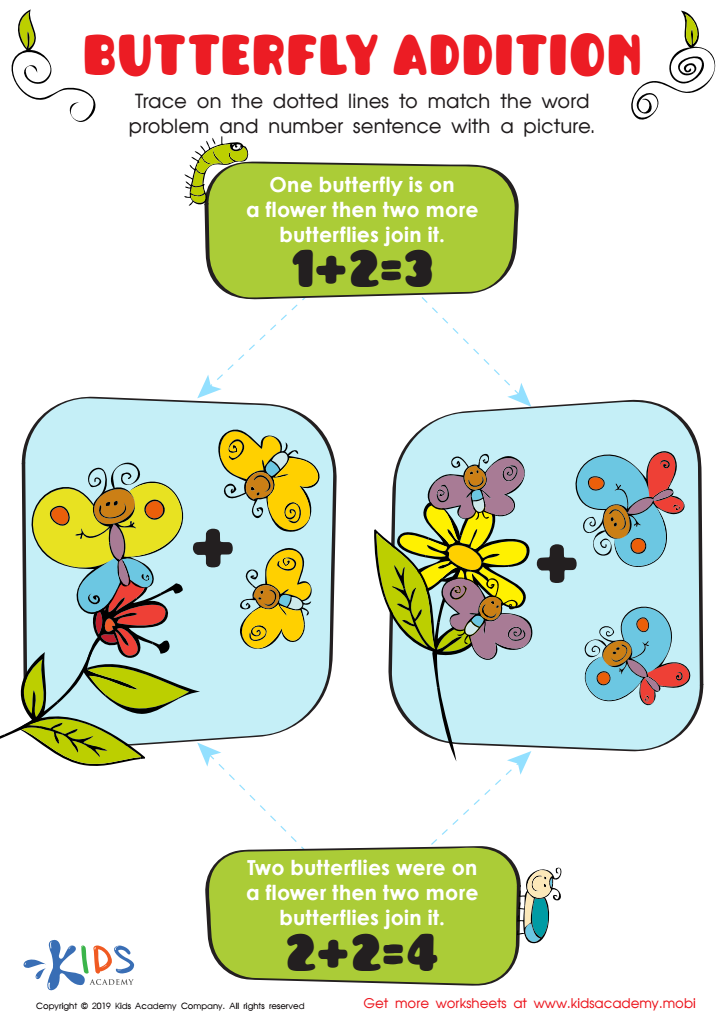
Butterfly Addition Worksheet

Butterfly Addition Worksheet

This tracing sheet is great for kids to work on math skills and have fun too. Read the word problems to them, then help them trace the dotted lines to match the problem and number sentence to a picture. Not only is it educational, it's beautiful too - your kids will love learning about butterflies!
Butterfly Addition Worksheet
Worksheet
Counting Seedlings Worksheet

Counting Seedlings Worksheet

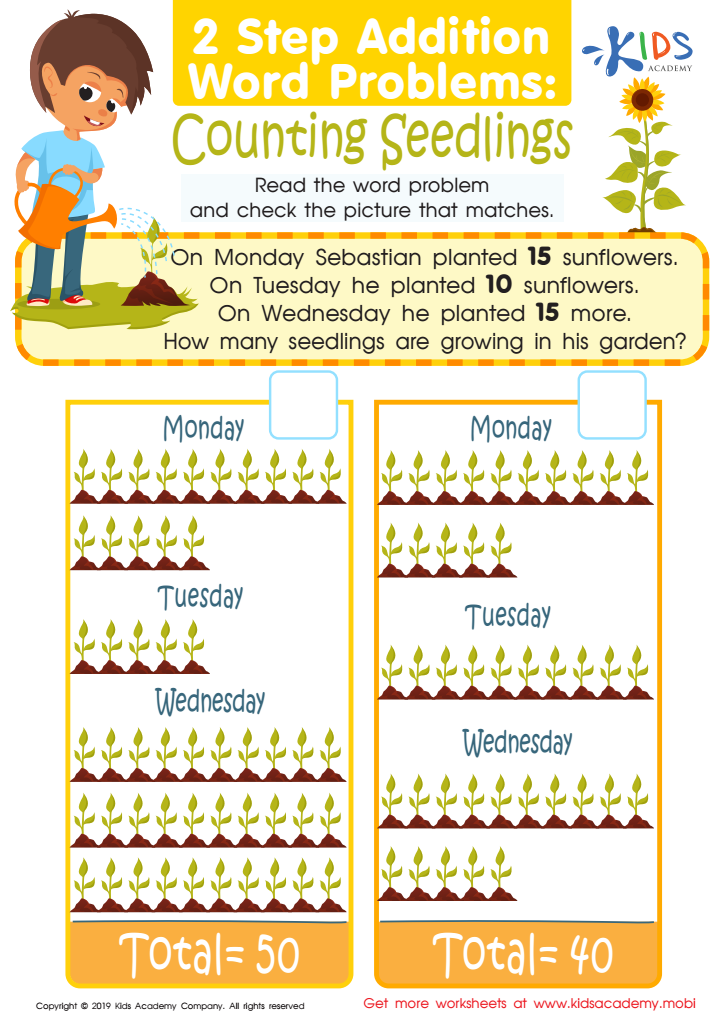
Understanding math word problems is key. Multiple steps can prove challenging - this free worksheet provides one-to-one picture representation to help kids solve multi-step addition word problems. Strengthen addition skills by choosing the matching picture to the answer.
Counting Seedlings Worksheet
Worksheet
Sea Math Worksheet
Sea Math Worksheet

Sea Math Worksheet

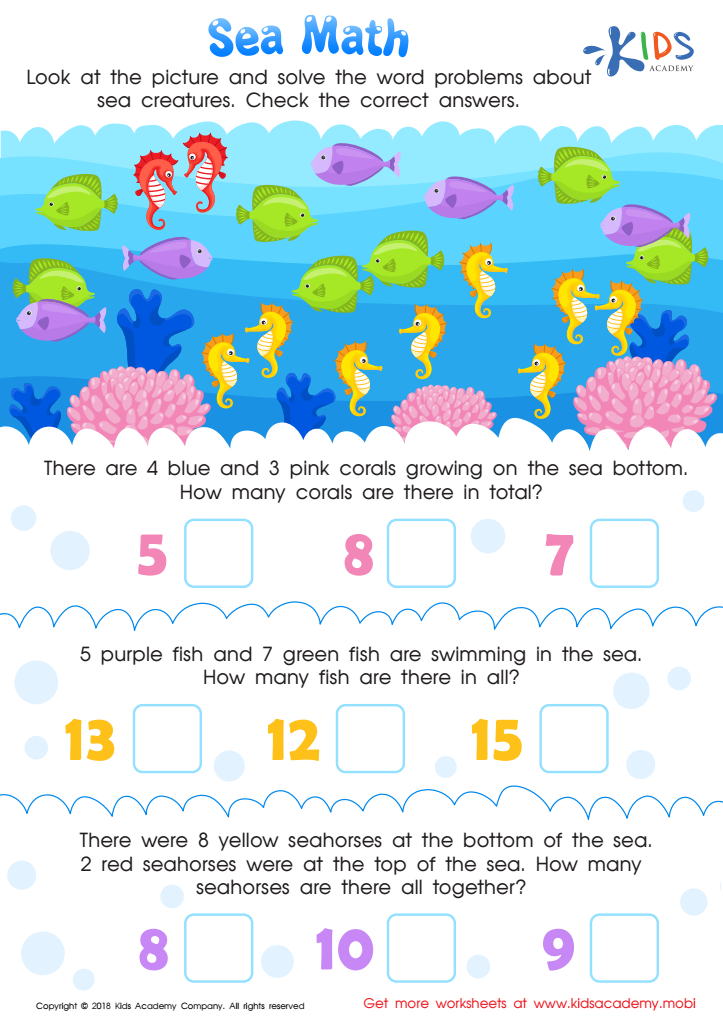
Dive into an ocean of addition with this fun math worksheet! Help your little mathematician count and add colorful coral and fish. Point out phrases like "in total" or "all together" as a reminder to use addition. Watch them add to find the answer and check the boxes to finish!
Sea Math Worksheet
Worksheet
Australian Animal Subtraction Worksheet

Australian Animal Subtraction Worksheet

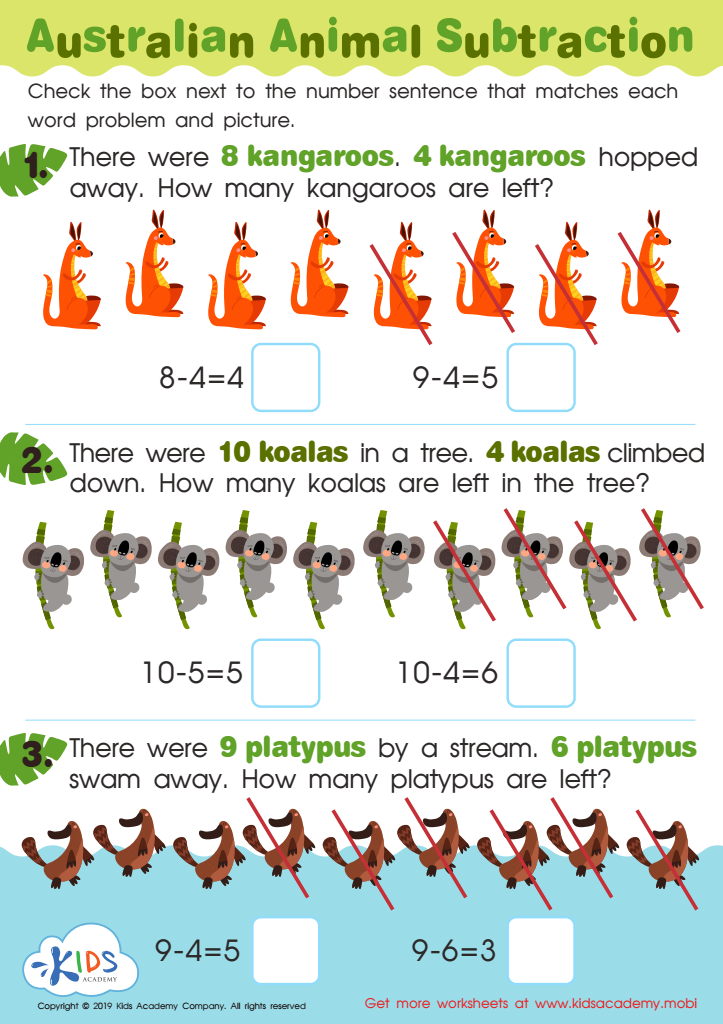
Test your child's wildlife knowledge. Ask them to name animals indigenous to Australia or other countries. Show them the animals in this worksheet and have them match each word problem and picture with the correct number sentence.
Australian Animal Subtraction Worksheet
Worksheet
Addition at the Zoo Worksheet

Addition at the Zoo Worksheet

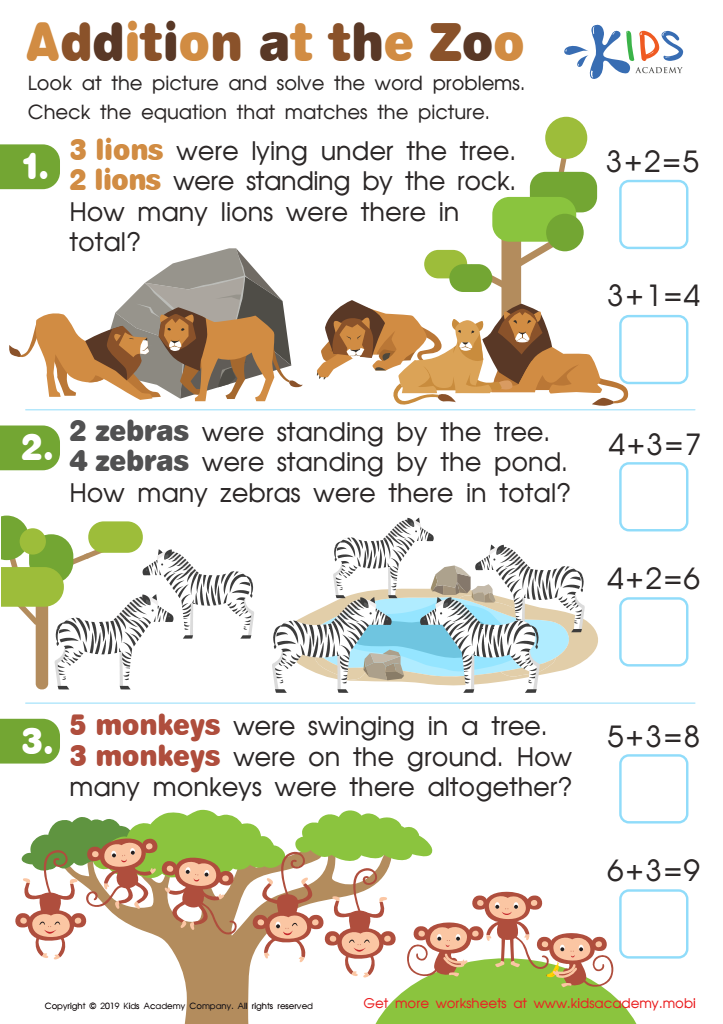
Visit the zoo with your kids and point out all the different animals. Ask them to name their favorites and identify animals on a worksheet. Challenge them to solve word problems related to the pictures. Ask them for the equation that fits the picture and check the answer.
Addition at the Zoo Worksheet
Worksheet
Animal Addition Worksheet


Animal Addition Worksheet

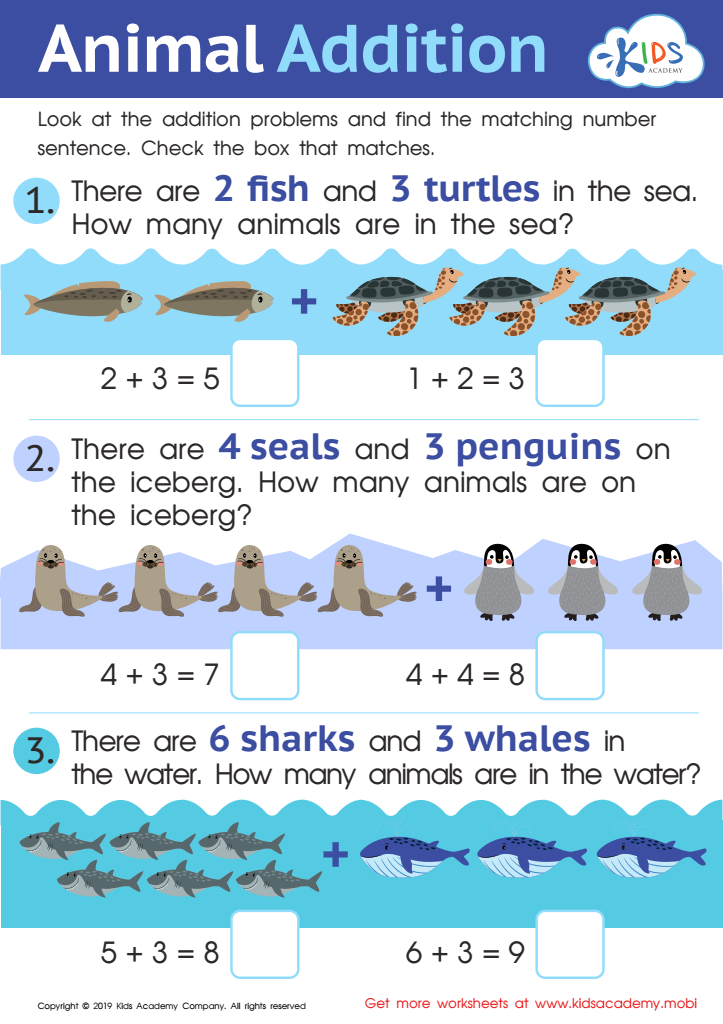
Get your kids learning addition and subtraction with this fun worksheet! Show them that solving equations can be enjoyable and help them match number sentences to the correct boxes. By doing this together, you'll create a positive learning experience that your kids won't forget.
Animal Addition Worksheet
Worksheet


Counting skills and early addition and subtraction word problems are foundational to a child's mathematical understanding, making them crucial for parents and teachers to prioritize. For children aged 3-8, developing these skills lays the groundwork for future academic success. Counting helps children understand number sense, which is essential for higher-level mathematics. Similarly, engaging with simple addition and subtraction word problems promotes critical thinking, problem-solving abilities, and comprehension skills.

By learning to decipher word problems, children learn to interpret language and connect it to numeric concepts, enhancing their vocabulary and cognitive skills. This not only supports mathematical learning but also reinforces their overall literacy and reasoning abilities.

Furthermore, these skills cultivate perseverance, as students learn to approach problems systematically and work through challenges. Introducing these concepts through playful and engaging methods, such as games and interactive activities, makes learning enjoyable and fosters a positive attitude towards mathematics.

Ultimately, prioritizing counting and basic verbal problems not only prepares youngsters for deeper mathematical concepts but also equips them with essential life skills, such as decision-making and logical reasoning, benefiting them academically and personally.