
Time reading skills Easy Time Worksheets for Ages 3-9
3 filtered results
Difficulty Level
Grade
Age
-
From - To
Subject
Activity
Standards
Introducing "Time Reading Skills: Easy Time Worksheets for Ages 3-9" by Kids Academy! Our carefully designed worksheets make learning to read time fun and easy for young minds. Perfect for children aged 3-9, these printable sheets cover essential skills, from identifying hours and minutes to understanding the concept of time. Engaging activities and colorful illustrations help kids grasp key concepts quickly and enjoyably. Whether your child is just starting to learn about clocks or needs extra practice, our worksheets provide a solid foundation. Boost your child's time-telling confidence with Kids Academy's expert resources today!
Favorites
With answer key
Interactive
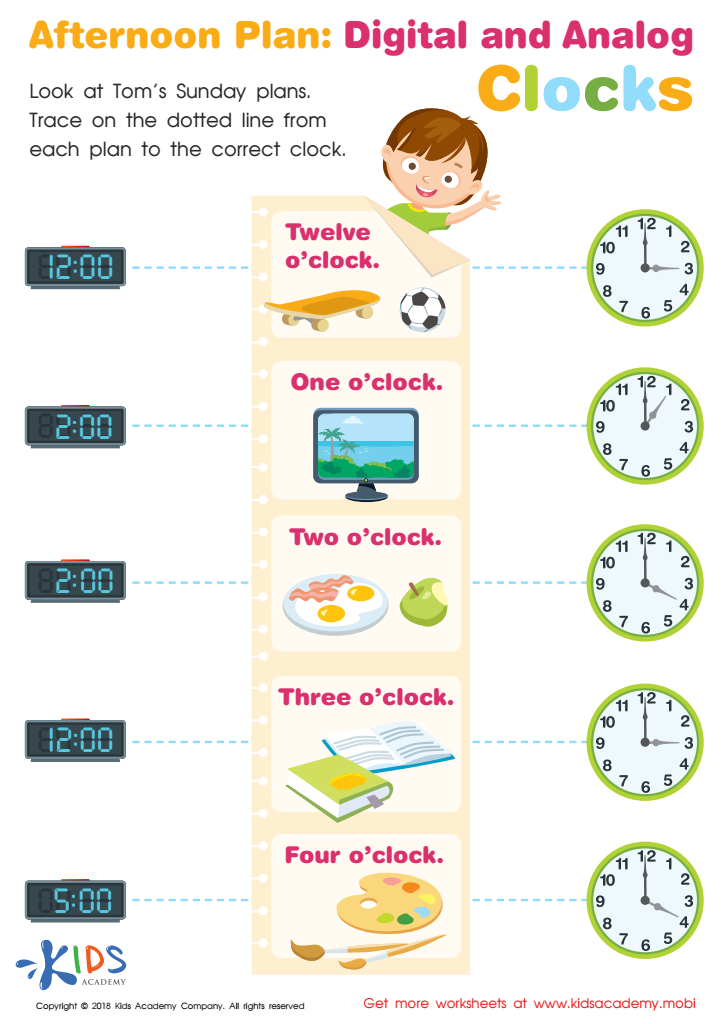
Afternoon Plan: Digital and Analog Clocks Worksheet
Tom's got Sunday plans and your kids can use this worksheet to help them learn how to tell the time. With tracing dotted lines from plans to the correct clock, they'll gain the skills to accurately convert digital time to analog. It'll be a great way to get them better at telling the time.
 Assign to My Students
Afternoon Plan: Digital and Analog Clocks Worksheet
Worksheet
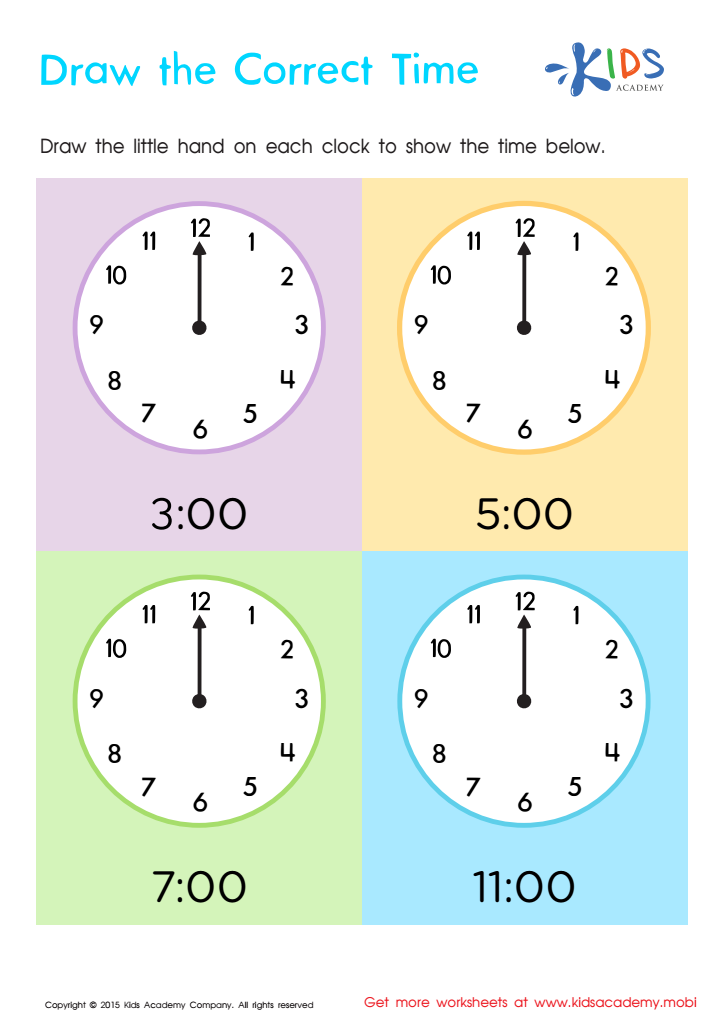
Telling The Time Worksheet: Part 1
Practice telling the time with Kids Academy. Our worksheets make it fun for kindergarteners to learn about clocks and reading the time. Find our free math worksheets on telling the time and draw the little hand on the clock faces to show the time. Let's learn together!
Telling The Time Worksheet: Part 1
Worksheet
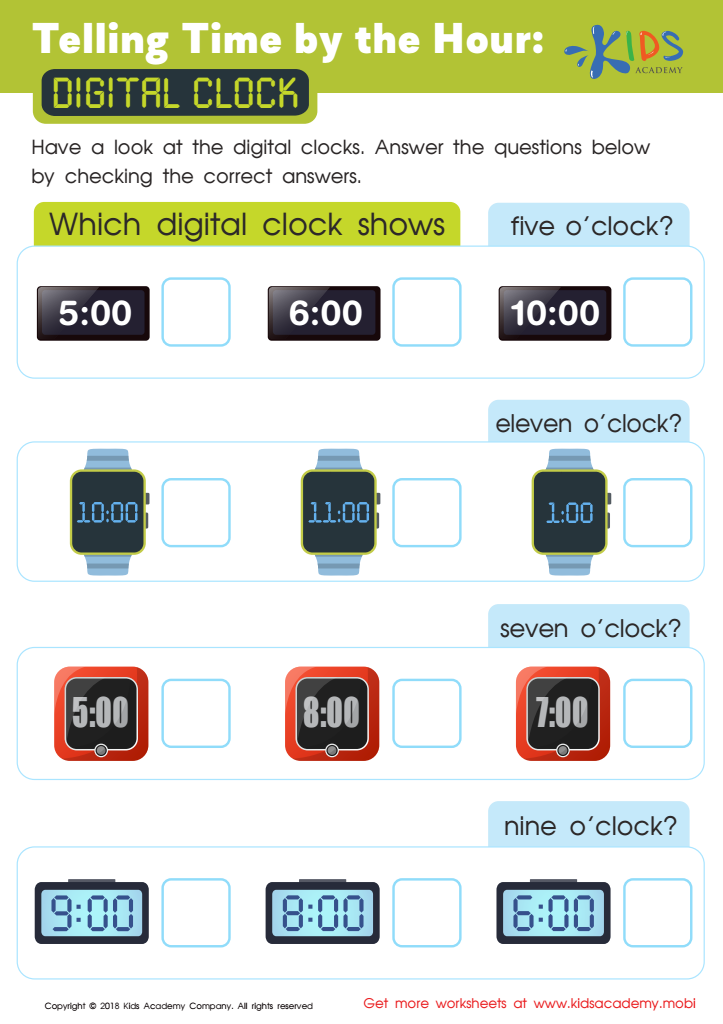
Telling Time by the Hour: Digital Clock Worksheet
Introduce your students to digital clocks. This worksheet will help them become familiar with them. Guide them through answering the questions - they're simple and stimulating. Encourage their young minds to explore the digital clocks in the exercise.
Telling Time by the Hour: Digital Clock Worksheet
Worksheet
Join Kids Academy for Free
Who is primarily going to use this learning content?







Parents and teachers should prioritize enhancing time-reading skills in children aged 3-9 because these skills are foundational for fostering a sense of responsibility and independence. At this pivotal age, children are developing cognitive abilities that enable them to understand the abstract concepts of time, such as hours, minutes, and the progression of events. By mastering the ability to tell time, children can more effectively manage and organize their daily activities, creating a sense of structure and predictability.
Moreover, time-reading proficiency contributes to academic success. Many classroom activities are time-bound, and understanding these constraints helps children keep pace with their lessons, transitions, and routines, reducing stress and enhancing productivity. Additionally, time-reading skills integrate with mathematical learning. Concepts like estimating durations, understanding time intervals, and learning to sequence events boost children's numeracy and critical thinking.
Lastly, fostering these skills early on encourages lifelong habits of punctuality and time management. These are critical competencies that extend beyond the classroom into adulthood, influencing professional and personal success. Thus, guiding children to become proficient in time reading empowers them with tools essential for managing their time efficiently and achieving their goals throughout life.








