Basic Math Skills Easy Worksheets for Ages 4-6 - Page 2
25 filtered results
-
From - To
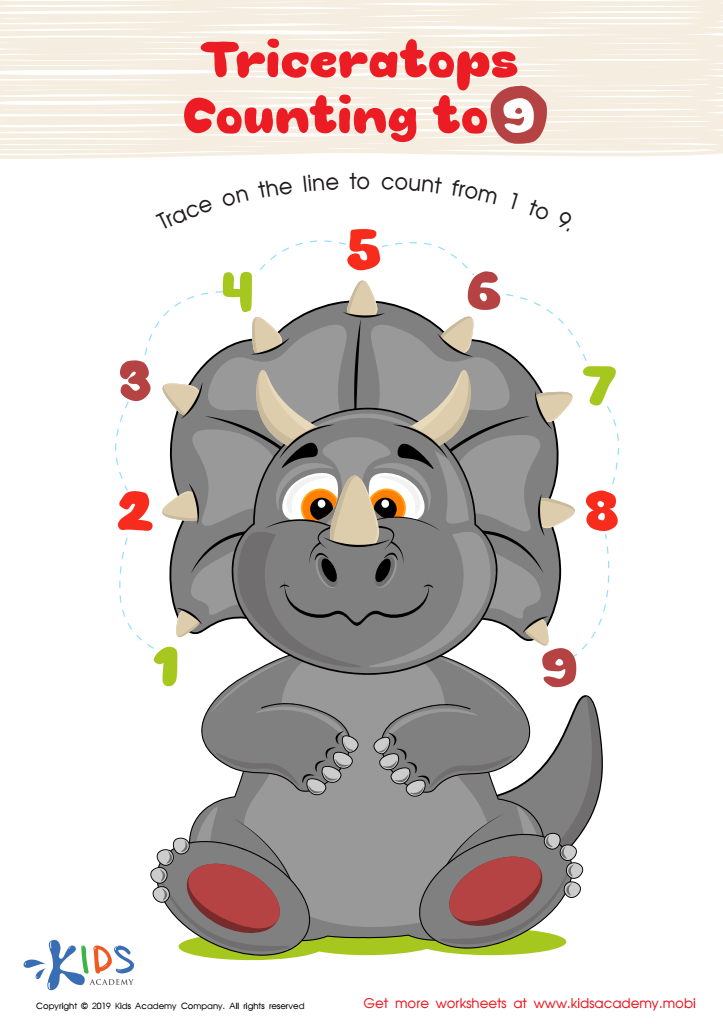
Triceratops Counting to 9 Worksheet
 Assign to My Students








Parents and teachers should prioritize basic math skills for children aged 4-6 for several compelling reasons. First, foundational math abilities serve as the building blocks for future academic success. Introducing concepts of counting, addition, and subtraction early sets the stage for more complex problem-solving in later grades.
Additionally, early math skills are critical for developing critical thinking and analytical abilities. Engaging children in fun learning activities can spark their curiosity and motivation to explore mathematical concepts further, creating a positive attitude towards learning overall.
Moreover, children at this age are naturally inquisitive and absorb information like sponges. By tapping into their fascination with numbers and patterns, parents and teachers can create a rich learning environment that supports cognitive development.
Socially, mastering basic math skills enables children to engage more effectively in group activities. They become adept at sharing resources, taking turns, and following rules in games that incorporate mathematical thinking.
Lastly, early numeracy skills are increasingly recognized as key indicators of later academic achievement. Parents and educators who focus on these foundational skills play a crucial role in setting children on a path towards lifelong learning and success in both mathematics and other subjects.








