
Comparing Fractions Easy Worksheets for Ages 4-7
4 filtered results
Difficulty Level
Grade
Age
-
From - To
Subject
Activity
Standards
Discover our engaging "Comparing Fractions Easy Worksheets" designed specifically for children ages 4-7. These fun and interactive worksheets help young learners grasp the concept of fractions in a clear and entertaining way. With vibrant visuals and age-appropriate exercises, children will develop essential skills to compare fractions effectively. Each worksheet is crafted to encourage critical thinking and foster a love for math. Ideal for both classroom settings and at-home learning, our resources support early education goals and help build a strong foundation in mathematics. Start your child's journey towards fraction mastery today!
Favorites
With answer key
Interactive
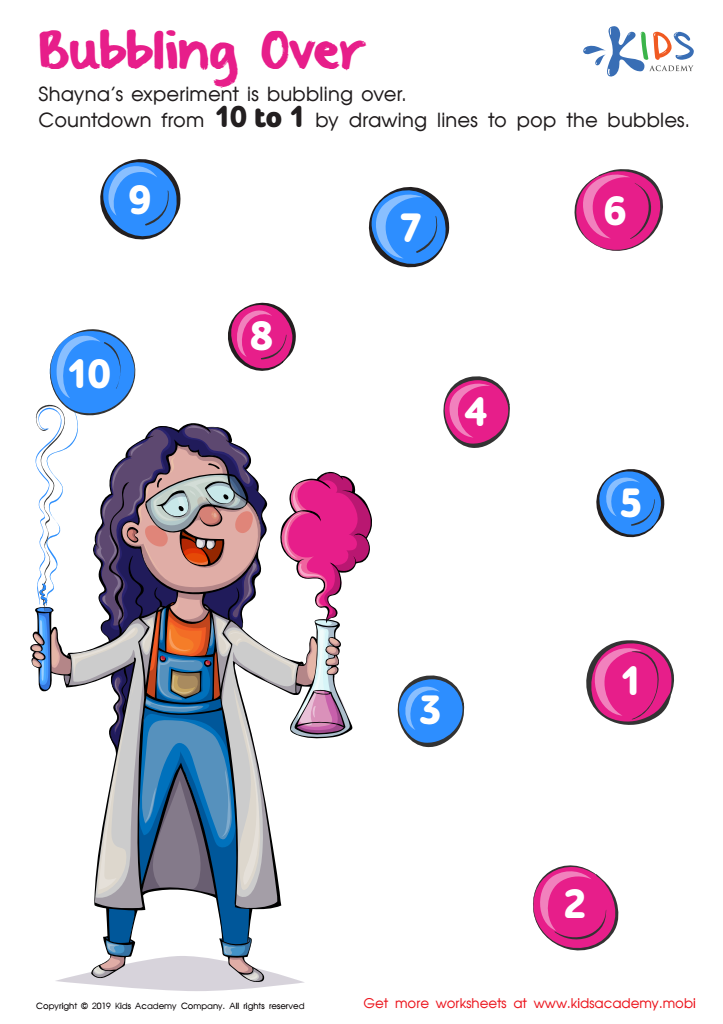
Bubbling Over Worksheet
Students love science experiments at the lab! They get to practice their counting skills while creating a masterpiece or an unexpected catastrophe! Ask them to count down from 10 to 1 by drawing lines to 'pop' the bubbles coming out of Shayna's experiment in the worksheet.
 Assign to My Students
Bubbling Over Worksheet
Worksheet
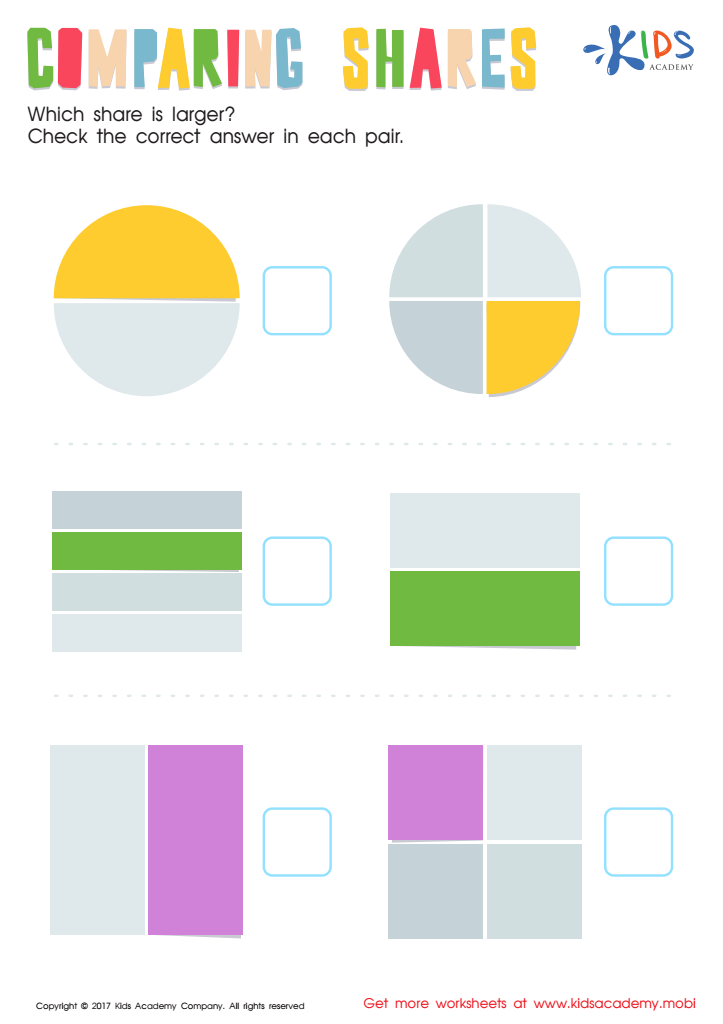
Comparing Shares Worksheet
Can your students identify and draw shapes correctly? If so, this exercise may be too easy. For those who are still learning, extra help may be needed. The worksheet requires students to select which shape is larger in each pair; circles and squares are included.
Comparing Shares Worksheet
Worksheet
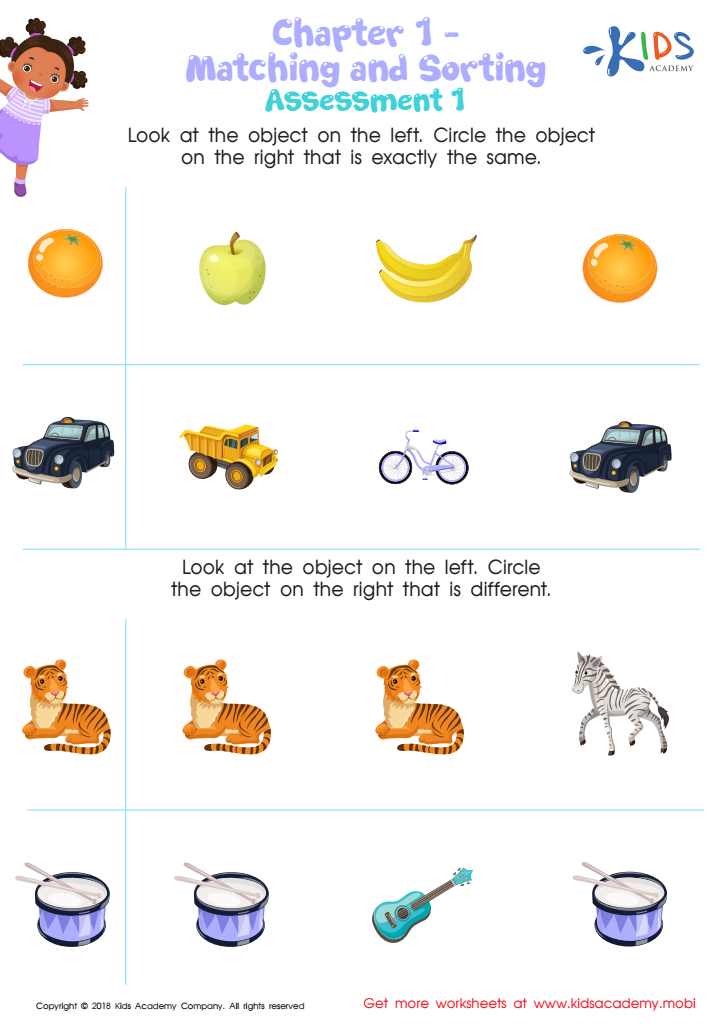
Matching and Sorting for Preschool: Assessment 1 Worksheet
Test your child's matching skills with this worksheet! Ask them to name each of the objects pictured, then circle the ones that are the same. Repeat for the second task. It's a great way to assess their skills and have fun at the same time!
Matching and Sorting for Preschool: Assessment 1 Worksheet
Worksheet
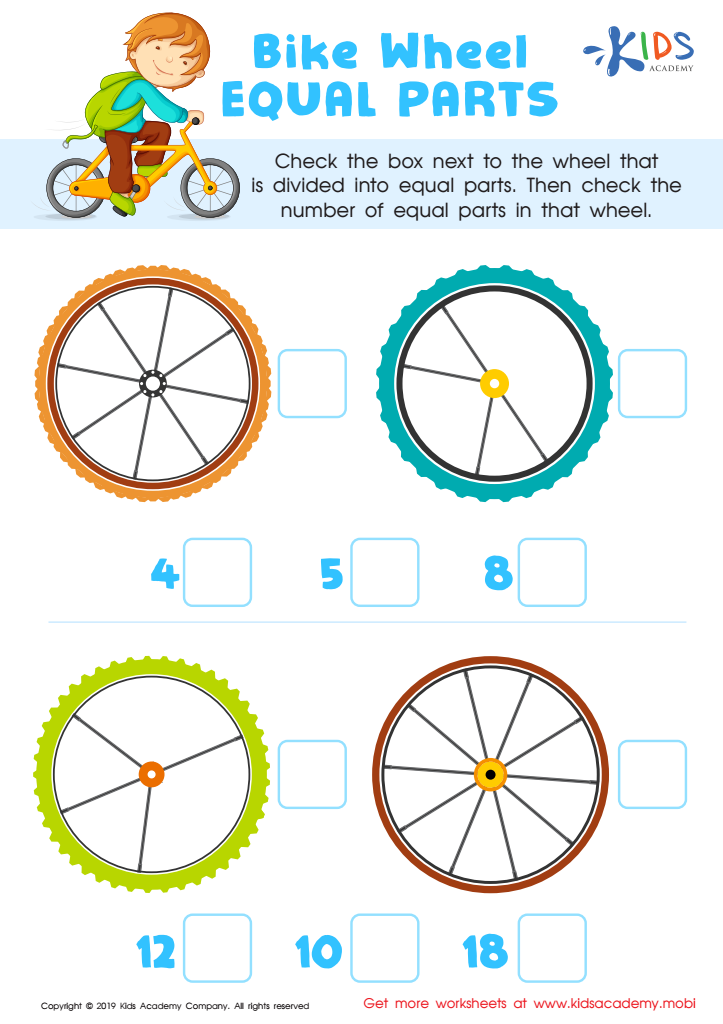
Bike Wheel Equal Parts Worksheet
Help your kids have fun while they learn! Ask them to identify the object in the picture with four wheels. Guide them to count the spokes, then check the box on the wheel with equal parts. Lastly, check how many equal parts the wheel is divided into.
Bike Wheel Equal Parts Worksheet
Worksheet
Join Kids Academy for Free
Who is primarily going to use this learning content?







Comparing fractions is a fundamental concept in early math education for children aged 4-7 that lays the groundwork for more complex mathematical skills later on. One notable reason parents and teachers should care about this is that it enhances children’s understanding of numerical relationships. By learning to compare fractions, children grasp the idea of parts to a whole, which forms the basis for addition, subtraction, and even concepts of division in their future studies.
Furthermore, comparing fractions fosters critical thinking and problem-solving abilities. Through interactive activities, children learn to analyze and evaluate different fractions, developing a sense of logical reasoning. These skills are transferable and valuable not just in mathematics but across various subjects and everyday life scenarios.
It's also important for social and cultural development; as children engage in group activities, they learn to communicate and negotiate, sharing their ideas and reasoning about fractions with peers. This collaboration can enhance their interpersonal skills.
Ultimately, focusing on comparing fractions at a young age builds a strong number sense, ensuring that children approach more advanced mathematics with confidence and curiosity. Thus, it is imperative for parents and teachers to prioritize this foundational math concept to promote a solid educational trajectory for young learners.








