Understanding patterns Easy Basic Times Tables up to 12 Worksheets for Ages 4-8
3 filtered results
-
From - To
Welcome to our "Understanding Patterns: Easy Basic Times Tables up to 12" worksheets, designed for children ages 4-8! These engaging and interactive resources aim to simplify the learning process of times tables through the exploration of patterns. By recognizing the repetitions and relationships within multiplication, students can build a strong mathematical foundation. Our worksheets feature colorful illustrations and clear instructions, making learning fun and accessible. Perfect for classroom use or at-home practice, these activities foster critical thinking and number sense. Help your child unlock the world of mathematics while developing essential skills in a supportive and enjoyable way!
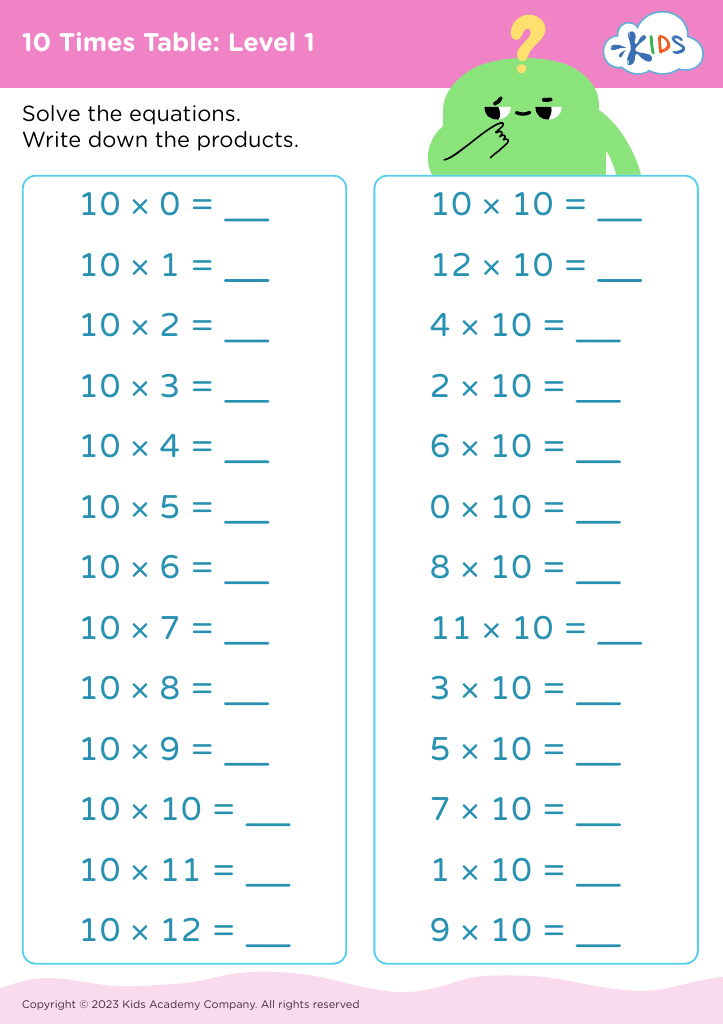
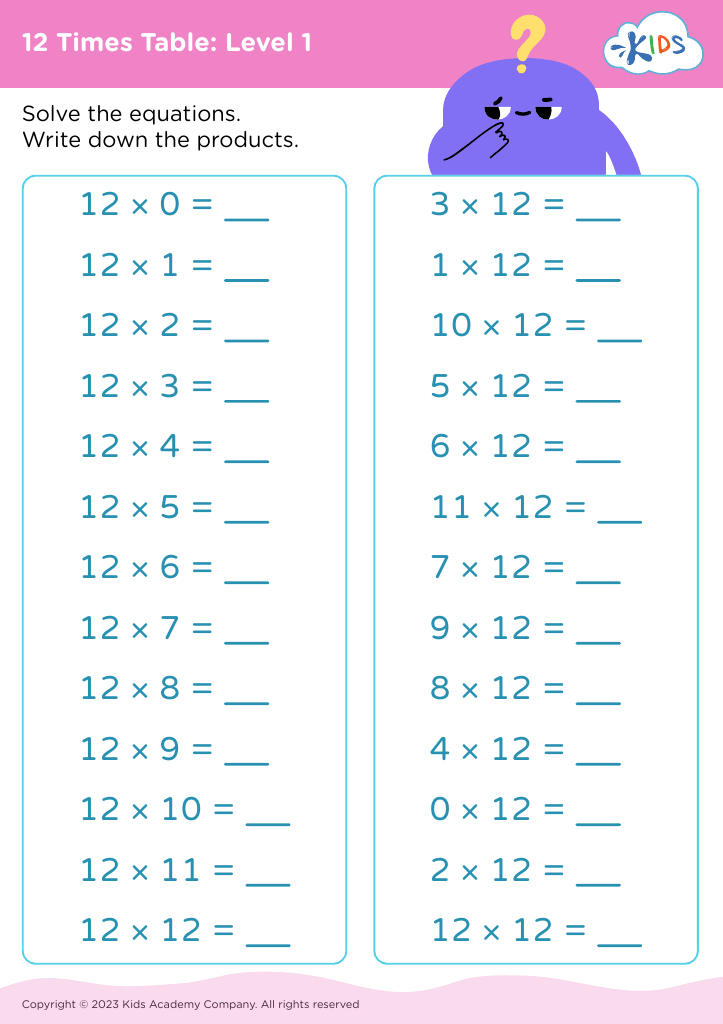
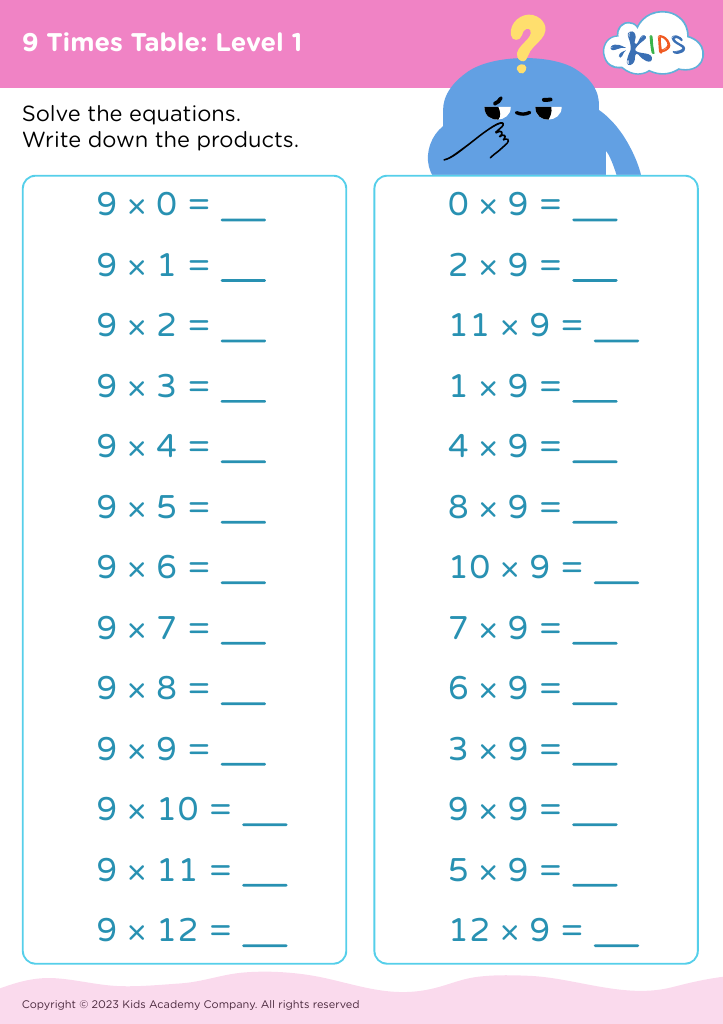


Understanding patterns in basic times tables up to 12 is essential for children ages 4-8, as it lays a strong mathematical foundation crucial for their future learning. Early exposure to multiplication patterns helps develop critical thinking and problem-solving skills. Recognizing that multiplication is related to addition enables young learners to grasp concepts of grouping and scaling, fostering a deeper understanding of numbers.
For parents and teachers, enhancing children's grasp of these patterns supports confidence in math, which can often be a challenging subject. Engaging children with fun activities and games based on these patterns encourages a positive attitude towards mathematics. Furthermore, mastery of the times tables boosts fluency, making complex mathematical concepts more accessible as children progress further in their education.
In today's technology-driven world, developing these foundational skills is increasingly important. Jobs increasingly require strong numerical competency, so encouraging early mastery in a low-pressure environment can set children on the path to academic success. Ultimately, investing time in understanding times table patterns not only prepares children for future math challenges but also cultivates lifelong learners who appreciate the beauty and functionality of mathematics.








