Problem-Solving Skills Easy Math Worksheets for Ages 4-9 - Page 3
49 filtered results
-
From - To
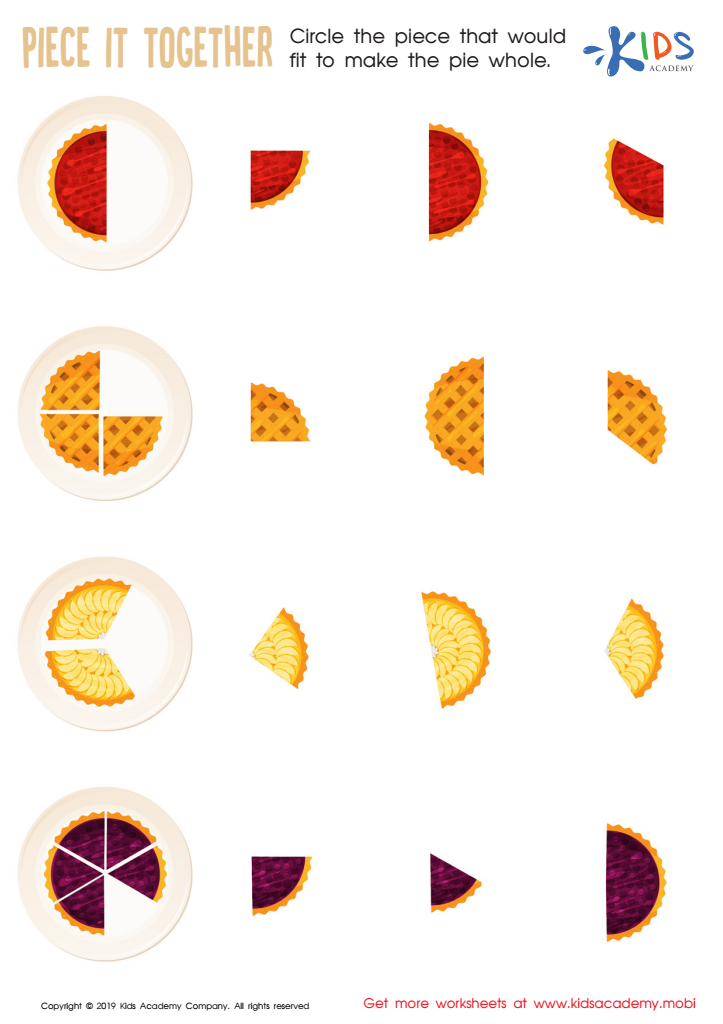
Piece it together Worksheet
 Assign to My Students








Problem-solving skills in math for children aged 4-9 are crucial for their overall cognitive development and future academic success. At this young age, children are naturally curious and eager to explore concepts; teaching them problem-solving strategies can ignite that enthusiasm while laying a strong foundation for mathematical thinking.
Engaging in easy math problem-solving helps children develop critical thinking abilities, enhances their creativity, and fosters persistence. When faced with a math problem, students learn to analyze situations, identify patterns, and consider multiple approaches to find solutions. These skills are not only essential for math but also transfer to other subjects and real-life scenarios, encouraging children to tackle challenges with confidence.
Moreover, problem-solving activities promote collaboration and communication among peers, teaching children how to share ideas and articulate their thought processes. Parents and teachers play a pivotal role by providing supportive environments that encourage exploration and experimentation. By focusing on problem-solving skills in early education, we equip kids not only with essential mathematical capabilities but with lifelong skills such as resilience, adaptability, and teamwork, preparing them to face complexities both inside and outside the classroom. Thus, investing in these skills fosters well-rounded individuals ready to thrive in a rapidly changing world.








