
Comparing Fractions Easy Worksheets for Ages 6-7
3 filtered results
Difficulty Level
Grade
Age
-
From - To
Subject
Activity
Standards
Unlock the fun of learning with our "Comparing Fractions Easy Worksheets" for ages 6-7! Designed for young learners, these engaging worksheets simplify the concept of fractions, making it easy for kids to grasp the differences between them. Through vibrant illustrations and interactive exercises, children enhance their understanding of fractions while developing critical thinking skills needed for math mastery. Each worksheet provides clear instructions and plenty of practice opportunities, ensuring that comparison of fractions becomes a rewarding experience. Perfect for classroom use or at-home practice, these resources support children’s educational growth and foster a love for math early on. Start exploring today!
Favorites
With answer key
Interactive
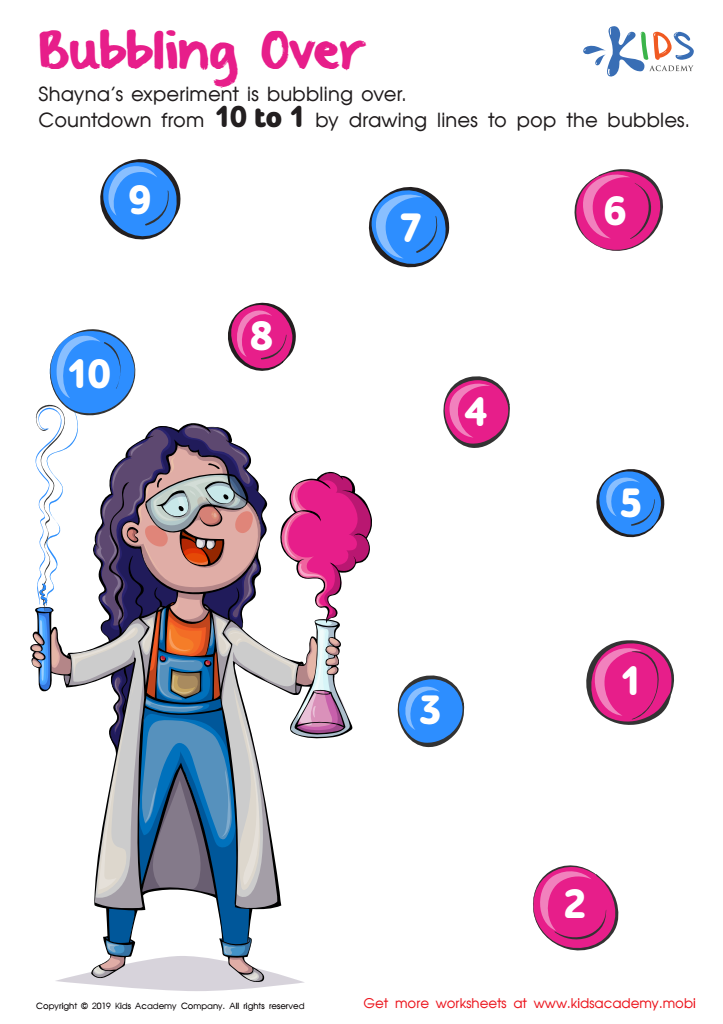
Bubbling Over Worksheet
Students love science experiments at the lab! They get to practice their counting skills while creating a masterpiece or an unexpected catastrophe! Ask them to count down from 10 to 1 by drawing lines to 'pop' the bubbles coming out of Shayna's experiment in the worksheet.
 Assign to My Students
Bubbling Over Worksheet
Worksheet
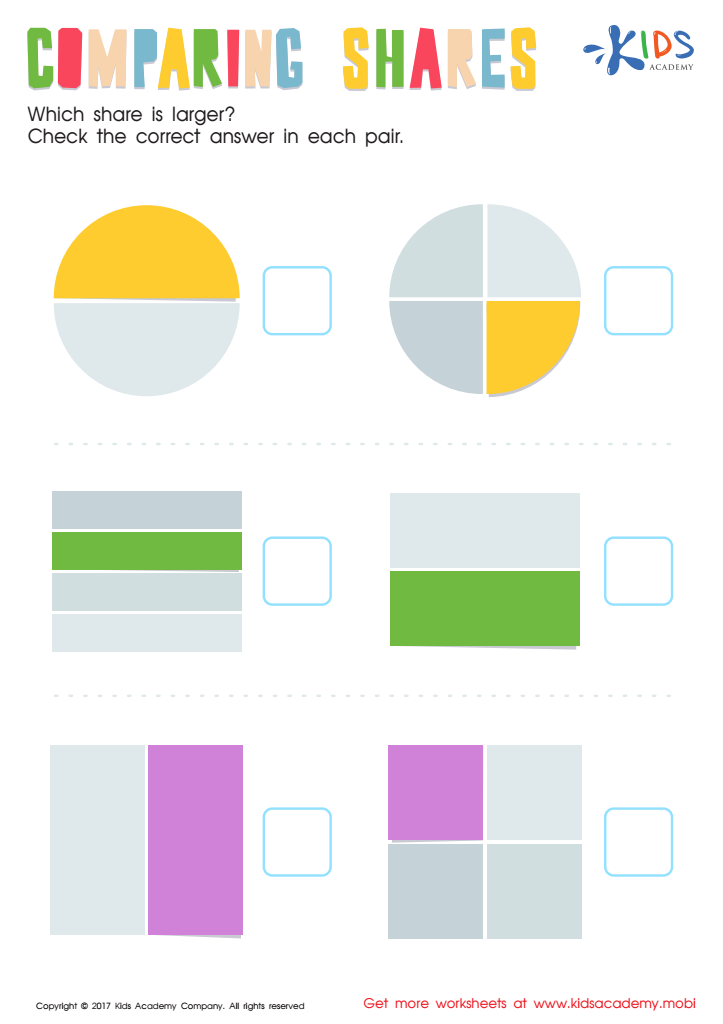
Comparing Shares Worksheet
Can your students identify and draw shapes correctly? If so, this exercise may be too easy. For those who are still learning, extra help may be needed. The worksheet requires students to select which shape is larger in each pair; circles and squares are included.
Comparing Shares Worksheet
Worksheet
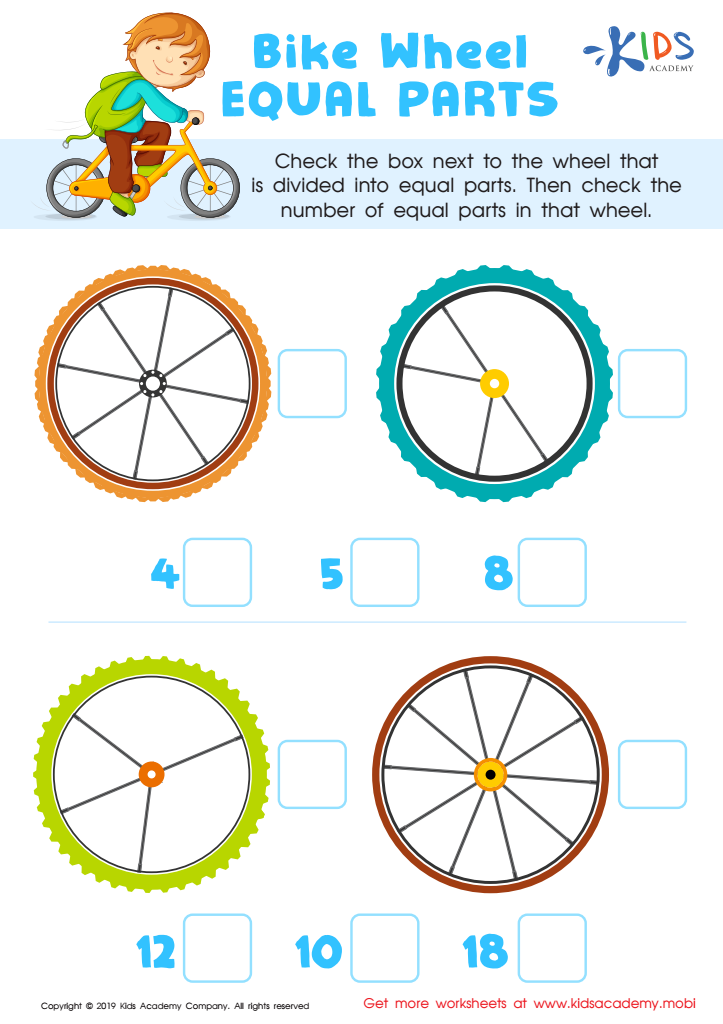
Bike Wheel Equal Parts Worksheet
Help your kids have fun while they learn! Ask them to identify the object in the picture with four wheels. Guide them to count the spokes, then check the box on the wheel with equal parts. Lastly, check how many equal parts the wheel is divided into.
Bike Wheel Equal Parts Worksheet
Worksheet
Join Kids Academy for Free
Who is primarily going to use this learning content?







Comparing fractions is a foundational skill in mathematics that significantly impacts a child's number sense and problem-solving abilities. For children aged 6-7, this concept introduces them to more complex mathematical thinking and enhances their overall understanding of numbers in relation to each other. Parents and teachers should prioritize this skill as it builds a strong mathematical foundation crucial for later learning in geometry, measurement, and even basic algebra.
Moreover, comparing fractions develops critical thinking and reasoning skills. Children learn to analyze and make judgments about different quantities, which fosters their ability to solve problems in real-world contexts—like sharing snacks or understanding pizza slices!
Understanding fractions also prepares children for more advanced concepts. Grasping how to compare fractions can lead to a better understanding of equivalent fractions and simplification, essential skills in later grades.
Engaging children in comparing fractions using visual aids, real-life examples, or interactive activities makes the learning process fun and relatable. This approach encourages a positive attitude towards math, reducing anxiety about the subject as they grow older. Ultimately, fostering these skills in young learners not only makes learning more enjoyable but also equips them with the necessary tools for future academic success.








