Problem-Solving Skills Easy Addition & Subtraction Worksheets for Ages 6-7 - Page 2
25 filtered results
-
From - To
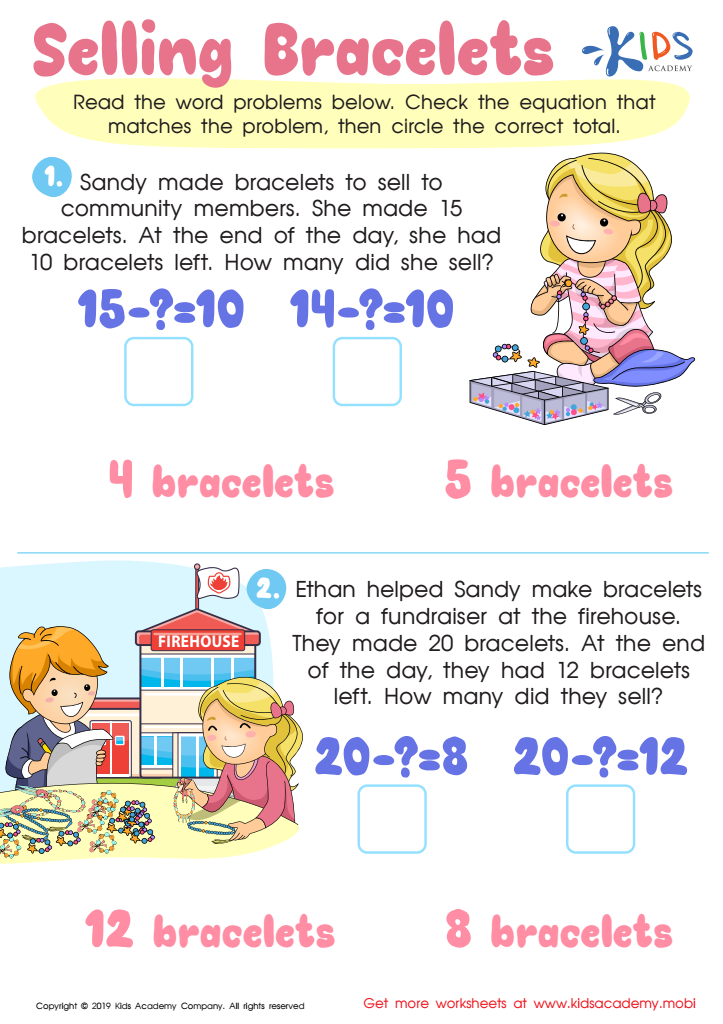
Selling the Bracelets Worksheet
 Assign to My Students








Problem-solving skills in early grade children, particularly involving addition and subtraction, are foundational for their academic and everyday life success. Ages 6-7 is a crucial period when cognitive abilities develop rapidly. At this age, understanding basic arithmetic is more than just learning to count; it's about developing critical thinking and reasoning.
Parents and teachers caring about these skills helps children build a strong mathematical foundation. Easy addition and subtraction tasks encourage logical thinking, pattern recognition, and numerical fluency, which are essential for tackling more complex mathematical concepts in later grades. Additionally, engaging in problem-solving enhances children's persistence, patience, and confidence—qualities valuable beyond the math classroom.
Moreover, early exposure to problem-solving cultivates a growth mindset. Children learn that challenges can be overcome through effort and strategy. This mindset is beneficial not only in academics but also in coping with day-to-day problems, teaching resilience and adaptability.
In essence, by nurturing problem-solving skills through simple arithmetic activities, parents and teachers equip children with tools to understand the world mathematically, boost their overall cognitive development, and lay the groundwork for future educational achievements. This holistic development sets a precedent for lifelong learning and adaptability.








