
Comparing quantities Easy Math Worksheets for Ages 6-7
3 filtered results
Difficulty Level
Grade
Age
-
From - To
Subject
Activity
Standards
Unlock fun and learning with our "Comparing Quantities Easy Math Worksheets for Ages 6-7"! These engaging and educational worksheets are designed to help young learners develop essential math skills. Through colorful illustrations and interactive activities, kids practice comparing numbers, amounts, and sizes in a simple and enjoyable way. Perfect for classroom use or at-home learning, these easy-to-follow worksheets build a strong foundation in mathematical thinking. Boost your child's confidence and proficiency in math with our expertly crafted resources! Download today and make learning fun with comparing quantities worksheets designed for young minds!
Favorites
With answer key
Interactive
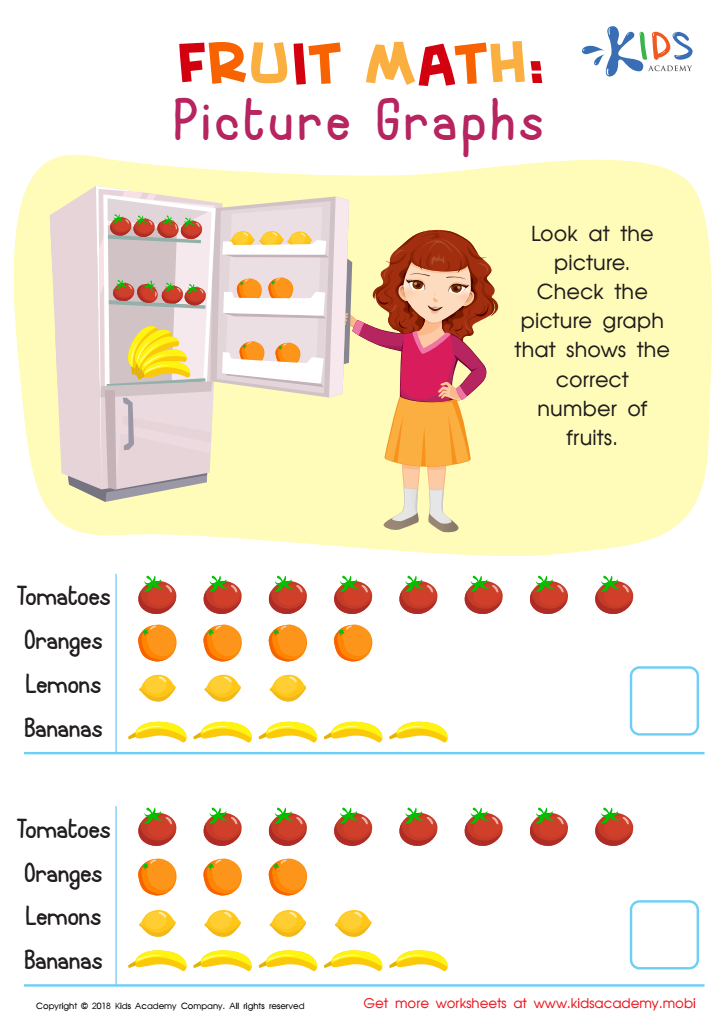
Fruit Math: Picture Graphs Worksheet
Help your child learn to draw graphs by having them look at pictures. Ask them to identify a graph that accurately portrays the data and have them explain why. This will prepare them to easily draw more complex graphs in the future. For example, have them look at the picture with the number of fruits in the colorful worksheet and explain why the graph is accurate.
 Assign to My Students
Fruit Math: Picture Graphs Worksheet
Worksheet
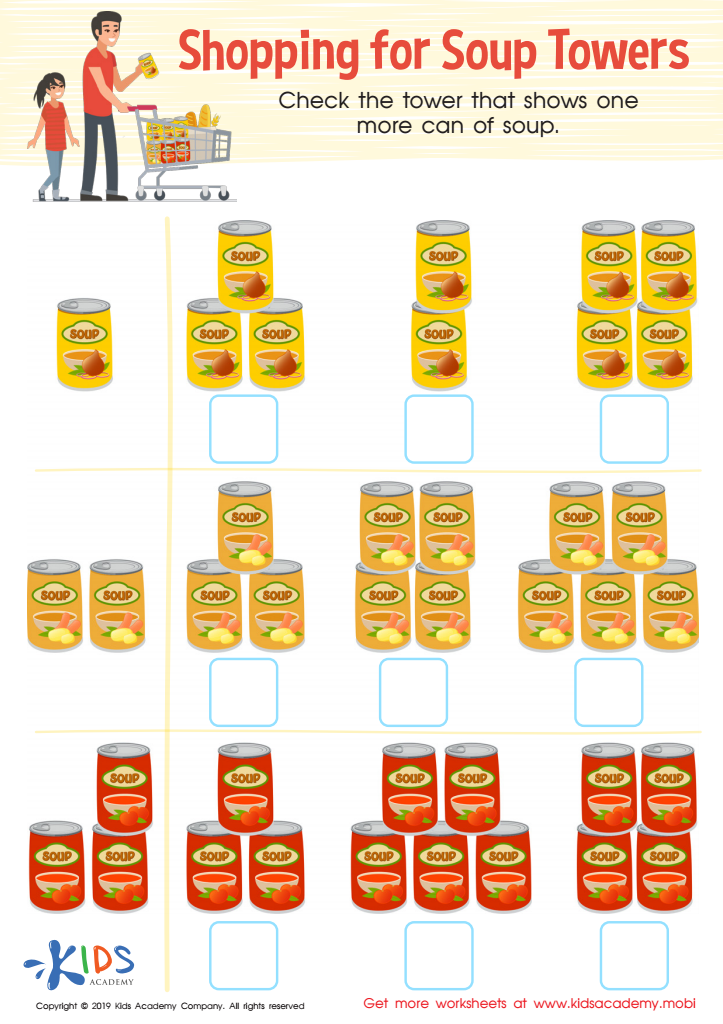
Soup Towers Worksheet
Do your kids come shopping? Transform it into a learning experience! Point out items and ask your kids what they are. Count each stack of cans, and have them check the tower with an extra can of soup. It's a great way to teach them counting and counting up!
Soup Towers Worksheet
Worksheet
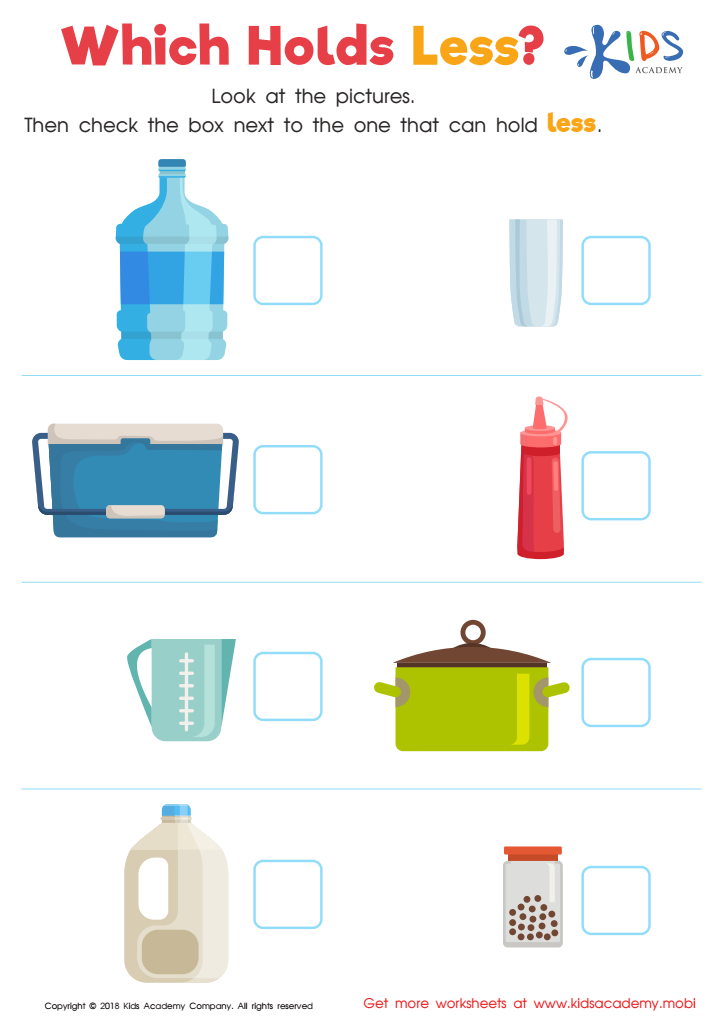
Which Holds Less? Worksheet
Students may find it hard to grasp volume without a visual aid. This free, downloadable worksheet helps with understanding by providing pictures of familiar objects. It allows students to practice comparing volumes and deciding which container holds less. It's a great introduction before they move onto using greater than and less than symbols.
Which Holds Less? Worksheet
Worksheet
Join Kids Academy for Free
Who is primarily going to use this learning content?








Parents and teachers should prioritize teaching children aged 6-7 to compare quantities because this foundational skill is critical for their cognitive and academic development. At this age, kids are beginning to grasp basic numerical concepts and simple arithmetic. Comparing quantities helps them understand the concepts of more than, less than, and equal to, which are fundamental for future mathematical learning.
This skill reinforced early on fosters logical thinking and the ability to make reasoned decisions. It is the groundwork for more complex skills such as problem solving, data interpretation, and graph understanding. For instance, when kids compare quantities, they begin to think critically about the relationships between different objects or groups, which enhances their analytical skills.
Moreover, comparing quantities can be seamlessly integrated into daily activities, making learning relatable and fun. For example, asking a child to compare the number of apples in two groups while grocery shopping makes math tangible and relevant.
Engaging children in these activities not only strengthens their mathematical foundation but also boosts their confidence. As they repeatedly practice and master these basic skills, they build a sense of achievement that encourages a positive attitude toward more advanced math in the future. Parents and teachers influencing this early can thus set children on a pathway to academic success and critical problem-solving abilities.








