
Comparing lengths Easy Measurement Worksheets for Ages 6-7
5 filtered results
Difficulty Level
Grade
Age
-
From - To
Subject
Activity
Standards
Introduce your young learners to the basics of measurement with our "Comparing Lengths Easy Measurement Worksheets for Ages 6-7." These engaging and colorful worksheets are specially designed to help children in grades 1-2 develop essential math skills. Kids will learn to compare lengths visually and through hands-on activities, building a solid foundation for more advanced measurement concepts. Perfect for both classroom and at-home learning, these worksheets are an excellent resource to boost your child’s confidence and interest in math. Watch as they master the basics of length comparison in a fun and interactive way!
Favorites
With answer key
Interactive
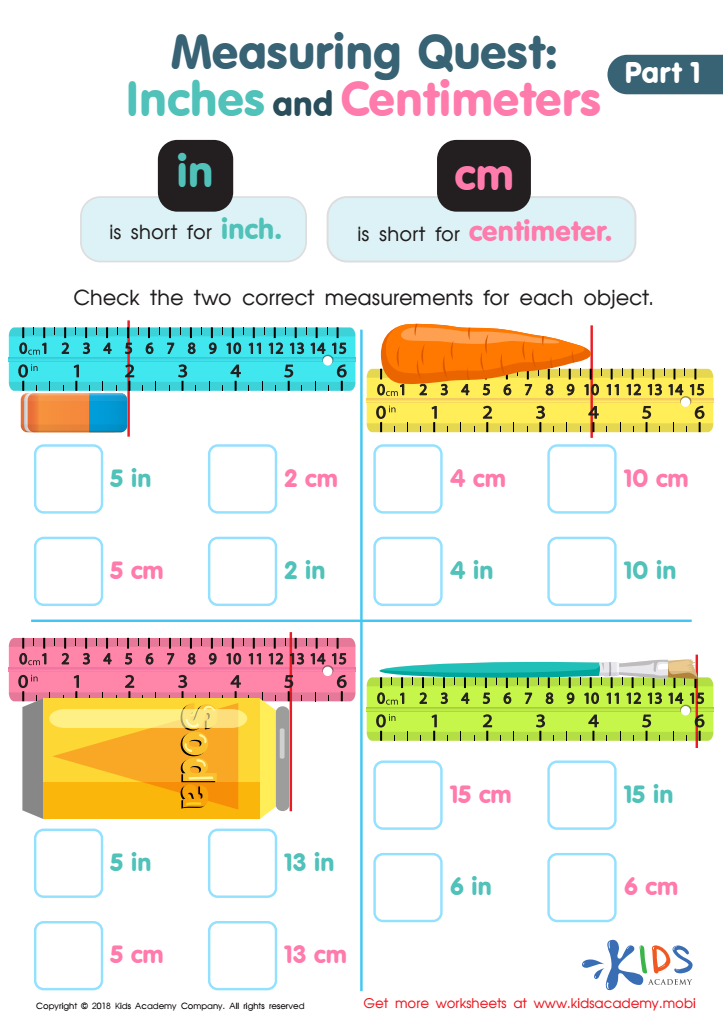
Measuring Quest: Inches and Centimeters Worksheet
Your child will measure items in both inches and centimeters and check the correct measurements from the options given. The metric ruler states 2.5 cm equals 1 inch, and 15 cm equals 6 inches. This worksheet helps ensure accurate measurements, despite the different figures.
 Assign to My Students
Measuring Quest: Inches and Centimeters Worksheet
Worksheet
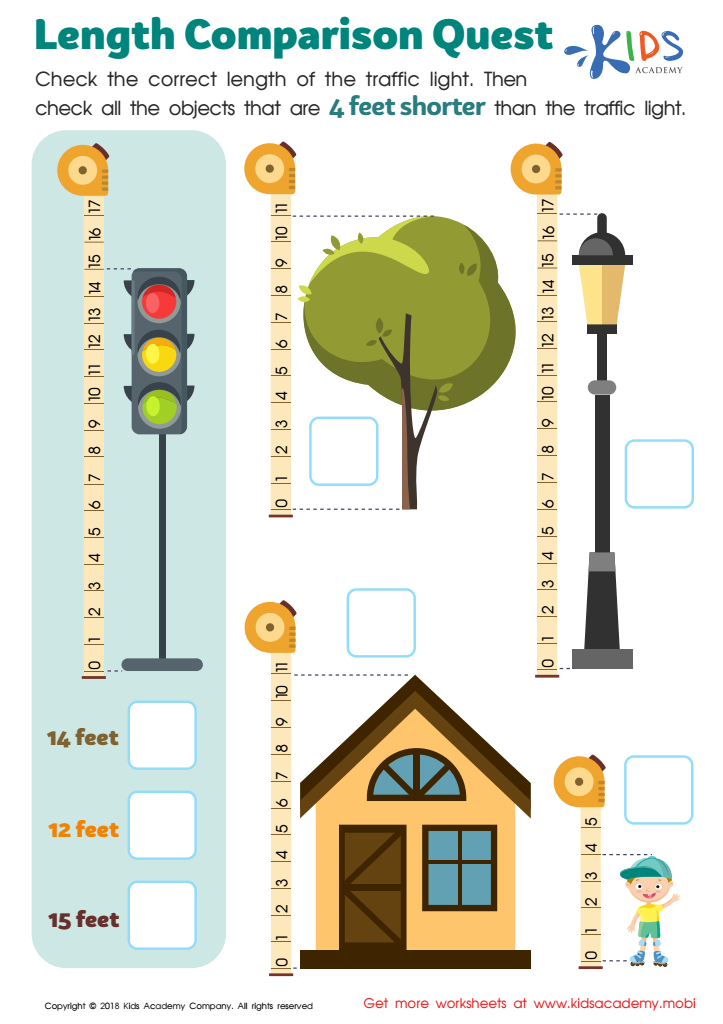
Length Comparison Quest Worksheet
Knowing measurement tools and how to use them is just the start. To be proficient, your kid must be able to accurately compare objects and their lengths. With the 'Length Comparison Quest' worksheet, they will check the correct length of the traffic light in the picture and then compare other objects to it, marking those that measure 4 feet shorter.
Length Comparison Quest Worksheet
Worksheet
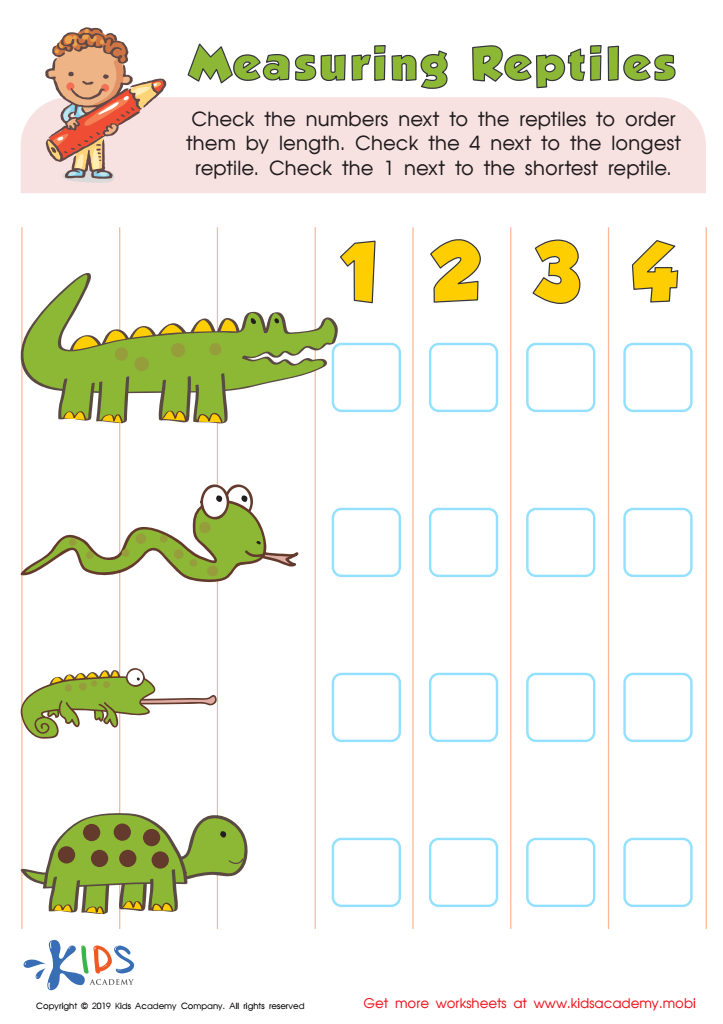
Measuring Reptiles Worksheet
Do your kids know what reptiles are? Ask them to name some and name features. In this activity, your kindergartners will measure with reptiles. Show them the picture and get them to order by length, starting with the one with 4 by the longest reptile, then the one with 1 by the shortest.
Measuring Reptiles Worksheet
Worksheet
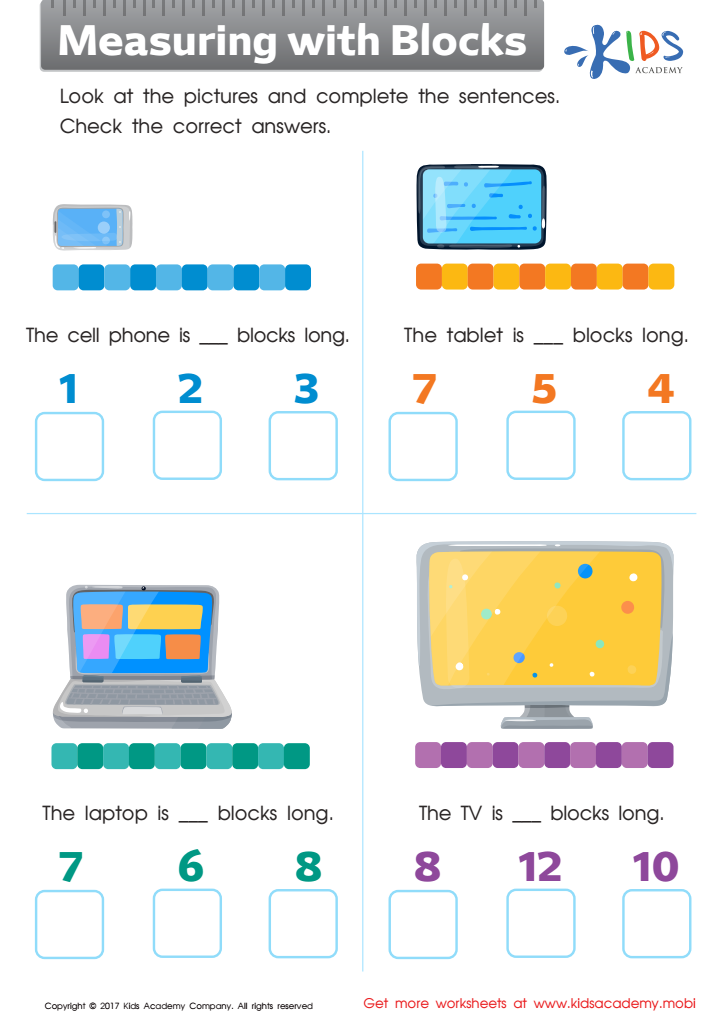
Measuring with Blocks Worksheet
Help your child get ready for math success with this Kids Academy worksheet. It provides colorful blocks to practice measuring objects. Coach them to count the boxes under each picture, then check the box with the right answer. It's a fun way to get acquainted with rulers!
Measuring with Blocks Worksheet
Worksheet
Let's Measure Animals! Worksheet
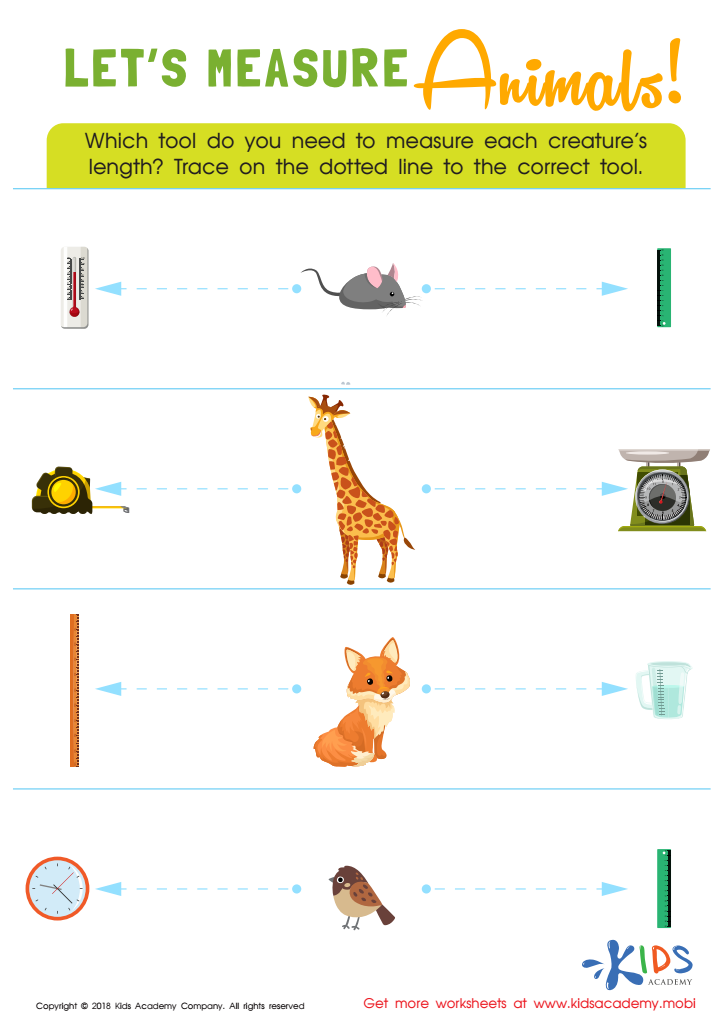
Have your students measure the length of animals like a mouse, giraffe, fox, and bird using this fun tracing sheet. They must carefully follow the dotted lines to the correct measuring tool, and by the end of the colorful worksheet, they'll know more about measuring and the different tools used.
Let's Measure Animals! Worksheet
Worksheet
Join Kids Academy for Free
Who is primarily going to use this learning content?








Comparing lengths is an essential early math skill that serves as the cornerstone for more advanced mathematical concepts children will encounter in the future. For ages 6-7, understanding how to compare and measure lengths lays the groundwork for grasping numbers, mastering basic arithmetic, and developing critical thinking abilities.
First, these activities strengthen a child's spatial awareness by helping them comprehend relative sizes and distances. This, in turn, enhances their ability to navigate and interact with the world around them. Additionally, comparing lengths introduces children to measurement vocabulary like "longer," "shorter," and "equal," enriching their language and communication skills.
From an academic perspective, skills in comparing lengths feed directly into other key areas. These tasks help children understand numerical relationships and sequences, which are fundamental to performing addition, subtraction, and even more complex mathematical operations later on. Furthermore, it nurtures problem-solving and logical reasoning. For instance, understanding that if object A is longer than object B, and object B is longer than object C, then object A is longer than object C—this logically structures their thought process.
Parents and teachers should care about this early measurement activity because it fosters a well-rounded educational experience, boosts a child’s confidence in handling numbers, and cultivates habit patterns useful for lifelong learning. Thus, investing time and attention in these skills offers long-term academic and practical benefits.








