Number Recognition Easy Addition & Subtraction Worksheets for Ages 6-8 - Page 2
25 filtered results
-
From - To
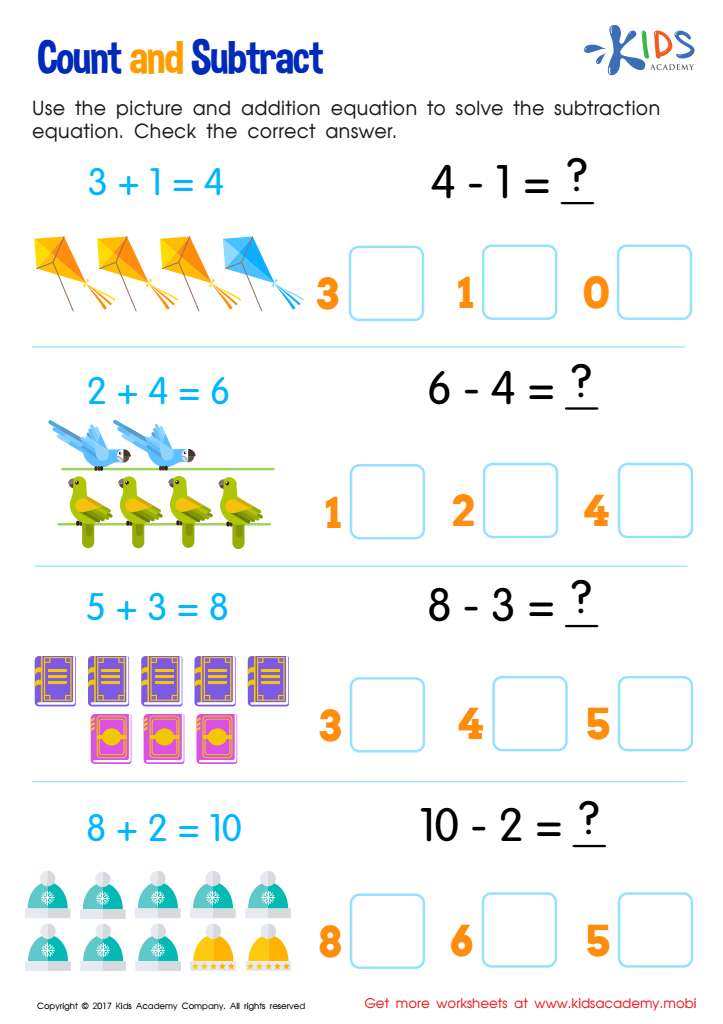
Count and Subtract Worksheet
 Assign to My Students








Parents and teachers should prioritize Number Recognition and basic Addition & Subtraction skills for ages 6-8 as they lay the educational foundation for more complex mathematical concepts. At this developmental stage, children transition from concrete knowledge to abstract thinking. Recognizing numbers solidifies their ability to understand quantity, which is fundamental for almost all subsequent mathematical operations.
Easy addition and subtraction not only enhance arithmetic skills but also improve problem-solving abilities and logical reasoning. These operations introduce the concepts of balancing equations, identifying patterns, and making predictions. Success in these foundational skills often boosts children's confidence, fostering a positive attitude toward learning and reducing math anxiety.
Furthermore, early proficiency in number-related tasks supports everyday activities such as telling time, handling money, and measuring ingredients in cooking. Strength in these skills is linked to better performance in later subjects, including science and technology, critical for academic progression and future career options.
Integrating Number Recognition and basic arithmetic in playful and engaging ways helps children develop essential skills without feeling overwhelmed, promoting lifelong numerical literacy and fostering critical life skills. Investing in this early educational stage can lead to long-term benefits both academically and practically.








