Basic Math Skills Easy Fractions of Shapes Worksheets for 7-Year-Olds
4 filtered results
Difficulty Level
Grade
Age
-
From - To
Subject
Activity
Standards
Discover our engaging "Basic Math Skills Easy Fractions of Shapes Worksheets" designed specifically for 7-year-olds! These colorful and interactive worksheets help young learners grasp the concept of fractions in a fun and accessible way. Children will develop their understanding of equal parts through visually appealing shapes, enhancing their mathematical knowledge with hands-on activities. Perfect for classroom use or as supplementary homework, these resources encourage critical thinking and boost confidence in math skills. Jumpstart your child's journey to mastering fractions and watch their excitement for learning grow! Explore our collection today for a fantastic, educational experience!
Favorites
With answer key
Interactive
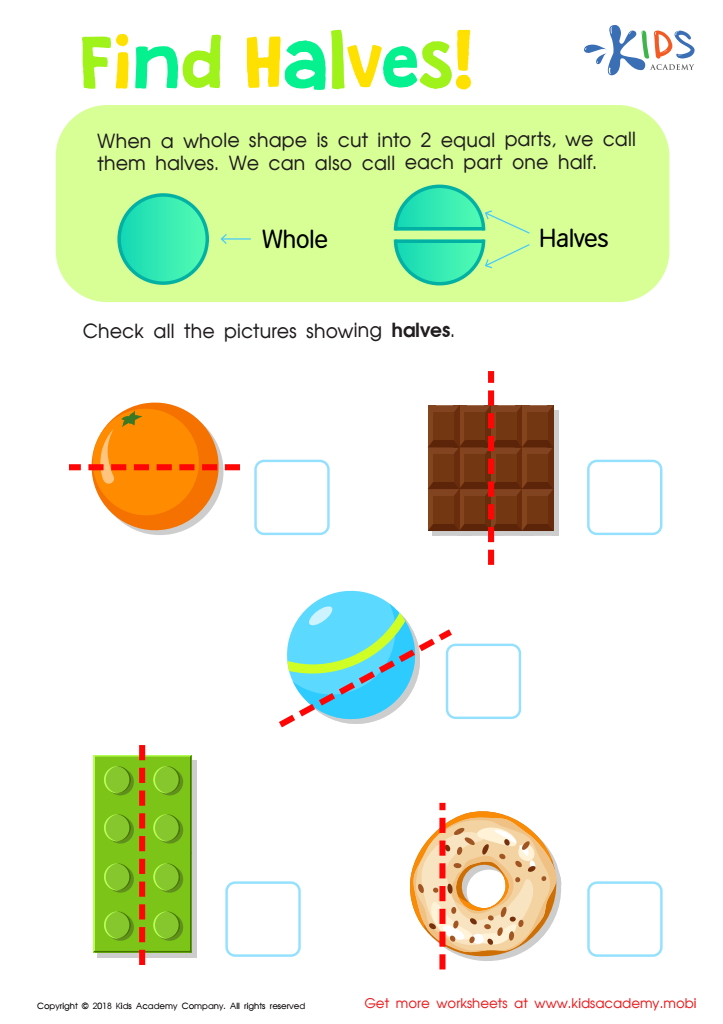
Find Halves Worksheet
If your child can tell you what two, three and four equal parts are called, give yourself a pat on the back! If not, this worksheet can help. Halves are two equal parts of a whole shape. Check the pictures in this printable pdf to help your child understand.
 Assign to My Students
Find Halves Worksheet
Worksheet
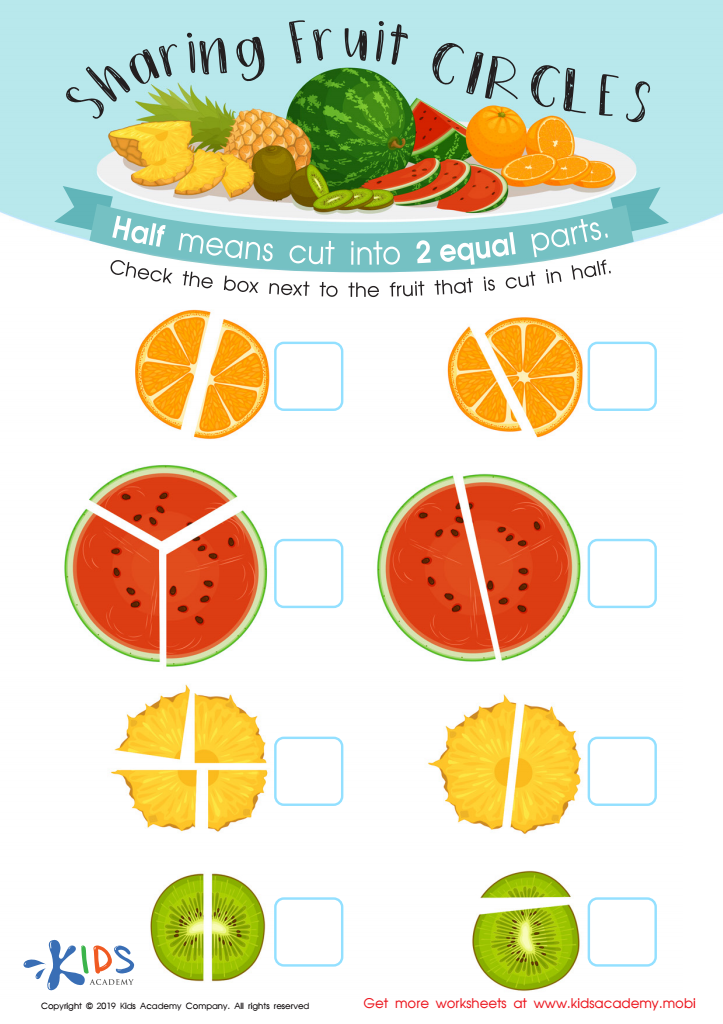
Sharing Fruit Circles Worksheet
Fruits are tasty and bright! Can your kids name some of their favorites? With this worksheet, you can use fruit to teach your kids geometry. Talk about how shapes can be cut into halves. Ask them to tick the box for the fruit halves in the printout.
Sharing Fruit Circles Worksheet
Worksheet
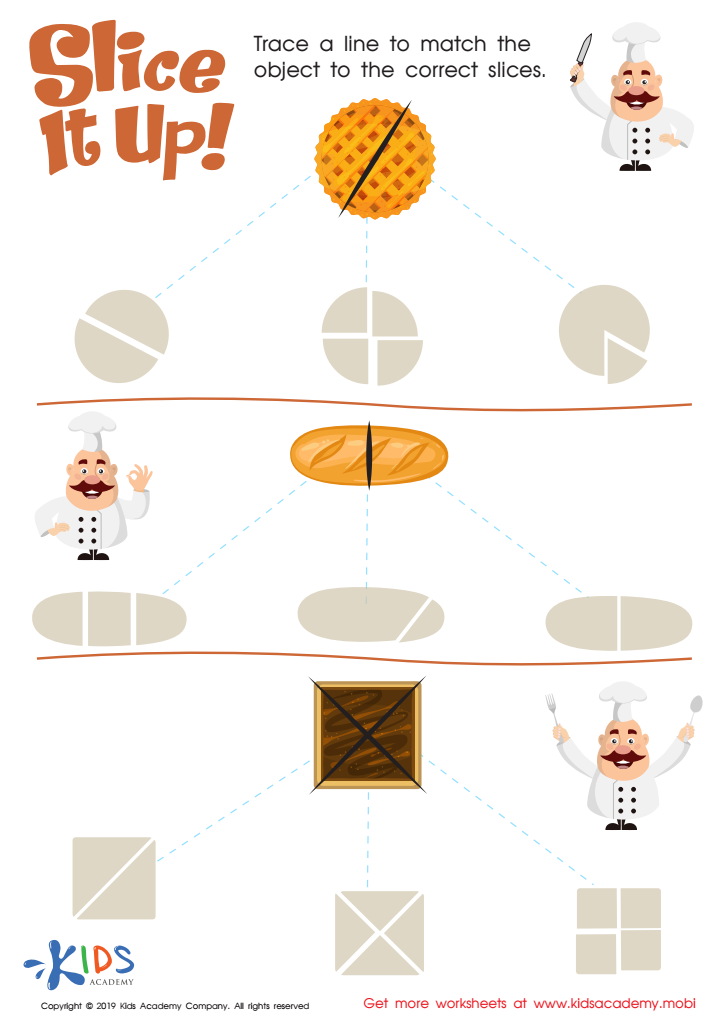
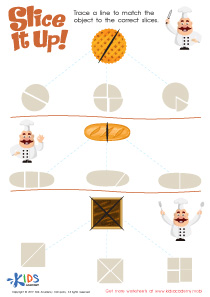
Slice It Up Worksheet
Try this fun math, reading and writing worksheet with your kids! They will love the colorful activities that perfect coordination and tracing. Engaging learning exercises help keep young minds sharp and boost skills. With these worksheets, your kids will be academically ahead of the curve!
Slice It Up Worksheet
Worksheet
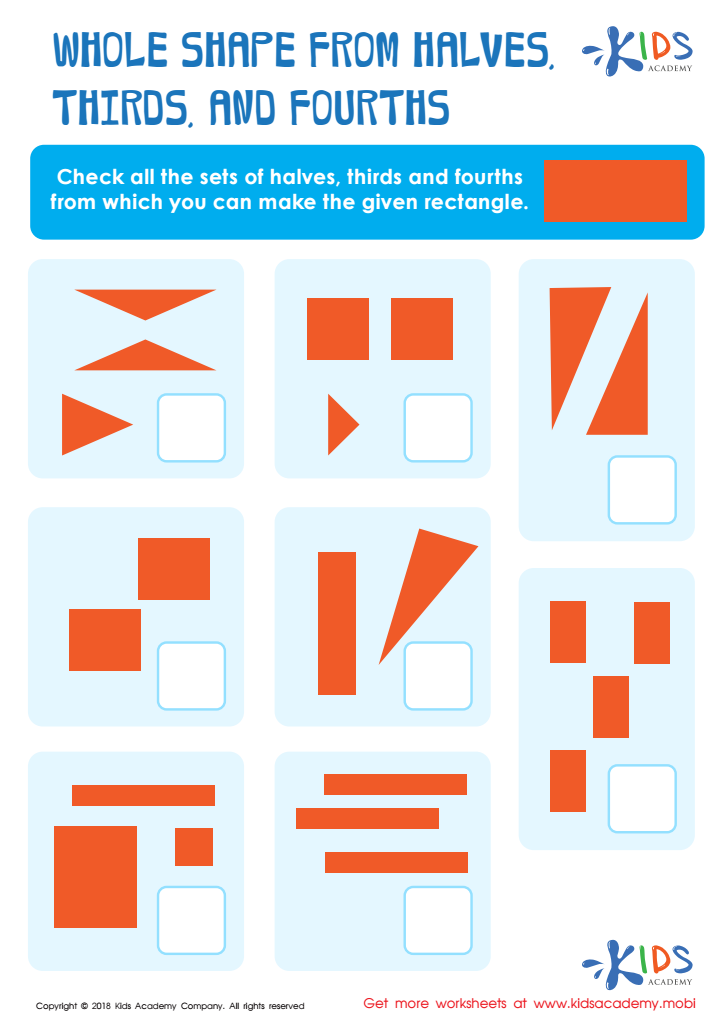
Whole Shape from Halves, Thirds and Fourths Worksheet
Explain to your students that they can make a new shape by combining halves, thirds, and fourths of a shape. Show them the worksheet with the rectangle at the top and ask them to find which sets of halves, thirds, and fourths make it. Have them check all the correct sets.
Whole Shape from Halves, Thirds and Fourths Worksheet
Worksheet
Join Kids Academy for Free
Who is primarily going to use this learning content?








Parents and teachers should prioritize teaching basic math skills, including easy fractions of shapes, to 7-year-olds for several important reasons. First and foremost, understanding fractions is foundational for a child's overall mathematical development. At this age, children are eager to grasp new concepts, and introducing easy fractions through visual aids, like shapes, helps build a solid base for more complex math in the future.
Moreover, teaching fractions using shapes makes abstract concepts tangible and relatable. Young minds can visualize how a circle can be split into halves, quarters, or thirds, fostering their ability to recognize parts of a whole. This clear understanding enhances spatial reasoning and makes math less intimidating.
Additionally, fractions are not just a school subject; they occur in everyday life—whether sharing pizza or measuring ingredients in cooking. By developing easy fraction skills early on, children gain essential problem-solving tools that boost their confidence and competence.
Lastly, nurturing these skills illuminates a lifelong appreciation for math. When parents and teachers actively engage with children in concepts like easy fractions, they help foster a positive attitude towards learning, ensuring that children not only excel academically but also enjoy the journey of mathematical discovery.