Number Recognition Easy Subtraction Worksheets for 7-Year-Olds
4 filtered results
Difficulty Level
Grade
Age
-
From - To
Subject
Activity
Standards
Discover our engaging and effective Number Recognition Easy Subtraction Worksheets tailored for 7-year-olds! Designed to boost essential math skills, these worksheets help young learners master subtraction while reinforcing their number recognition abilities. Each worksheet features colorful illustrations and interactive exercises that keep children motivated and excited about math. By practicing these worksheets, kids will gain confidence in their mathematical knowledge and improve their problem-solving skills. Perfect for classroom or home use, our resources are printable and easy to follow, making math fun and accessible. Enhance your child’s learning experience with our specially designed subtraction worksheets today!
Favorites
With answer key
Interactive
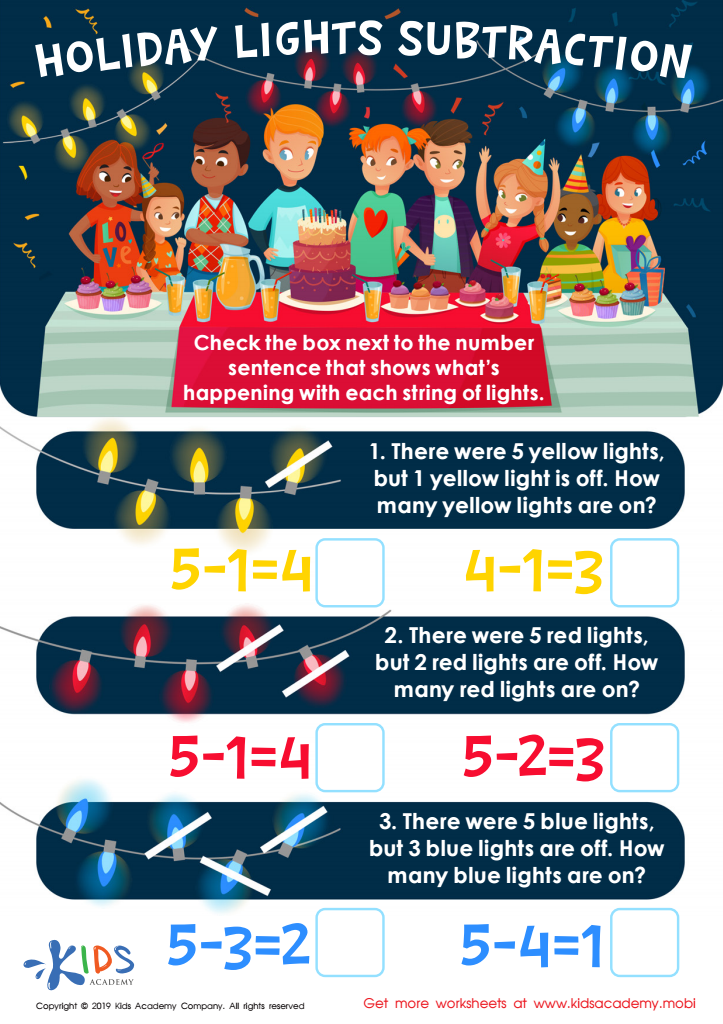
Holiday Lights Subtraction Worksheet
Before tackling the math problem, get your kids ready by asking them to share their favorite holiday and why. Then, look at the picture on the worksheet with them. Help them examine the numbers and problems, and select the number sentence that shows what's happening with each string of light. 80 words.
 Assign to My Students
Holiday Lights Subtraction Worksheet
Worksheet
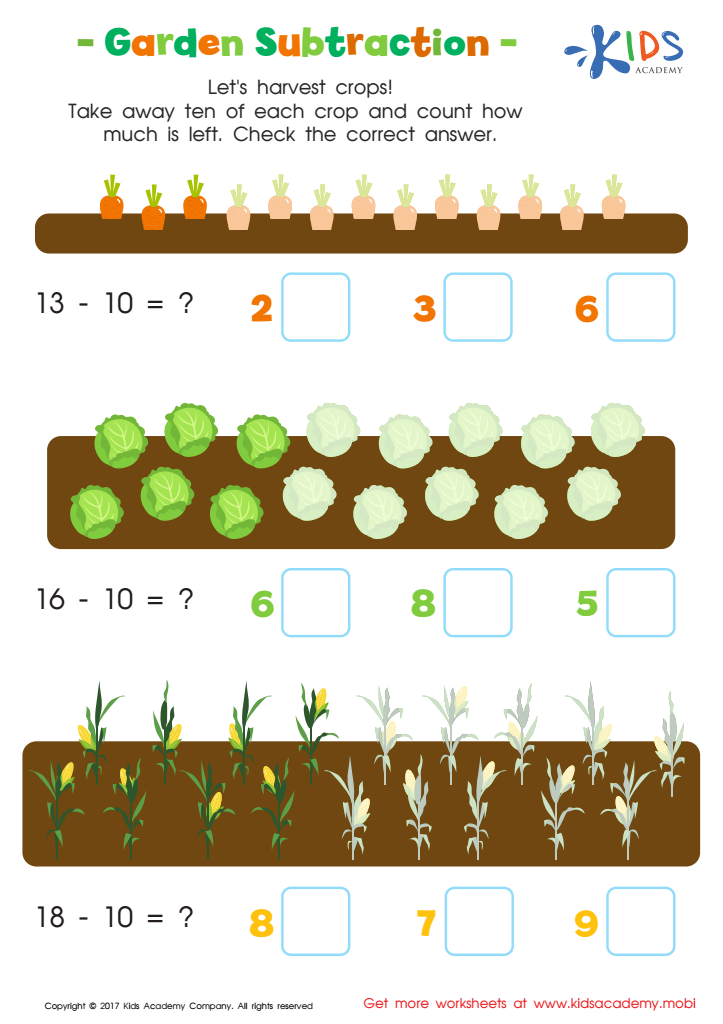
Garden Subtraction Worksheet
Help your kids understand math with this fun, garden-themed subtraction worksheet! Have them read the number sentences and count the veggies in each row. Then, subtract 10 from each row to find the answer. They'll love counting the colorful veggies and solving the problems!
Garden Subtraction Worksheet
Worksheet
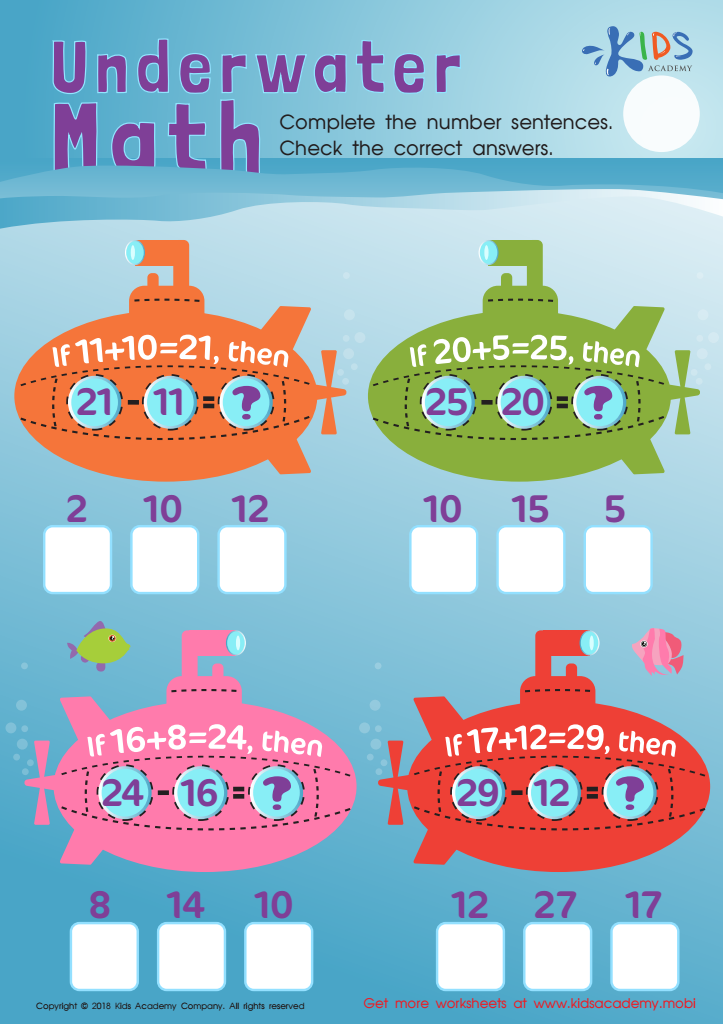
Addition and Subtraction: Underwater Math Worksheet
Take your little mathematicians on an undersea adventure as they work to solve number sentences. With fun worksheets, they'll analyze numbers, orders of operation and use if/then statements. They'll learn addition and subtraction are opposites, helping them solve more problems!
Addition and Subtraction: Underwater Math Worksheet
Worksheet
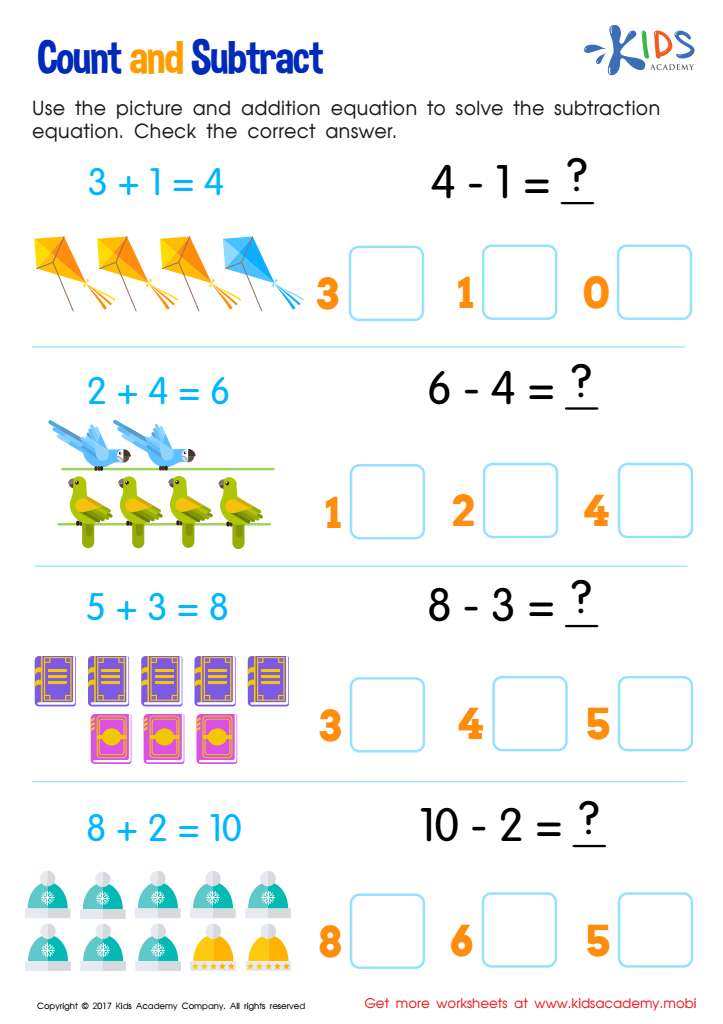
Count and Subtract Worksheet
This worksheet helps your child learn math via colorful pictures and equations. Count the items together, adding and subtracting as necessary. Your child will be challenged to get the correct total, thereby developing their math skills.
Count and Subtract Worksheet
Worksheet
Join Kids Academy for Free
Who is primarily going to use this learning content?








Number recognition and easy subtraction are foundational skills critical for a 7-year-old’s mathematical development. Mastery of these skills not only builds a child's confidence in math but also sets the stage for more complex concepts they will encounter in later years.
For parents and teachers, fostering number recognition ensures that children can identify and understand numbers, which is crucial for both academic success and real-world application. It lays the groundwork for understanding place value, measurement, and data interpretation.
Easy subtraction, on the other hand, promotes logical thinking and problem-solving abilities. By engaging with simple subtraction problems, children develop critical cognitive skills and learn to approach challenges systematically. Additionally, proficiency in subtraction allows children to tackle scenarios involving sharing, grouping, and even basic budgeting tasks later on.
Furthermore, early mathematical skills correlate strongly with later academic performance. Investing time and effort into these fundamental areas can yield significant long-term benefits, fostering a love for learning and mathematics in particular. Therefore, it's important for parents and teachers to recognize the significance of these skills and proactively support their development in young learners.