Basic Math Skills Grade 1 Money Worksheets
3 filtered results
Difficulty Level
Grade
Age
-
From - To
Subject
Activity
Standards
Enhance your first grader's financial literacy with our Basic Math Skills Grade 1 Money Worksheets! Designed specifically for young learners, these engaging and fun worksheets encourage kids to recognize, count, and manage money. By exploring essential concepts like coin identification, addition, and subtraction, children build a strong mathematical foundation. Perfect for use in classrooms or at home, our printable worksheets support a hands-on learning approach, making math practical and enjoyable. Help your child gain confidence and develop essential life skills with our expertly crafted money worksheets. Download today and watch your child excel!
Favorites
With answer key
Interactive
Money: Coins Dollars Printable
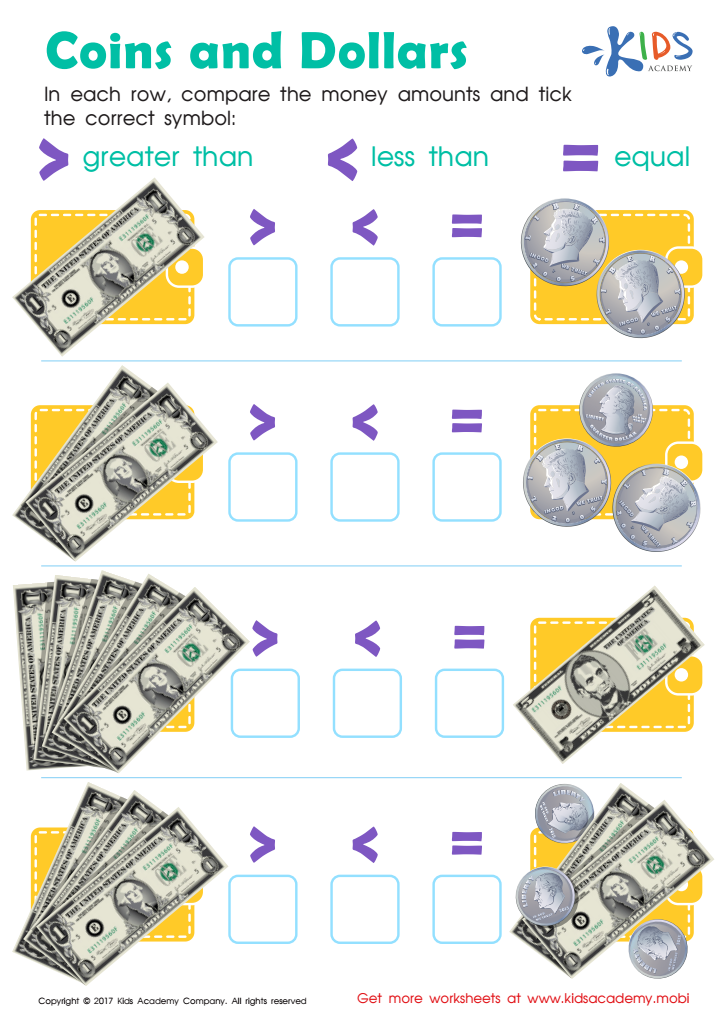
Motivate your kid to learn and practise essential math skills, like 'greater than' and 'less than', by introducing the importance of money! The money worksheet "Coins and Dollars" will give them a hands-on experience of counting coins and dollars, making math symbols more memorable.
 Assign to My Students
Money: Coins Dollars Printable
Worksheet
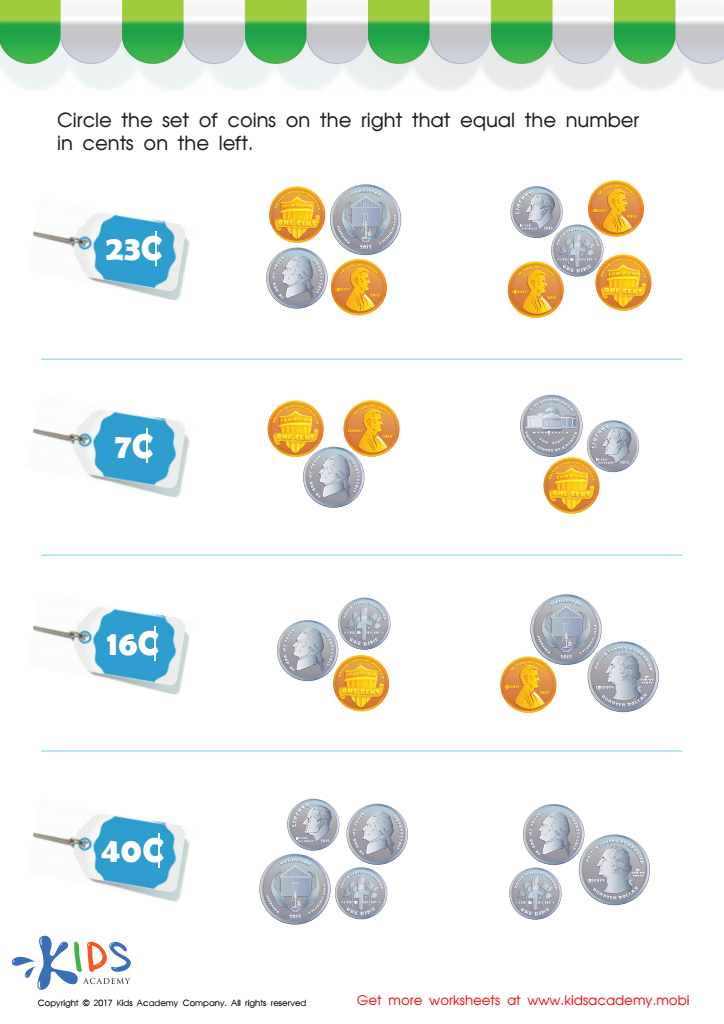
Picking the Coins You Need Money Worksheet
Let's learn to count money with Parents and Kids Academy! Investigate a real shop together: buy a globe, pencils, books, and a school bag using coins. Then, circle the coins you'll need. Visit our website for more free and fun money games for kids!
Picking the Coins You Need Money Worksheet
Worksheet
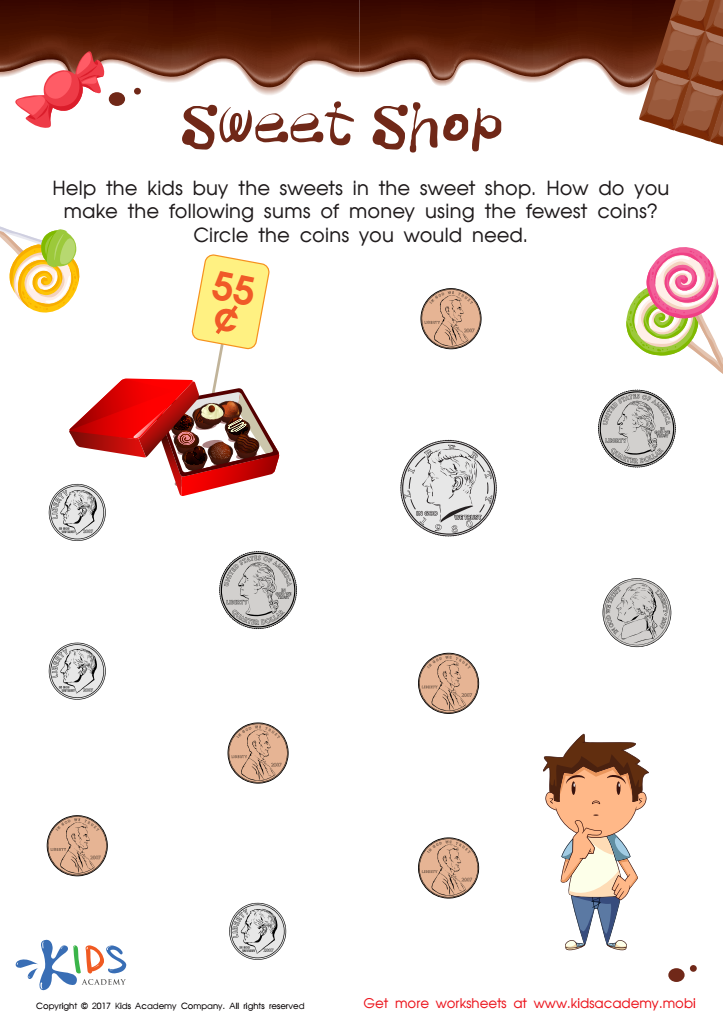
Sweet Shop – Counting Coins Worksheet
Help your child get ready to buy sweet treats with this coin counting worksheet. It'll challenge them to use the fewest coins possible. With knowledge of coin values, they'll work out the right combination to get the sweets!
Sweet Shop – Counting Coins Worksheet
Worksheet
Join Kids Academy for Free
Who is primarily going to use this learning content?







Basic math skills, especially those introduced in Grade 1, lay the foundation for a child's future understanding of more complex mathematical concepts. One key area is understanding money, which is crucial for real-world applications. Here’s why parents and teachers should place importance on this:
-
Practical Life Skills: Understanding money teaches children about financial literacy from an early age. They learn to recognize coins and bills, grasp the concept of value, and carry out simple transactions. This sets the stage for making responsible financial decisions in the future.
-
Cognitive Development: Learning about money strengthens cognitive functions such as addition, subtraction, and the understanding of equivalency (e.g., two nickels equal a dime). It enhances problem-solving skills and the ability to think logically.
-
Numeracy Skills: Mastery of basic math skills, including money, boosts overall numeracy. This is critical not just academically, but also in everyday tasks, from budgeting an allowance to shopping for groceries.
-
Engagement and Motivation: Money-related activities can be especially engaging for children because they relate to their daily lives. Handling real or play money captures their interest and provides practical examples they can relate to.
In summary, a solid grasp of money in Grade 1 builds necessary life skills, supports cognitive development, enhances numeracy, and makes learning engaging. This foundational knowledge benefits children academically and prepares them for real-world financial literacy.