
Vocabulary development Grade 1 Science Worksheets
5 filtered results
Difficulty Level
Grade
Age
-
From - To
Subject
Activity
Standards
Enhance your child’s science vocabulary with our Grade 1 Science Vocabulary Development Worksheets. These engaging printables are designed to boost young learners’ understanding of essential scientific terms and concepts. With activities covering various topics like weather, plants, and animals, kids will expand their vocabulary while exploring the wonders of science. Fun illustrations and interactive exercises make learning an enjoyable experience. Suitable for classroom use or at-home practice, our worksheets support first graders in laying a strong foundation for future scientific exploration. Empower your child’s language and cognitive skills with our expertly crafted educational resources.
Favorites
With answer key
Interactive
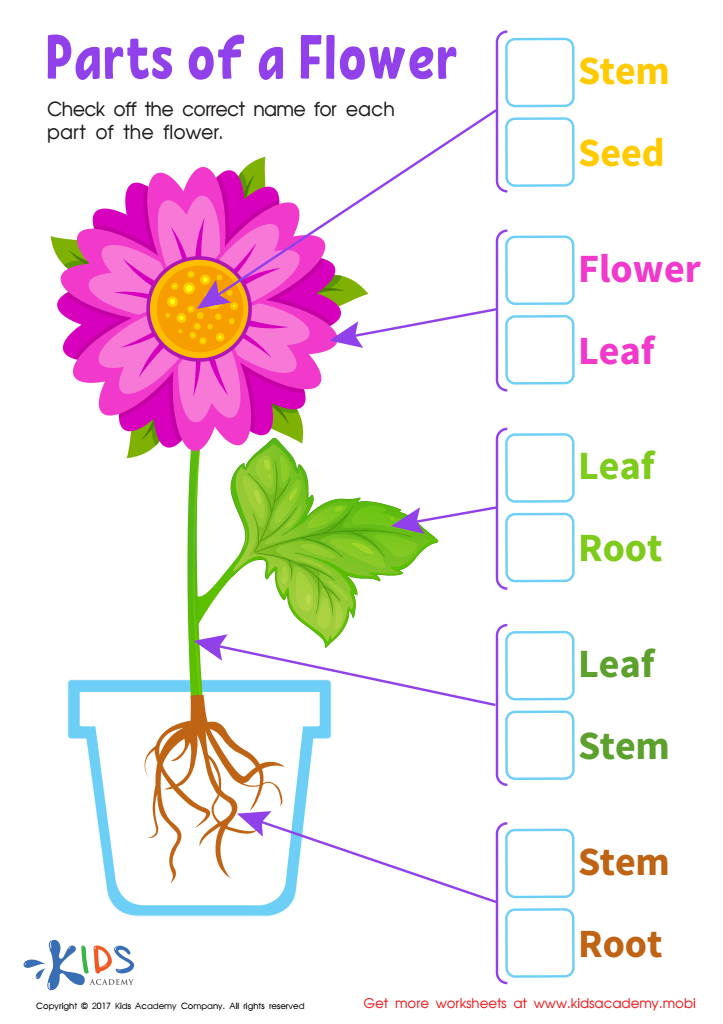
Parts Flower Printable
Introduce your child to life science with this vivid parts of a flower worksheet! They'll learn basic flower structures while building biology vocabulary and discovering plants are living creatures too! Perfect for budding little scientists!
Parts Flower Printable
Worksheet
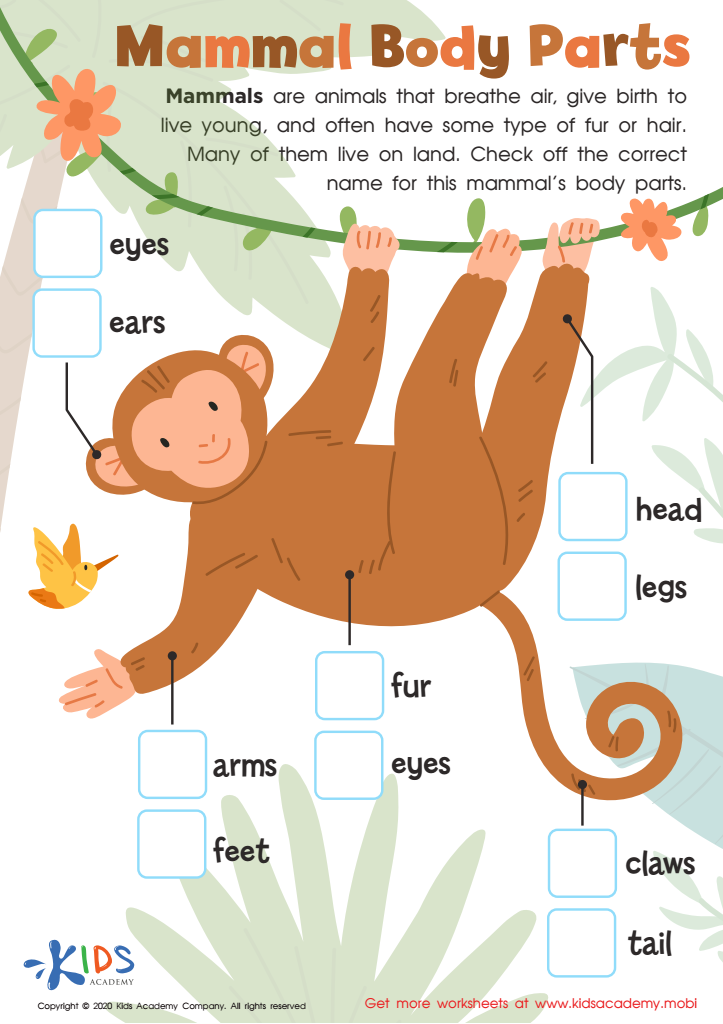
Mammal Body Parts Worksheet
Help your little scientist identify a mammal's body parts with this cute and colorful worksheet. It includes fur, arms, legs, tails, and more! Read the passage to learn what makes an animal a mammal, then have them check off the boxes to identify parts of the monkey. It's a fun way to learn about animals in the animal kingdom!
Mammal Body Parts Worksheet
Worksheet
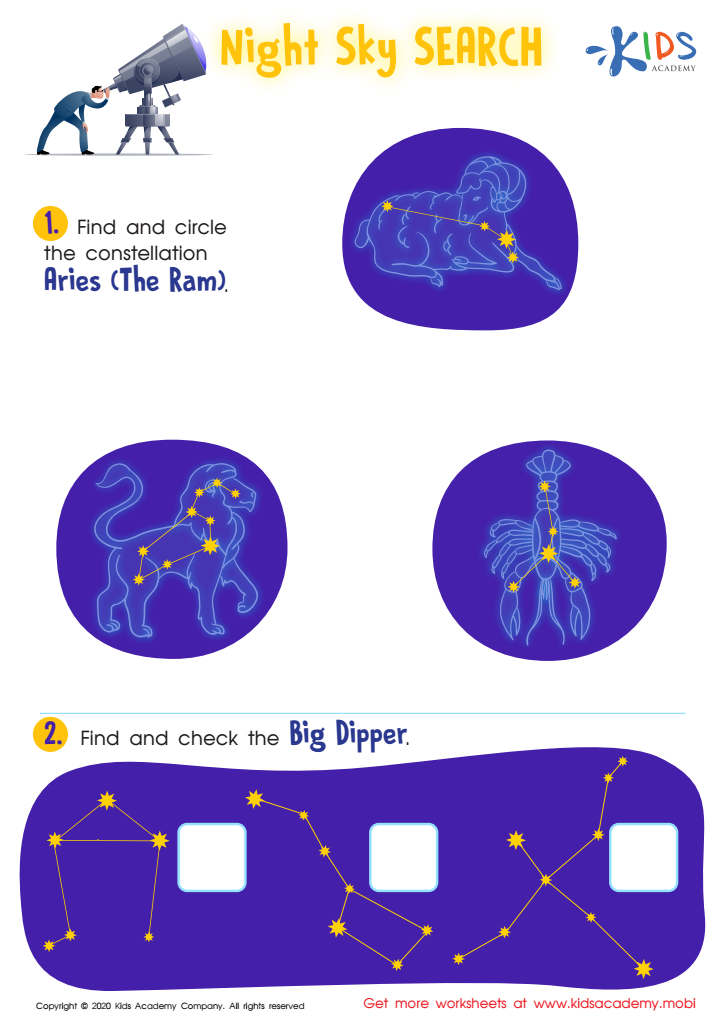
Night Sky Search Worksheet
Gaze up into the night sky and spot the stars! Your little astronomer can learn about Aries and Big Dipper constellations with this science worksheet. Simply find the ram for Aries and check the box for Big Dipper. Then, when the weather is right, go outside and look for them in the night sky!
Night Sky Search Worksheet
Worksheet
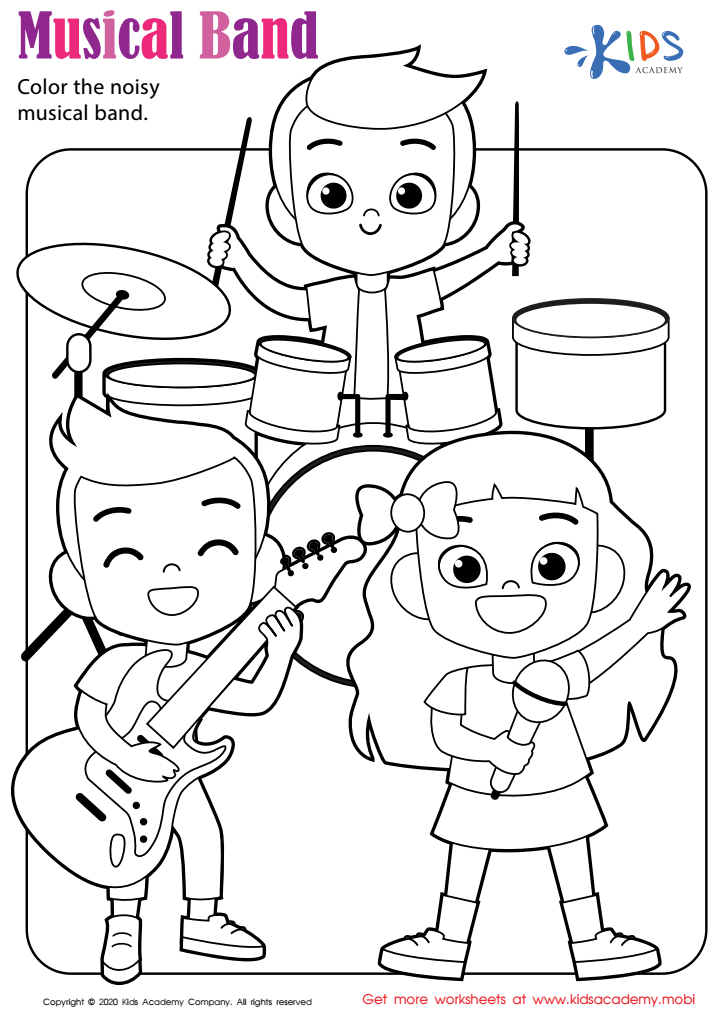
Musical Band Worksheet
Introduce music to your kids with this free printable coloring worksheet! Ask them to name the instruments and their sounds, then let them get creative with the colors. A band is formed when several people play instruments together - help your child learn this concept and get inspired to join a band one day!
Download (PDF)
 Assign to My Students
Assign to My Students
Musical Band Worksheet
Worksheet
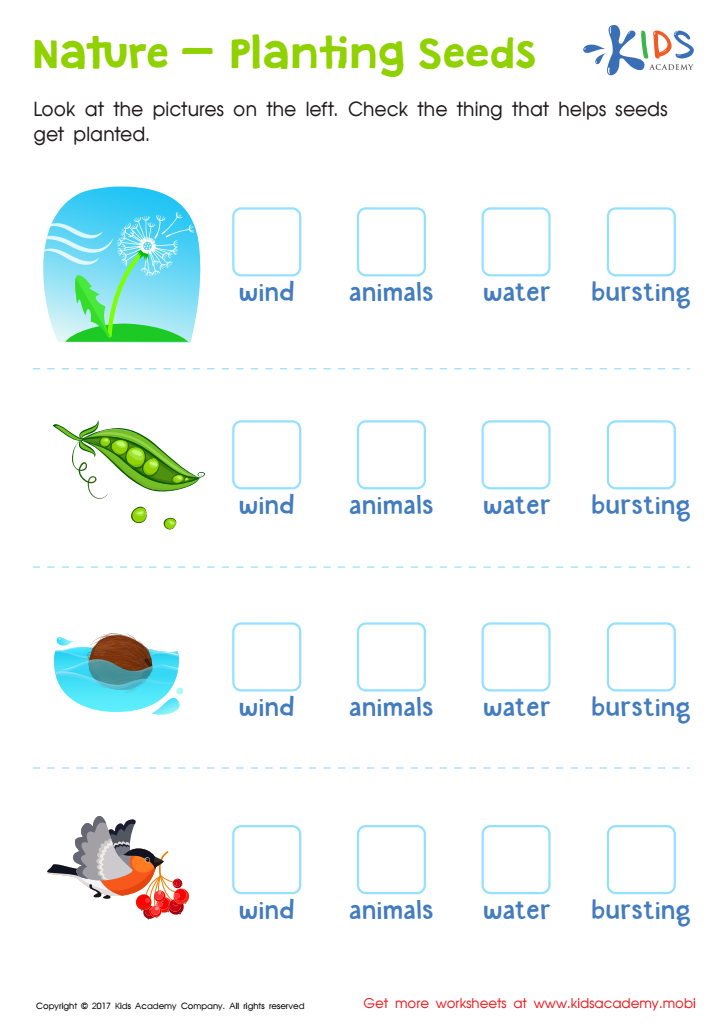
Nature Planting Seeds Worksheet
Help your child explore the fascinating cycle of plants and seeds with this worksheet. They'll learn how plants grow and how seeds travel to the ground. Challenge them to identify the right way each seed gets planted!
Nature Planting Seeds Worksheet
Worksheet
Join Kids Academy for Free
Who is primarily going to use this learning content?







Vocabulary development is crucial in Grade 1 Science because it supports overall learning, comprehension, and communication skills. At this stage, children are developing foundational knowledge that will support their academic growth throughout their education. Learning scientific vocabulary helps them grasp basic concepts more easily and fosters critical thinking.
When parents and teachers emphasize vocabulary development in science, they aid children in understanding complex ideas through simpler terms. For example, knowing words like "observe," "measure," and "predict" allows students to articulate what they see and think during experiments, thereby enhancing their analytical skills. Enhanced vocabulary also promotes curiosity and engagement as children feel more competent and interested in exploring scientific topics when they understand the terminology.
Furthermore, a strong vocabulary lays the groundwork for reading comprehension, not just in science but across all subjects. Children with robust vocabularies can better understand science textbooks, follow instructions for experiments, and participate in class discussions, all of which are essential for academic success.
Parents and teachers partnering to enrich children’s science vocabularies contribute to building their confidence, making learning enjoyable, and setting the stage for future scientific literacy and lifelong learning. Therefore, a focus on vocabulary development in early science education is fundamental in fostering well-rounded, curious, and capable learners.







