
Comparing lengths Extra Challenge Math Worksheets for Ages 3-4
3 filtered results
Difficulty Level
Grade
Age
-
From - To
Subject
Activity
Standards
Enhance your toddler’s math skills with our "Comparing Lengths Extra Challenge Math Worksheets for Ages 3-4." These engaging worksheets are expertly designed to introduce children to the concept of length comparison through fun, vibrant illustrations and activities. Perfect for preschoolers, they help develop critical thinking and fine motor skills by challenging kids to identify longer and shorter objects. Our printable worksheets ensure that learning is both educational and enjoyable, making math fun for your little ones. Visit us today at Kids Academy to download and ignite a lifelong love of learning in your child!
Favorites
With answer key
Interactive
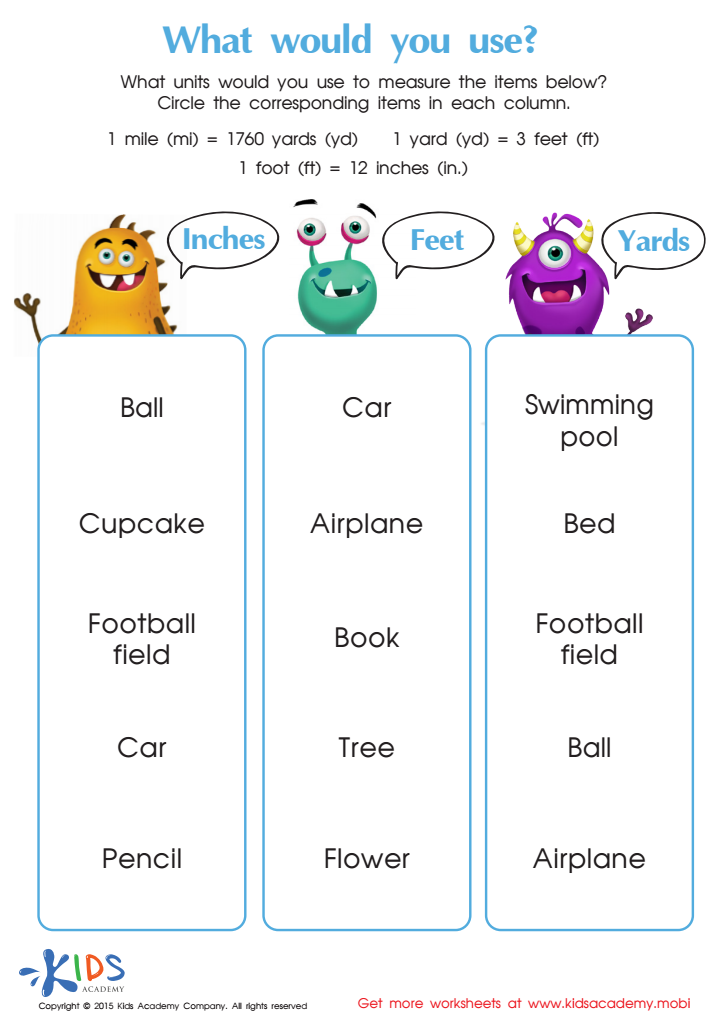
Learning about measuring objects in inches, feet and yards Worksheet
Download, cut and let your preschoolers learn and have fun estimating objects like pencils, airplanes and swimming pools in inches, feet and yards!
 Assign to My Students
Learning about measuring objects in inches, feet and yards Worksheet
Worksheet
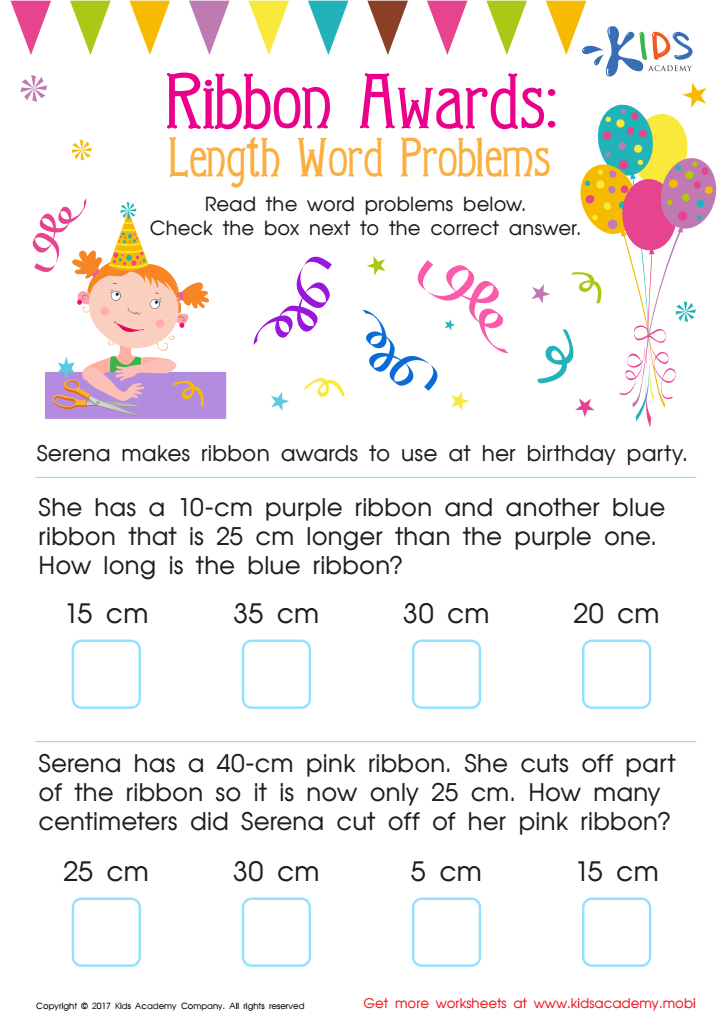
Length Word Problems Worksheet
Word problems help grade 2 students practice measurement using everyday scenarios. This worksheet provides practice in working with centimeters and inches, like measuring ribbon. It's a great way to learn and apply math skills.
Length Word Problems Worksheet
Worksheet
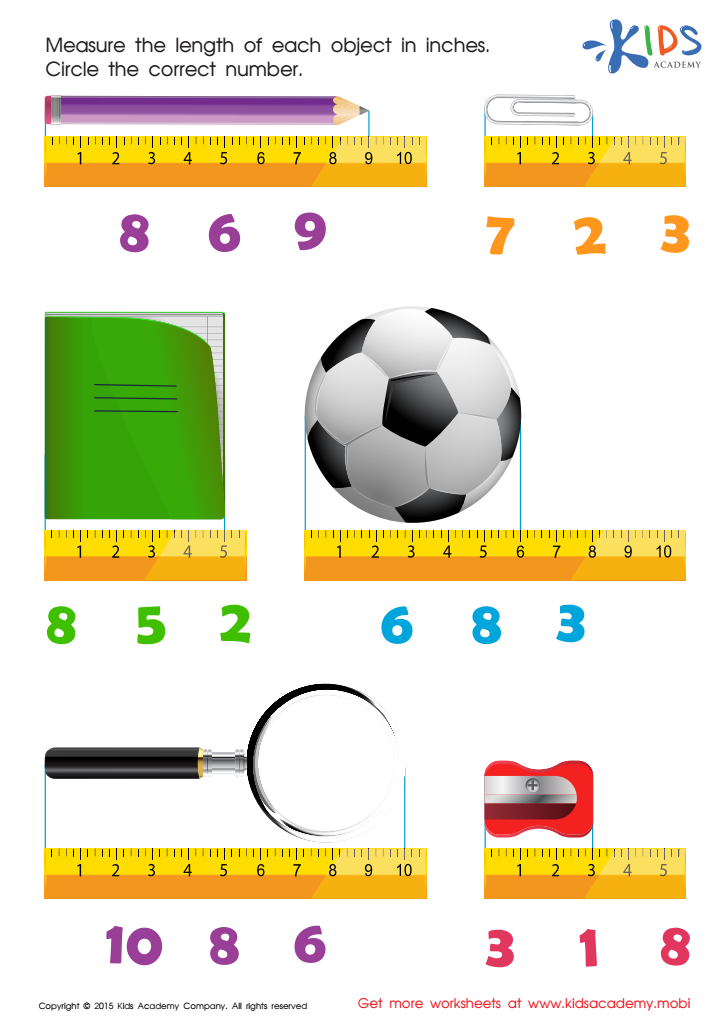
Learning measuring objects in inches Worksheet
Help your little learners gain confidence in using a ruler! Print out our free worksheet, cut out the inch ruler, and let them measure and record objects' width and length. Kids Academy has a variety of math worksheets to make learning math fun! Check out our website for more free printables!
Learning measuring objects in inches Worksheet
Worksheet
Join Kids Academy for Free
Who is primarily going to use this learning content?






.jpg)

Introducing the concept of comparing lengths to children aged 3-4 is vital for cognitive and motor skill development. This early exposure to mathematical thinking fosters critical problem-solving abilities and spatial awareness. At this age, children's brains are extremely adaptable, and engaging them with tasks that involve comparing lengths often stimulates their curiosity and lays the foundation for later mathematical learning.
Additionally, activities that challenge children to compare lengths can significantly improve fine motor skills and hand-eye coordination. For example, handling physical objects to compare their dimensions requires precise manipulation, enhancing dexterity and control. These activities also encourage children to use descriptive language, which can improve their communication skills. They learn to use terms like "longer," "shorter," "taller," and "smaller," expanding their vocabulary in a meaningful context.
For parents, participating in these activities provides quality bonding time and enhances their child's academic readiness. Teachers benefit as well, as engaging kids in such exercises can foster a supportive classroom environment where children feel confident in exploring new ideas. Ultimately, incorporating comparing lengths into early math education supports holistic developmental growth and lifelong learning skills. When children grasp basic concepts of measurement early, they become more adept at tackling complex mathematical challenges in the future.








