Time reading skills Extra Challenge Time Worksheets for Ages 3-5
3 filtered results
Difficulty Level
Grade
Age
-
From - To
Subject
Activity
Standards
Unlock your child's potential with our "Time Reading Skills Extra Challenge Worksheets" designed for ages 3-5! These engaging worksheets offer young learners an exciting way to enhance their understanding of time. With colorful illustrations and kid-friendly activities, children will practice reading clocks, understanding hours and half-hours, and developing crucial time management skills. Perfect for home or classroom use, our worksheets foster independence and boost confidence in time-telling abilities. Tailored for early learners, these extra challenge worksheets encourage exploration and discovery, setting a strong foundation for future learning. Download now and start your child's journey towards mastering time!
Favorites
With answer key
Interactive
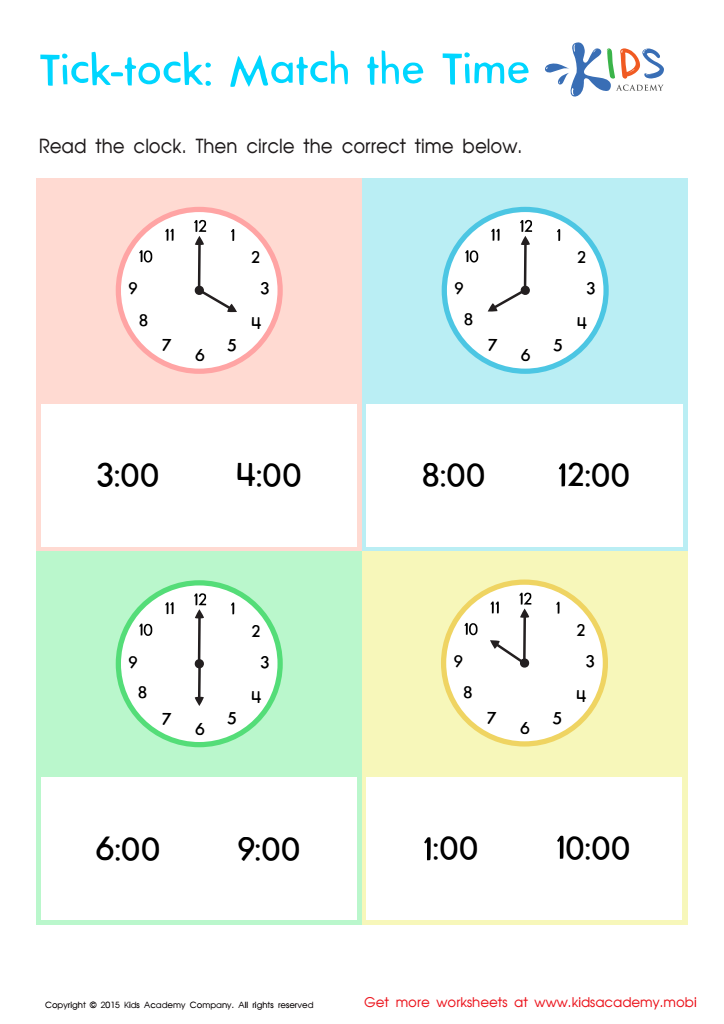
Telling The Time Worksheet: Part 4
Test your skills in telling the time! Circle the right time on 4 analog clock faces.
 Assign to My Students
Telling The Time Worksheet: Part 4
Worksheet
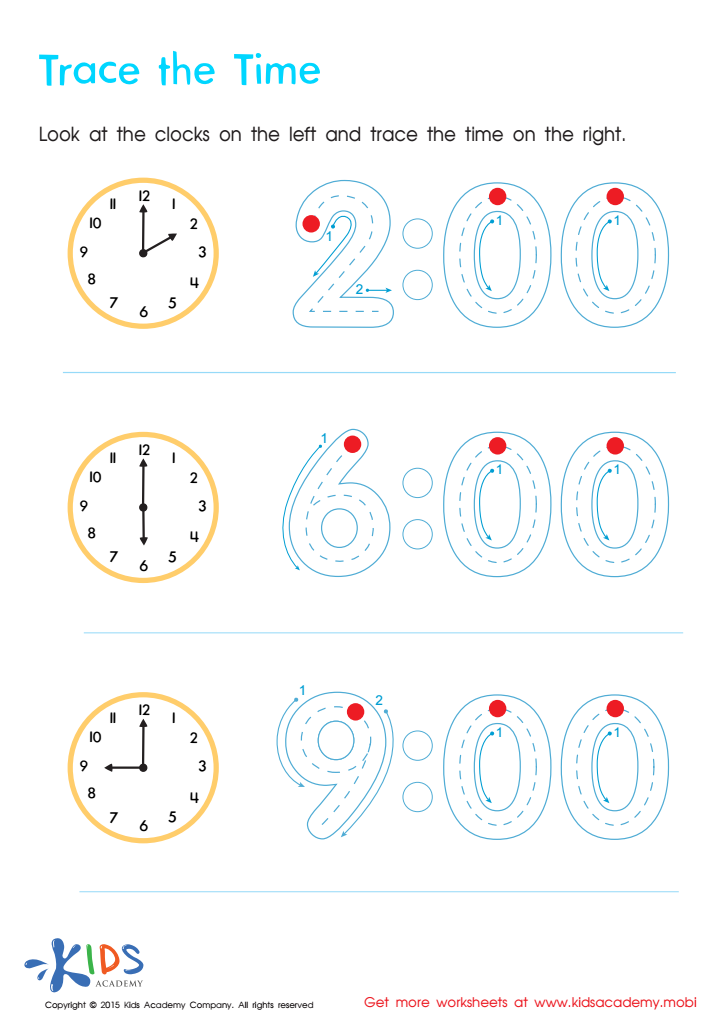
Telling The Time Worksheet: Part 2
Help your kids learn to tell the time with this free math worksheet from Kids Academy. Have them look at the clock faces and trace the time on the right - is it a full hour or half an hour? Get more practice with our wide selection of math worksheets for kindergarten.
Telling The Time Worksheet: Part 2
Worksheet
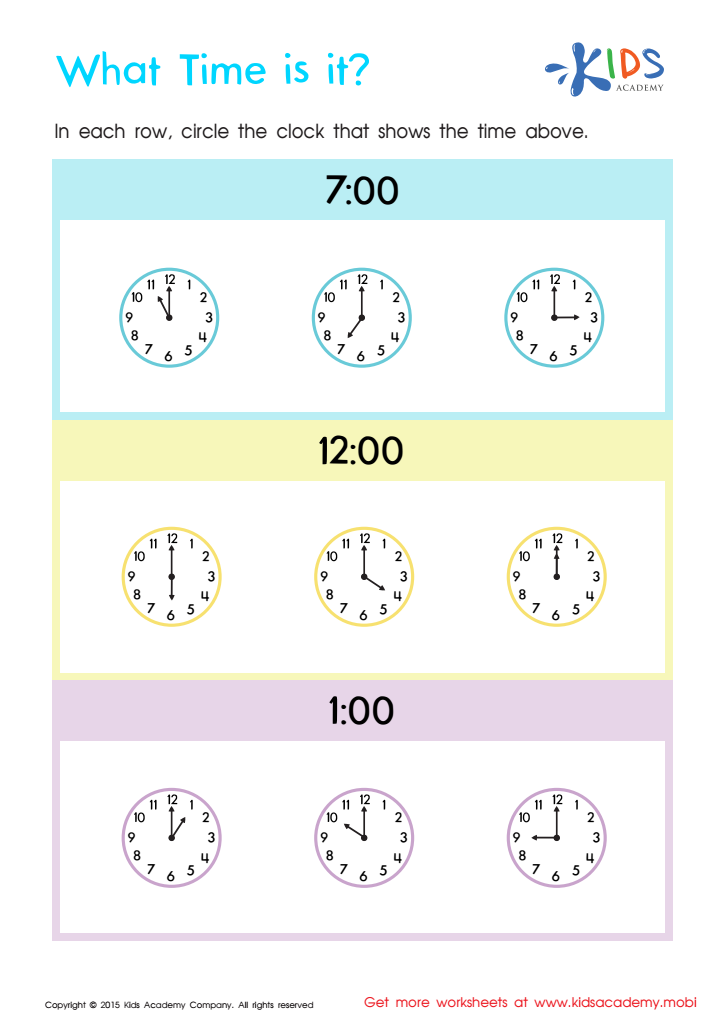
Telling The Time Worksheet: Part 3
Make learning to read clocks fun with our free printable worksheets! Have kids circle the clocks that show the time, remembering that the short hand is for hours and the long one is for minutes. For more worksheets, visit Kids Academy and explore the wonderful world of math with your little learners.
Telling The Time Worksheet: Part 3
Worksheet
Join Kids Academy for Free
Who is primarily going to use this learning content?








Time reading skills are crucial for children aged 3-5 as they lay the foundation for their ability to understand and interpret the world around them. At this age, children are naturally curious, and developing time literacy enhances their cognitive and social skills. Parents and teachers should be particularly attentive to this aspect of learning, as recognizing and understanding time helps childrenbuild rhythm in their daily lives—such as knowing when to wake up, when to play, and when to eat.
Having a grasp of time reading skills encourages responsibility as children begin to comprehend schedules and routines. It also nurtures key mathematical competencies, like sequencing and measuring, even in simple contexts. Furthermore, time-related discussions promote vocabulary development and strengthen critical thinking, as children learn to compare durations, make estimations, and predict outcomes.
Engaging in activities that promote time reading—such as storytelling, games, and interactive lessons—stimulates interest and exploration. Involving parents through regular conversations around clocks, calendars, and daily schedules enriches the learning experience, reinforcing the importance of time in everyday life. Hence, prioritizing time reading skills is essential for a well-rounded early education, making it critical for both parents and teachers.