Understanding plurals Extra Challenge Grammar Worksheets for Ages 3-6
3 filtered results
Difficulty Level
Grade
Age
-
From - To
Subject
Activity
Standards
Boost your child's grammar skills with our "Understanding Plurals Extra Challenge Grammar Worksheets for Ages 3-6". These engaging and educational worksheets are designed to help young learners master the concept of plurals through fun activities and exercises. Each worksheet focuses on different word endings, provides practice for both regular [-s, -es] and irregular plurals, and incorporates colorful illustrations to keep kids motivated. Perfect for preschool and early elementary students, these challenges enhance both reading and writing skills, paving the way for successful literacy development. Give your little ones a head start with our expertly crafted resources.
Favorites
With answer key
Interactive
Plural Nouns Practice Worksheet
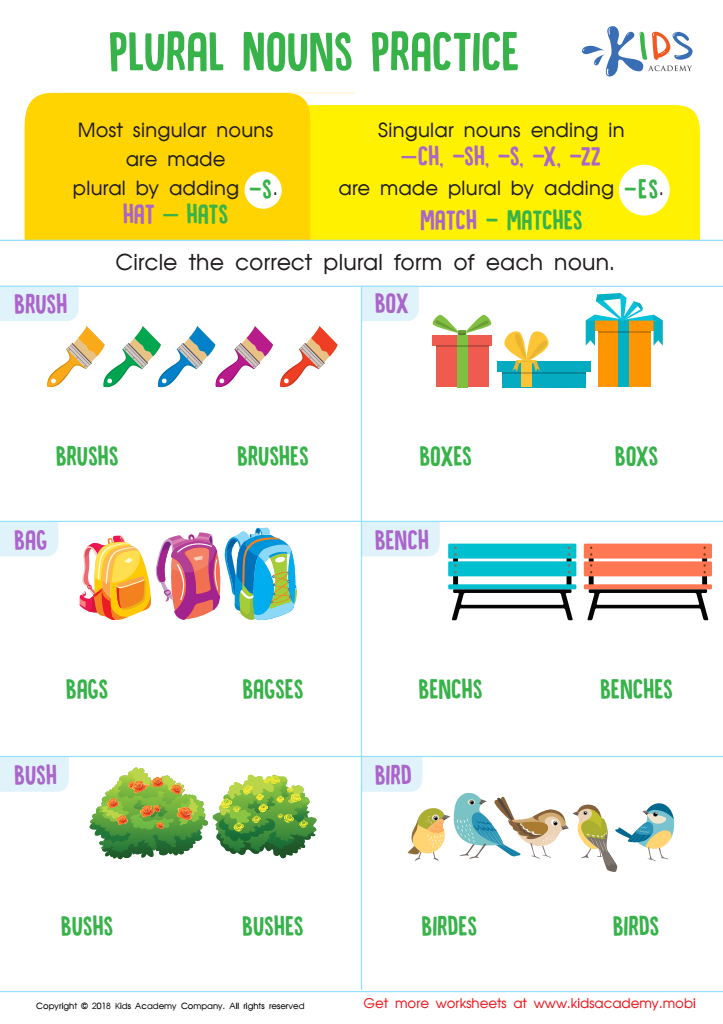
Explain to your child that most singular nouns become plural by adding "-s". E.g. "cat"->"cats". For words ending in "-ch", "-sh", "-s", "-x", or "-zz", add "-es". E.g. "buzz"->"buzzes". Then, get them to circle the right plural form of each noun on the worksheet.
 Assign to My Students
Plural Nouns Practice Worksheet
Worksheet
Plural Nouns Maze Worksheet
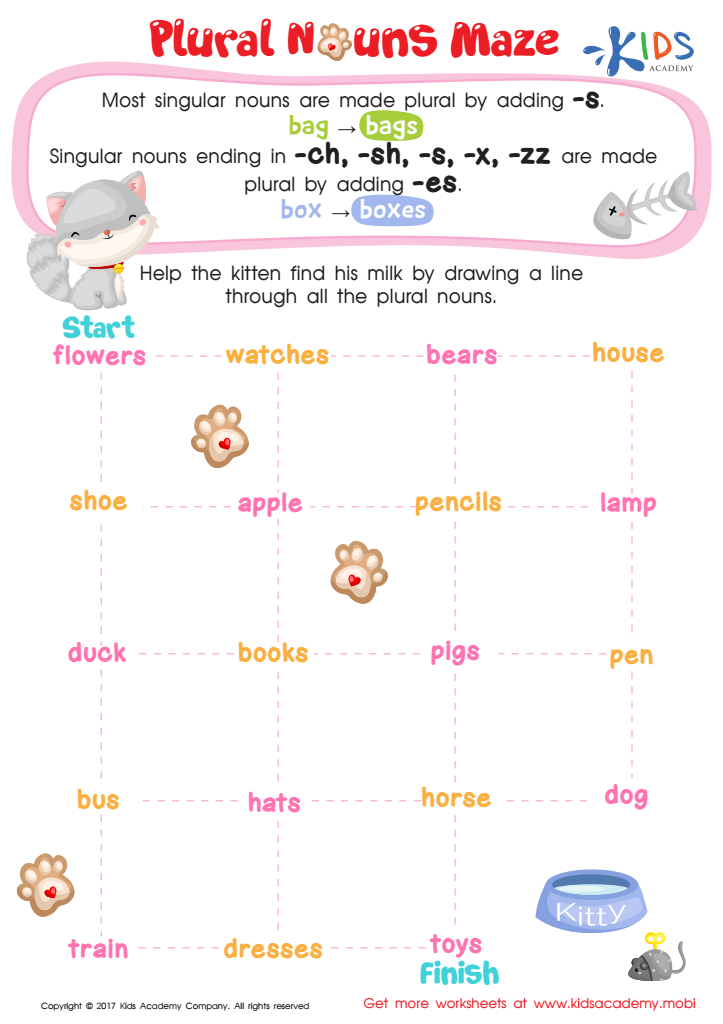
Oh no, the kitty needs her milk! Help your learner navigate the maze by drawing a line through the plural words. Review the grammar rules on -s and -es endings, then get to work to guide the kitten to her bowl! Download this PDF worksheet to start.
Plural Nouns Maze Worksheet
Worksheet
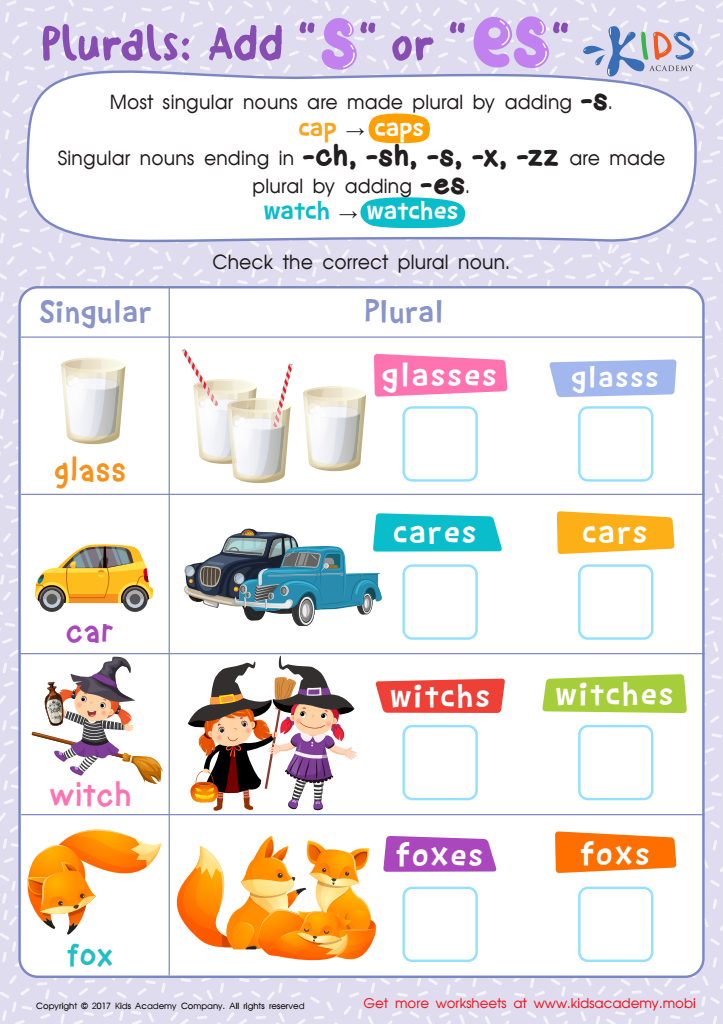
Plurals: "–es" or "–es"? Worksheet
Learning plural nouns can be tough for young readers. This worksheet shows them the difference between singular and plural spelling with cute images. Read each word and check the correct version. Remind them why the other ending can't be used.
Plurals: "–es" or "–es"? Worksheet
Worksheet
Join Kids Academy for Free
Who is primarily going to use this learning content?







Understanding plurals and engaging with extra challenge grammar activities for ages 3-6 is important for several reasons. For young children, language development acts as a foundational pillar for later academic success and effective communication. First, mastering plurals helps children grasp the concept of quantity and number, which is critical in both conversational and written language. It enables them to articulate properly whether they are referring to one or multiple items, thus enhancing their clarity in communication.
Secondly, introducing complex grammar earlier, such as plural formation (regular -s or-irregular forms like 'mice' and 'feet'), stimulates cognitive development. It improves their pattern recognition, memory, and even their problem-solving skills. Studies have indicated that early exposure to structured grammar increases linguistic performance as children age, cultivating a deep understanding of the language framework.
Moreover, working on plurals and extra grammar challenges can sharpen listening and speaking abilities. Correctly using plurals entails thinking about word sequences, which can contribute to their reading and writing proficiency later on.
Parents and teachers play a vital role in fostering a rich language environment. Through interactive activities, storybooks, games, and day-to-day conversations, they can seamlessly integrate grammar skills, making learning both fun and effective. Establishing these basics early provides children with tools that will benefit their educational journey and everyday interactions.