Understanding plurals Extra Challenge Writing Worksheets for Ages 3-6
3 filtered results
Difficulty Level
Grade
Age
-
From - To
Subject
Activity
Standards
Unlock the magic of plural nouns with our "Understanding Plurals Extra Challenge Writing Worksheets" designed for ages 3-6! These carefully curated worksheets provide young learners with an engaging approach to mastering plural formation, from simple -s endings to irregular plurals. Through fun exercises and creative writing tasks, children enhance their literacy skills while building a solid grammatical foundation. Perfect for parents and teachers, our printable activities support early writing development and foster a lifelong love for learning. Watch your little ones flourish as they tackle these extra challenges with confidence and joy!
Favorites
With answer key
Interactive
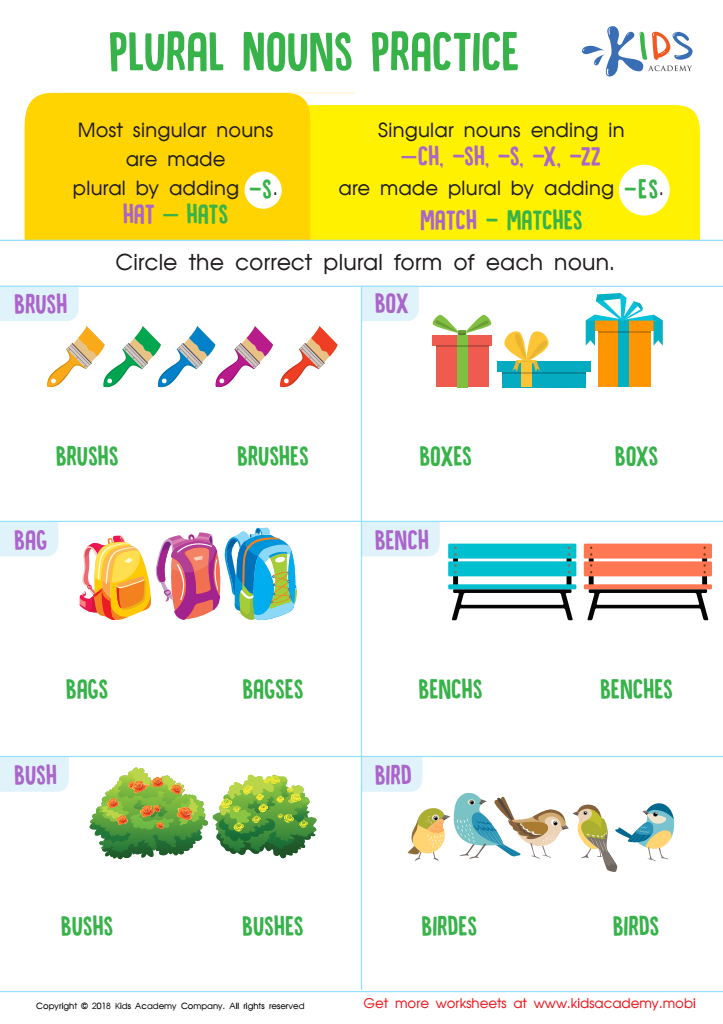
Plural Nouns Practice Worksheet
Explain to your child that most singular nouns become plural by adding "-s". E.g. "cat"->"cats". For words ending in "-ch", "-sh", "-s", "-x", or "-zz", add "-es". E.g. "buzz"->"buzzes". Then, get them to circle the right plural form of each noun on the worksheet.
 Assign to My Students
Plural Nouns Practice Worksheet
Worksheet
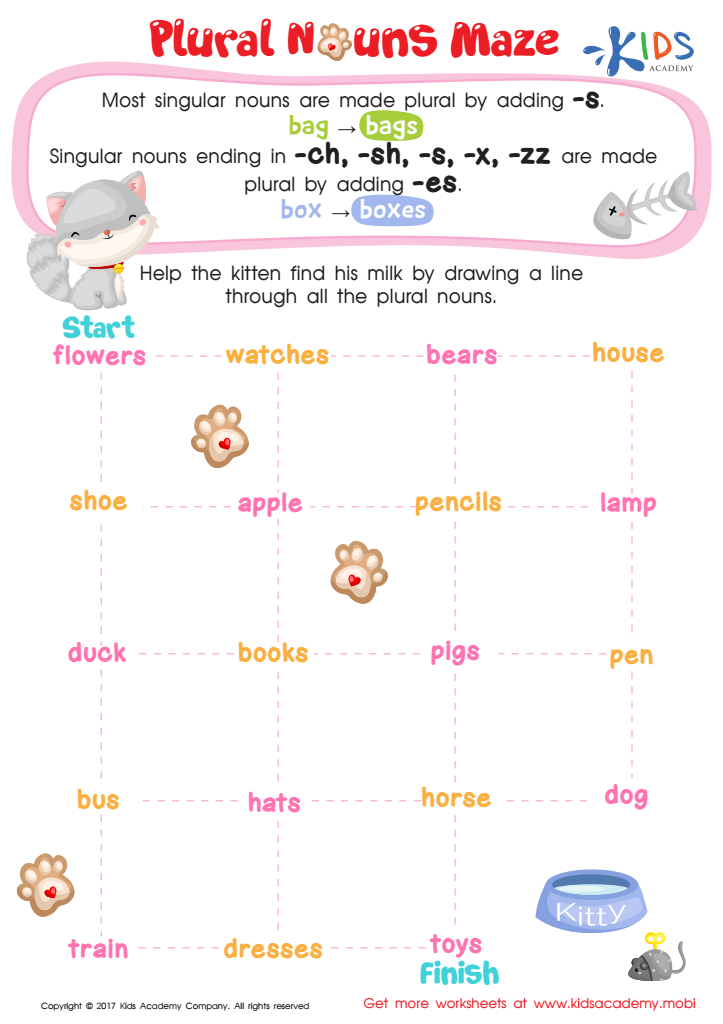
Plural Nouns Maze Worksheet
Oh no, the kitty needs her milk! Help your learner navigate the maze by drawing a line through the plural words. Review the grammar rules on -s and -es endings, then get to work to guide the kitten to her bowl! Download this PDF worksheet to start.
Plural Nouns Maze Worksheet
Worksheet
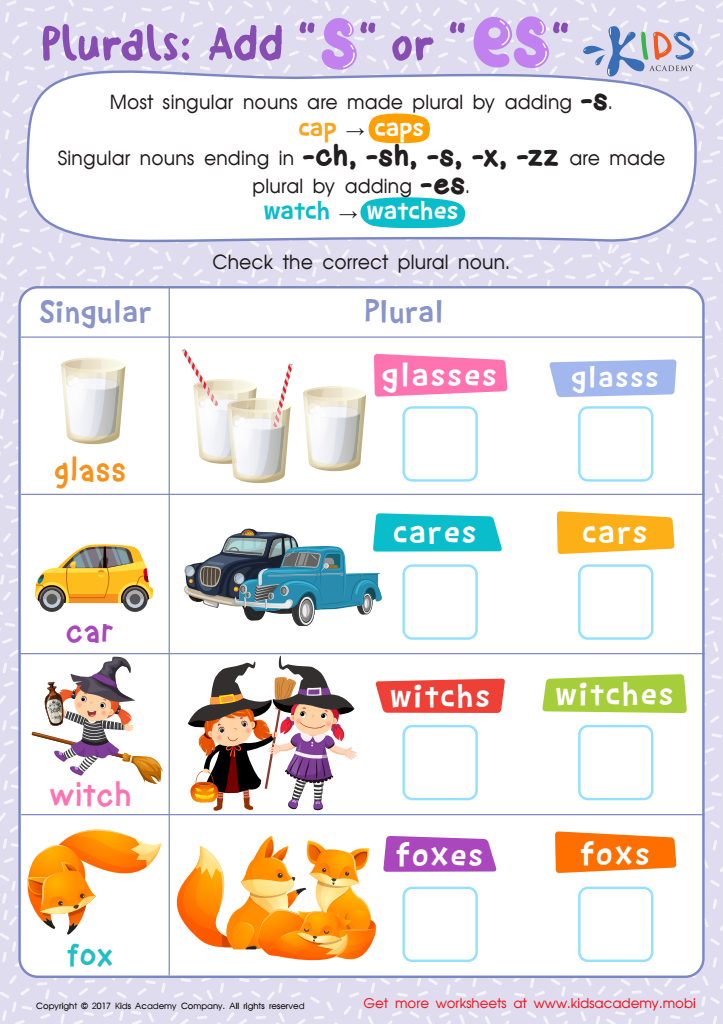
Plurals: "–es" or "–es"? Worksheet
Learning plural nouns can be tough for young readers. This worksheet shows them the difference between singular and plural spelling with cute images. Read each word and check the correct version. Remind them why the other ending can't be used.
Plurals: "–es" or "–es"? Worksheet
Worksheet
Join Kids Academy for Free
Who is primarily going to use this learning content?








Understanding plurals is a fundamental aspect of early language development for children ages 3-6. At this stage, children are in the critical period of learning the building blocks of communication, phonics, vocabulary, and grammar. Mastery of plurals not only expands their vocabulary but also enhances their ability to describe and comprehend the world around them. It helps children differentiate between singular and multiple items, which is crucial for clear and accurate communication.
For parents and teachers, emphasizing plurals through extra challenge writing activities encourages active engagement with language. It prompts children to think critically about word forms and usage, fostering a deeper understanding of linguistic patterns. This foundation is essential for later reading comprehension and writing skills, as understanding plurals contributes to more accurate sentence construction and storytelling.
Extra challenge writing tasks at this age can stimulate creativity and cognitive development. For instance, asking children to write and illustrate sentences using both singular and plural forms can aid memory retention and motivate them through interactive learning. Caring about children mastering plurals provides them with the tools to succeed academically and socially, as effective communication is a key element in all areas of life. Ultimately, it prepares them for the more complex language tasks they will encounter in higher grades.