Understanding plurals Extra Challenge Grammar Worksheets for Ages 3-8
5 filtered results
Difficulty Level
Grade
Age
-
From - To
Subject
Activity
Standards
Unlock your child's potential with our "Understanding Plurals Extra Challenge Grammar Worksheets" designed specifically for ages 3-8! These engaging worksheets cultivate early literacy skills by guiding young learners through the complexities of pluralization. Children will explore various concepts, including regular and irregular plurals, through fun exercises that foster critical thinking and creativity. Each worksheet presents an extra challenge, ensuring that your child will not only understand but also apply their knowledge in enjoyable ways. Perfect for homeschooling or classroom use, these worksheets will enhance your child’s grammar skills while keeping them entertained and engaged. Start their learning journey today!
Favorites
With answer key
Interactive
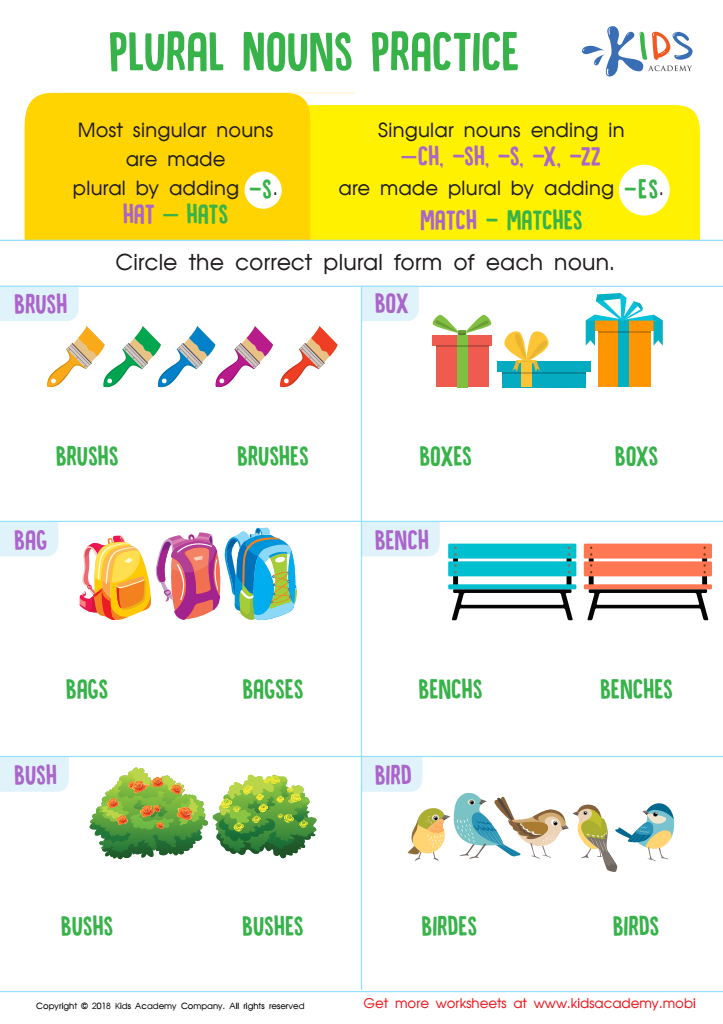
Plural Nouns Practice Worksheet
Explain to your child that most singular nouns become plural by adding "-s". E.g. "cat"->"cats". For words ending in "-ch", "-sh", "-s", "-x", or "-zz", add "-es". E.g. "buzz"->"buzzes". Then, get them to circle the right plural form of each noun on the worksheet.
 Assign to My Students
Plural Nouns Practice Worksheet
Worksheet
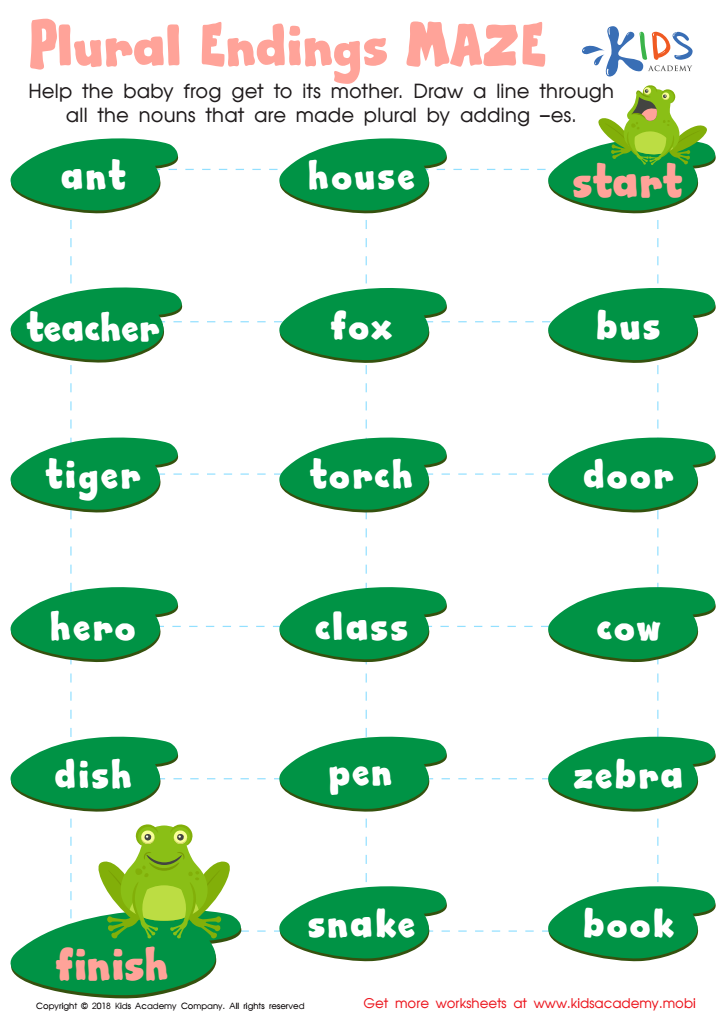
Plural Endings Maze Worksheet
Help your child have fun while learning new things with this worksheet. Does your child know that some nouns require '-es' to make them plural? Use this pdf to teach them the rule and get the little frog to its mother – draw a line through the words with '-es' plural forms.
Plural Endings Maze Worksheet
Worksheet
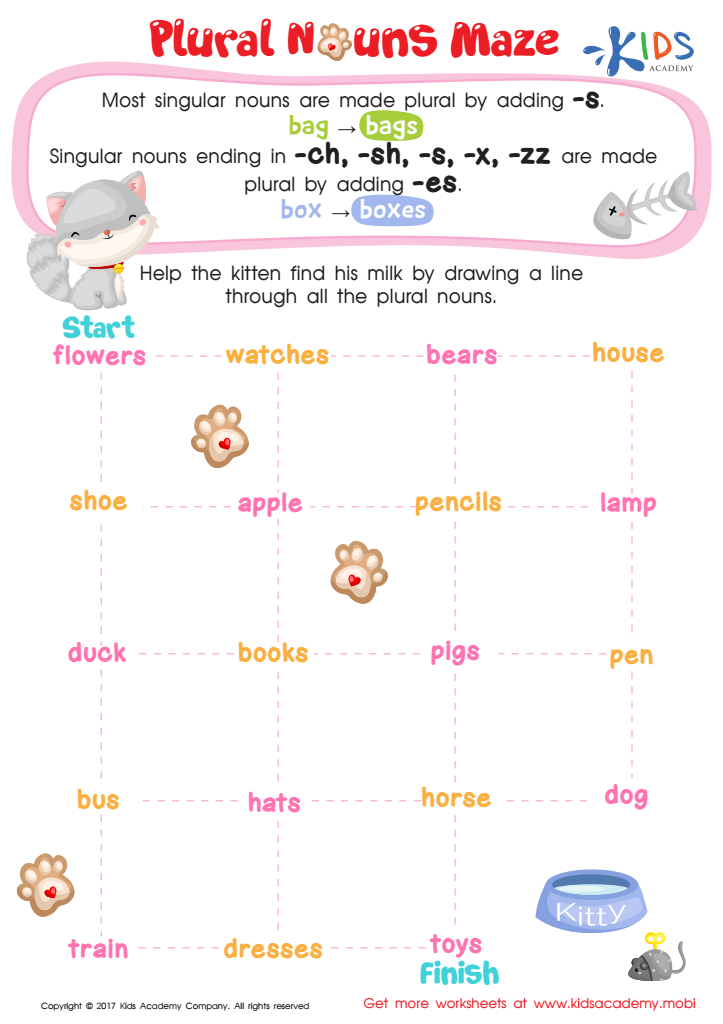
Plural Nouns Maze Worksheet
Oh no, the kitty needs her milk! Help your learner navigate the maze by drawing a line through the plural words. Review the grammar rules on -s and -es endings, then get to work to guide the kitten to her bowl! Download this PDF worksheet to start.
Plural Nouns Maze Worksheet
Worksheet
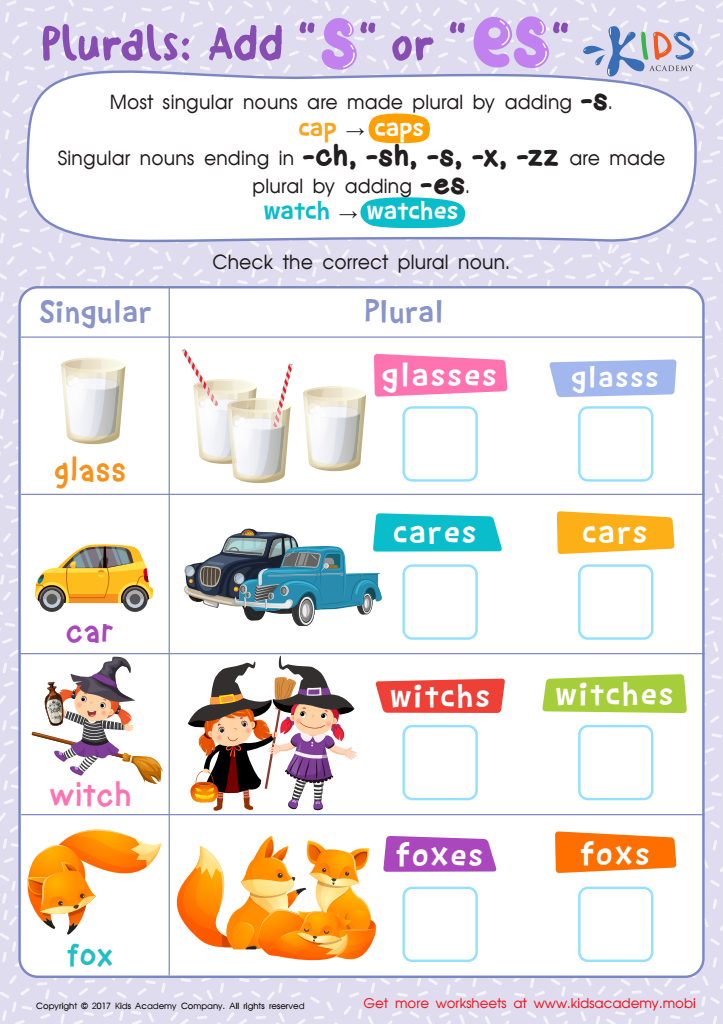
Plurals: "–es" or "–es"? Worksheet
Learning plural nouns can be tough for young readers. This worksheet shows them the difference between singular and plural spelling with cute images. Read each word and check the correct version. Remind them why the other ending can't be used.
Plurals: "–es" or "–es"? Worksheet
Worksheet
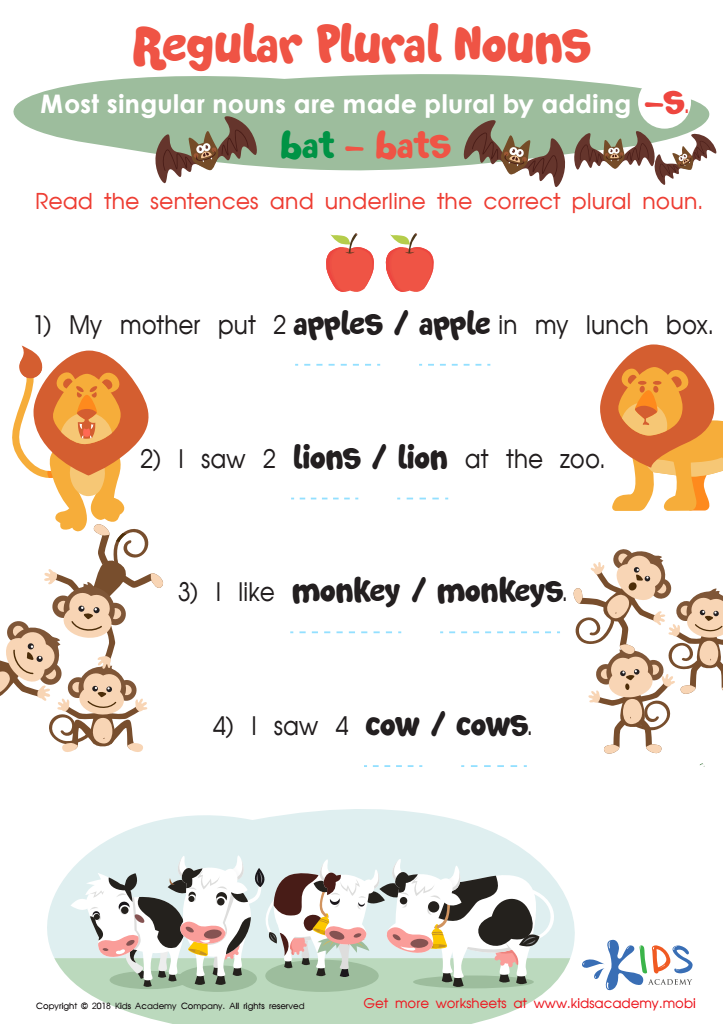
Regular Plural Nouns Worksheet
Your child should know the rule of adding '-s' to form plurals of nouns by now. Examples: bat-bats, cat-cats, song-songs etc. If they understand this, the task in the worksheet should be easy. Read the sentences and ask them to underline the correct plural noun.
Regular Plural Nouns Worksheet
Worksheet
Join Kids Academy for Free
Who is primarily going to use this learning content?




Understanding plurals is fundamental in the early stages of a child's language development. For parents and teachers working with children aged 3-8, grasping plural forms significantly enhances communication skills, vocabulary expansion, and overall literacy. Recognizing the difference between singular and plural helps children to describe the world around them accurately, allowing for clearer expression of thoughts, needs, and experiences.
Plurals typically introduce logical thinking patterns; children begin to recognize rules in language (such as adding "s" or changing sounds) which can benefit their problem-solving skills. Moreover, a solid foundation in grammar aids in reading comprehension and writing fluency as children progress in their education.
Additionally, involving parents in teaching plurals fosters strengthened bonds through shared learning experiences. By creating interactive and enjoyable activities, like counting objects or drawing books, adults reinforce academic development within natural play settings—transforming everyday moments into language lessons.
Lastly, addressing plurals not only prepares students for future linguistic challenges but also equips them with confidence in their communication abilities, contributing positively to their social interactions hence nurturing a love for language that extends beyond the classroom. Understanding plurals is a crucial step in their expansive educational journey.